
Google
Google · Security · Filed Feb 4, 2026 · USPTO published Nov 19, 2026 · This week's release
Google Files Patent for Matching Shared Customers Without Either Side Seeing the Other's List
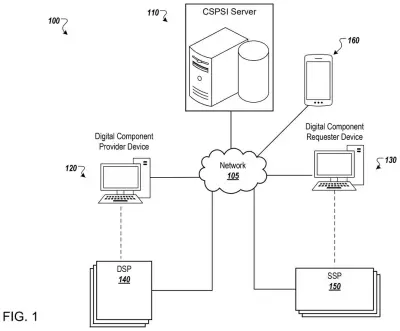
Google has filed a patent application for a way for two companies to learn how many customers they share without either one seeing the other's customer list. A go-between server does the matching on scrambled IDs it can't read.
- Publication number
- US 2026/0370455 A1(US20260370455A1)
- Applicant
- Google LLC
- Filed · Published
- Feb 4, 2026 · Nov 19, 2026
- Inventors
- Shreedhar Madhavapeddi, Marcel M. Moti Yung, Bashar Kachachi, Stephen W. Rupp, Samuel Benjamin Temes, Shreya Mathur
- Status when we published
- Waiting for an examiner
- Document
- 20 claims
- US classification
- 713/171
- Parent application
- Continuation of 18/283,387 (filed Sep 21, 2023)(18283387)
What Google's private customer matching does
Every time you open a news app and see an ad for something you really shopped for, two companies had to figure out you're a customer of both. For years, tracking cookies did that job. Browsers are now blocking them.
This Google patent application describes a way to do the matching without handing over anyone's identity. Each company scrambles its own customer IDs with a private key, then sends the scrambled list to a go-between server. The server adds a second layer of scrambling using the other company's key. The trick is that the order of the two layers doesn't matter, so the same person ends up with the same code on both lists.
The server can spot the matches without reading a single name. Each company just learns what share of its own list overlaps with the other's.
… encrypting, by the cryptographically-secure private set intersection server, i) the first set of encrypted user identifiers using the second encryption key to obtain a first set of bilateral encrypted user identifiers, ii) the second set of encrypted user identifiers using the first encryption key to obtain a second set of bilateral encrypted user identifiers; …
Translation: The server scrambles both customer lists a second time using the other company's key.
How double-locked IDs let two firms compare
The patent covers a cryptographically secure private set intersection server, a go-between that finds the overlap between two companies' customer lists without reading them. Each company first encrypts its own user IDs with its own private key. The server receives both scrambled lists, plus both keys, though the keys are built so they can't unlock the IDs.
The method relies on permutable encryption (two keys that give the same result whichever one is applied first). The server then:
- Locks the first company's list with the second company's key
- Locks the second company's list with the first company's key
- Compares the two double-locked lists to find identical entries
- Sends back numbers such as the share of each list that matched
The filing's example: one company has 10 IDs, the other has 20, and 5 match. The first learns that 50% of its list overlaps, the second 25%. Each can compare that against its own threshold to decide whether to go ahead.
Later steps cover a live ad request. The site showing the ad asks the server to swap the user's scrambled ID for the double-locked version. The advertiser's side then asks the server for its own scrambled ID for that person, decrypts it, and picks an ad. Optional extra keys (one shared, one held by the server) add layers, and a different key for each partner means the same person looks different in every pairing.
The CSPSI server determines, using the encrypted user identifier, a bilateral encrypted user identifier for the user generated by encrypting the first encrypted user identifier using a second encryption key corresponding to the second entity.
Translation: The server creates a doubly encrypted version of the user ID that both sides can safely compare.
Why Google's cookie-free ad matching matters
As browsers block third-party cookies, advertisers lose an old way of recognizing you across sites. This patent application describes a replacement that uses only what a company already knows about its own customers, so the ad you see can still reflect your past purchases.
For your privacy, the key point is who can see what. The ad middlemen and the matching server only handle scrambled IDs, and because each pair of companies uses its own keys, the same person looks different in every pairing. That makes it hard for anyone to stitch your activity together across sites. The two companies themselves still end up recognizing you, though.
That makes this Google's 1085th filing we've tracked in our Google coverage since May, a run that includes work on context-aware ads and cleaner compressed video.
Source: US 2026/0370455 A1 at the USPTO (PDF). Full patent text and figures are in the official publication.
Get our take in your Top Stories
Liked this breakdown? Add Patentlyze as a preferred source on Google, and our plain-English take shows up more often in your Top Stories the next time Google patent news breaks.
Add Patentlyze on Google
One click.
There are more where this came from
We read every patent application Big Tech publishes and send you the ones worth knowing. Plain English, free, every week.
The drawings · 7 sheets
7 drawing sheets from US 2026/0370455 A1 · click any drawing to enlarge


More from Google
All 1,127 Google patents →
More in Security
All 353 Security patents →
IBM
IBM Files Patent for Payment Audits That Check One Person Without Exposing Everyone
IBM
IBM Files Patent for Testing Apps With Real Data After Scrubbing Private Details
Microsoft
Microsoft Files Patent for Telling a Gunshot From Its Echo in a City
Microsoft
No comments yet