
Google
Google · Software · Filed Dec 11, 2025 · USPTO published Nov 19, 2026 · This week's release
Google Files Patent for Ads That Know Which Cambridge You Searched For
When you search "hotels in Cambridge," an ad system has to guess which Cambridge you mean. This Google patent application lays out how it could guess better, and how advertisers could set far more detailed location rules.
- Publication number
- US 2026/0370654 A1(US20260370654A1)
- Applicant
- Google LLC
- Filed · Published
- Dec 11, 2025 · Nov 19, 2026
- Inventors
- YaoShuang Wang, Walter Alejandro Vulej, Kalluri Eswar, Li Zou, Usama Sarwar
- Status when we published
- Waiting for an examiner
- Document
- 20 claims
- US classification
- 726/26
- Parent application
- Claims priority from a provisional application 63807026 (filed May 16, 2025)
What Google's two-level location matching does
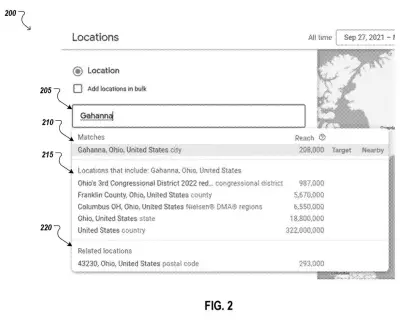
Type "hotels in Cambridge" into a search box and a computer has to guess which one you mean: the Massachusetts city or the English one. Older ad systems leaned on keywords for that job, and keywords get it wrong often. Many cities share names, and a phrase like "Chicago pizza" is not really about the city of Chicago.
This Google patent application describes a fix on both sides of the ad. Advertisers could set location rules for their whole account, then separate rules for smaller groups of ads inside it. A concert promoter, for example, could give each city its own ads.
On the searcher's side, the system works out the place you care about, which may differ from where you are standing. It can weigh your search words, your past searches, and how often you have visited each candidate place, if you allow it. If it can't tell, it falls back to where your device is.
Methods, systems, and apparatus, including computer programs encoded on a computer storage medium, for disambiguating location information and distributing digital components based on the location information.
Translation: This patent covers software methods to figure out ambiguous location details and serve targeted ads.
How Google picks the place you mean
Think of an advertiser's setup as a filing cabinet. The account is the whole cabinet and each account group is one folder. Location rules can sit on the cabinet (say, the United States) and on each folder (say, Nevada).
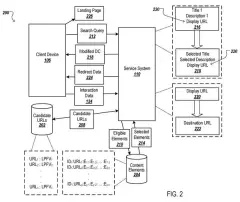
When a request for content arrives from your device, the system does the following:
- Checks whether the request contains an area of interest, meaning a place you seem to care about, usually pulled from your search words.
- If the words are ambiguous, weighs extra signals: your device's location, places you have been (including how often), and your past searches.
- Builds a list of candidate ads whose folder-level location rules match that area.
- Picks from the list and sends the winners to your device.
If no area of interest can be found, the system checks the location of presence, meaning where the request came from. In that case the location has to satisfy both the account-level and group-level rules. With no location at all, only items without location rules are considered.
The filing says final picks can weigh the advertiser's bid and the expected chance you will interact. It also says location use can be controlled by the user, and that device location may be kept broad, such as city or ZIP code level.
… determining that the digital component request comprises an area of interest; in response to determining that the digital component request comprises an area of interest, identifying a set of candidate digital components …
Translation: The system detects when a user's search includes a specific place and finds matching ads for it.
Why Google's ad location fix matters to you
If you search from one place about another, you are more likely to see ads for the place you mean. Someone at work in Boston looking up plumbers in Salem gets results aimed at Salem, and someone searching for hotels in Cambridge has a better shot at the right Cambridge.
Advertisers gain too. The filing says older setups pushed them to open several accounts for different regions or lean on keywords, which wastes money on clicks from the wrong people. Two levels of rules would let one account run, say, nationwide ads plus Nevada-only offers. The filing also stresses that people can control whether their location data is used.
That makes this Google's 1084th filing we've tracked in our Google coverage since May, a run that spans work like fixing blocky compressed video and a personal AI TV channel.
Source: US 2026/0370654 A1 at the USPTO (PDF). Full patent text and figures are in the official publication.
Get our take in your Top Stories
Liked this breakdown? Add Patentlyze as a preferred source on Google, and our plain-English take shows up more often in your Top Stories the next time Google patent news breaks.
Add Patentlyze on Google
One click.
There are more where this came from
We read every patent application Big Tech publishes and send you the ones worth knowing. Plain English, free, every week.
The drawings · 4 sheets
4 drawing sheets from US 2026/0370654 A1 · click any drawing to enlarge


More from Google
All 1,127 Google patents →
More in Software
All 814 Software patents →
Samsung
Samsung Files Patent for a Phone Search Box That Suggests What to Look For
Microsoft
Microsoft Wins a Patent for Picking the Best Shortcuts to Search Text and Images Together
Samsung
Samsung Files Patent for Surround Sound That Adapts to Whatever Speakers You Have
Adobe
No comments yet