
Google
Google · Other · Filed Mar 20, 2026 · USPTO published Nov 19, 2026 · This week's release
Google Files Patent for Quantum Error Fixes That Admit When They're Guessing
Quantum computers make mistakes constantly, and the software that fixes them usually commits to one best guess without saying how shaky it was. A new Google patent application makes the software argue with itself, then use the disagreement as a trust score.
- Publication number
- US 2026/0368608 A1(US20260368608A1)
- Applicant
- Google LLC
- Filed · Published
- Mar 20, 2026 · Nov 19, 2026
- Inventors
- Nathan Cody Jones
- Status when we published
- Waiting for an examiner
- Document
- 22 claims
- US classification
- 714/746
- Parent application
- Claims priority from a provisional application 63775042 (filed Mar 20, 2025)
What Google's quantum error check actually does
Imagine a proofreader who finds a smudged word that could be 'farm' or 'form.' Both fit the sentence equally well, so they pick one and never mention it was a coin toss. You would have no idea whether to trust the page.
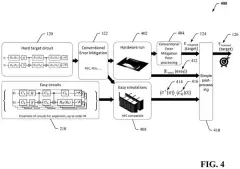
Quantum computers have a version of this problem. Their basic building blocks, called qubits, make mistakes all the time, and the machine only gets warning signals that say something went wrong somewhere. A helper program then has to guess the most likely set of mistakes. Google's patent application has that program guess once, make its first answer less appealing, and guess again.
If the two answers are nearly equally likely but would lead to different results, the system knows the fix was shaky. If one answer is far ahead, it can trust the fix. The result is a built-in confidence score for each correction.
… selecting a first edge grouping of the set of edge groupings based on a first set of weights for the first edge grouping and other sets of weights for at least another portion of the set of edge groupings …
Translation: The system makes an initial guess about where the errors are based on probability weights.
How Google makes the first answer less appealing
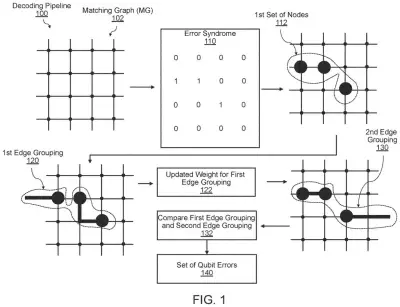
When a quantum computer runs, it checks itself along the way. Those checks produce an error syndrome (a pattern of alarms showing that errors happened, without saying exactly which ones). The patent models this as a matching graph, a map where each alarm is a dot and each possible error is a line linking two dots, or linking a dot to the edge of the map.
Every line carries a weight based on how likely that error is. The filing says the weight can be based on the logarithm of the probability. A normal decoder (the classical program that guesses which errors happened) picks the set of lines with the lowest total weight. The new step is called matching repulsion:
- Pick a first set of lines (an edge grouping) that explains the alarms, using the starting weights.
- Raise the weights of the lines in that first set. One example in the filing doubles them from 10 to 20.
- Run the decoder again. The first answer is now more expensive, so it tends to pick a second, different set.
- Compare the two sets to decide which qubit errors occurred.
The comparison can include a logical gap, the difference between the two answers when scored with the original probabilities. A small gap means low confidence. The filing also describes maps where one error links more than two dots, random weight changes, repeated rounds that build a larger collection of answers, and applying quantum gates to correct the errors that were found.
Why a confidence score matters for quantum chips
For a quantum computer, knowing when a correction is shaky is as useful as the correction itself. The filing says a low confidence score could trigger throwing out a prepared quantum state and starting over, or putting more decoding effort into the problem. A high score lets the machine move on. That kind of decision could help a quantum computer produce reliable results more often.
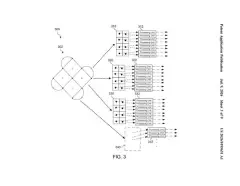
The filing also says the method works by changing weights only, so the underlying map keeps its shape and the technique can fit many error correcting codes. It describes running the decoding in parallel across regions and in real time. It even says the same idea could apply to classical error correcting codes used in Wi-Fi and cellular networks.
This is the 1102nd Google patent application we've tracked since May in our Google coverage, a company also filing on tying searches to ads and spotting trending apps.
Source: US 2026/0368608 A1 at the USPTO (PDF). Full patent text and figures are in the official publication.
Get our take in your Top Stories
Liked this breakdown? Add Patentlyze as a preferred source on Google, and our plain-English take shows up more often in your Top Stories the next time Google patent news breaks.
Add Patentlyze on Google
One click.
There are more where this came from
We read every patent application Big Tech publishes and send you the ones worth knowing. Plain English, free, every week.
The drawings · 6 sheets
6 drawing sheets from US 2026/0368608 A1 · click any drawing to enlarge


No comments yet