
Google
Google · Software · Filed May 14, 2025 · USPTO published Nov 19, 2026 · This week's release
Google Files Patent for Tying Your Searches Back to the Ads You Saw
Google has filed a patent application for software that notices when you search for a brand after seeing its content, then counts that search as a sign the content worked. No special test is needed.
- Publication number
- US 2026/0368764 A1(US20260368764A1)
- Applicant
- Google LLC
- Filed · Published
- May 14, 2025 · Nov 19, 2026
- Inventors
- Charles Huyi, Yonathan Schwarzkopf, Jeffrey Wilhelm, Jay Lieske JR., Jiaxin Shao, Jing Wang, Claire Smith, David Quintero, Jeffrey Yam, Jiro Root, Jonathan Harel, Anton Nemchenko, Tommy Truong, Stephanie Shin-hui Zhang, Jonathan Sirlin, Kechy Eke, Alexander Howard, Dattatraya Koujalagi, Ankur Agiwal, Chaolun Zhang, John Chen, Harikesh Sasikumar Nair
- Status when we published
- Company responded; back with the examiner
- Document
- 19 claims
- US classification
- 705/7.31
- Examiner
- WAESCO, JOSEPH M (Art Unit 3625)
What Google's search-to-ad matching actually does
Today, a company that wants to know whether an ad made you curious usually has to build a special test into the campaign. The test runs for a fixed stretch, often 30 days, and watches for a short list of keywords. If you searched a month later, or typed words nobody put on the list, you simply don't show up in the results.
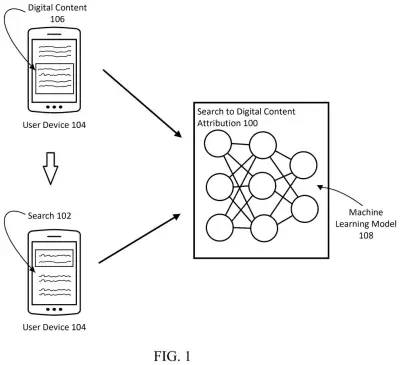
Google's filing swaps that test for an AI model. It reads the ad and works out which brand, product or service it is about, then does the same with the searches you make afterward. If the two match and the search came inside a set time window (28 days is the example), the search is counted as a response to that ad.
The same counting can also produce a mind share score: out of all the searches in a category, such as cola, how many were for one particular brand.
Rather than setting up tracking of digital content campaigns or limiting the tracking to predetermined keywords, the attribution uses a machine learning model to identify any brands, products, and/or services associated with digital content and to map the searches of a user to the identified brands, products, and/or services after the user views the digital content.
Translation: Instead of pre-selecting keywords, AI scans ads and user searches to connect them.
How Google matches a search to an earlier ad
The system is built from three parts. An identification engine reads the content you viewed (the ad image or video, its landing page, and details like its web address) and uses a machine learning model to pull out the brand, product or service and the category it belongs to. It does the same for your searches, which can be typed, image, video or app searches, or questions put to an AI assistant.
A mapping engine then connects the two. It uses a knowledge graph (a web of brands and products, where each link says how closely two things are related) to decide that, say, a search for a rival product or a related item still points back to the ad you saw.
A timing engine compares timestamps. If the search falls within a configurable window, such as days, weeks or months, it is attributed to the content.
From there the system can:
- Keep a running count of attributed searches and draw it as a histogram (a bar chart of counts)
- Calculate mind share, meaning attributed searches as a fraction of all searches in that category
- Give each query a unique ID, so a search naming several brands isn't counted twice
The filing says the content and the search can come from the same device or different ones.
… determining, by the one or more processors, that the search was performed within a threshold time range from the digital content being viewed based on the mapping; and attributing, by the one or more processors, the search to the digital content based on the search being performed within the threshold time range from the digital content being viewed.
Translation: The system decides an ad caused your search if you look it up soon enough afterward.
Why advertisers would want this from Google
For advertisers, the pitch is simple: you get a read on whether your ads sparked interest without building a test into every campaign or guessing the right keywords in advance. The filing also says this cuts processing and storage costs, since there is no tracking program running while ads are served.
For you, it means the link between what you watch and what you look up could be measured more closely, including searches made through AI assistants. The examiner's first review rejected the claims as filed, which is routine at this stage and usually followed by amendments, so the final scope could change.
That makes this Google's 1101st filing we've tracked in our Google coverage since May, adding to work like spotting trending apps and fixing blurry faces.
Source: US 2026/0368764 A1 at the USPTO (PDF). Full patent text and figures are in the official publication.
Get our take in your Top Stories
Liked this breakdown? Add Patentlyze as a preferred source on Google, and our plain-English take shows up more often in your Top Stories the next time Google patent news breaks.
Add Patentlyze on Google
One click.
There are more where this came from
We read every patent application Big Tech publishes and send you the ones worth knowing. Plain English, free, every week.
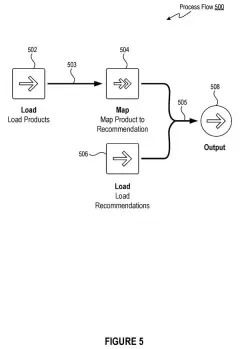
The drawings · 5 sheets
5 drawing sheets from US 2026/0368764 A1 · click any drawing to enlarge


More from Google
All 1,127 Google patents →
More in Software
All 814 Software patents →
Microsoft
Microsoft Patents a Chatbot That Jumps In When You Get Stuck in an App
Apple
Apple Patents Tapping a Photo of Your Room to Control Its Lights
Samsung
Samsung Files Patent for a Phone Search Box That Suggests What to Look For
Salesforce
No comments yet