
Google
Google · AR / VR · Filed Feb 27, 2026 · USPTO published Nov 12, 2026 · This week's release
Google Files Patent for Smartglasses Menus You Control by Moving Your Eyes
Google's smartglasses patent application skips the hard question of exactly where you're looking and asks an easier one: which way did your eyes just move?
- Publication number
- US 2026/0358884 A1(US20260358884A1)
- Applicant
- GOOGLE LLC
- Filed · Published
- Feb 27, 2026 · Nov 12, 2026
- Inventors
- Jochen Weber, Tobias Toft, Prasanthi Gurumurthy
- Status when we published
- Waiting for an examiner
- Document
- 20 claims
- US classification
- 715/810
- Parent application
- National Stage Entry of PCT/US2023/075404 (filed Sep 28, 2023)(PCTUS2023075404)
What Google's eye-movement menu system does
Every time you open an app on your phone, you tap it with a finger. Smartglasses give you nothing to tap, and nobody wants to carry a mouse around for a pair of glasses. Google's answer in this patent application is your eyes.
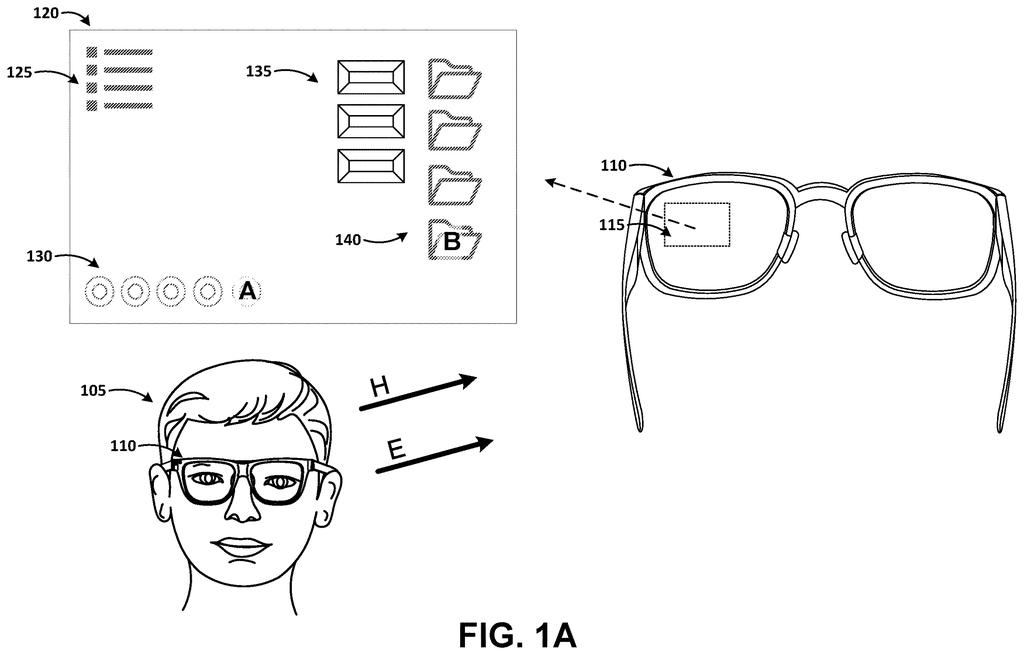
Most eye tracking tries to work out the exact spot you're staring at, which is hard to do accurately. This filing takes a different route. The glasses remember the last spot you looked at, then watch which direction and how fast your eyes moved from there. That tells them which icon you're heading for, even if the exact spot is a little off.
Your head helps too. If your head nudges the same way your eyes went, the glasses treat it as a real choice. If the two disagree, they treat it as a glitch and do nothing.
determining a gaze characteristic of a user of a wearable device; identifying a previous fixation point as a first fixation point; determining a second fixation point based on the first fixation point and the gaze characteristic; …
Translation: The glasses track how your eyes move from one spot to another.
How the glasses guess your next glance
The claims cover a method for glasses with a head-locked interface (menus that stay fixed in the same place on the lens no matter how you turn your head). The device measures a gaze characteristic, meaning data like the direction and speed of your eye movement. It takes your previous fixation point (the last spot on the interface you looked at) as a starting position.
From that starting point plus the eye movement, it works out a second fixation point. In the described version, this is a lookup table: find the starting point, then filter by the eye movement to land on one answer. A second table links that point to an icon or menu item, and selecting it triggers an action, such as showing contacts or taking a photo.
The filing describes several supporting pieces:
- Grid sectors: the interface is divided into blocks, and each icon covers a group such as 2×2, which makes targets easier to hit.
- Saccades (fast eye jumps): a slow one means you're moving within a menu, a fast one means you're heading to a different element.
- Head check: a motion sensor builds a head movement vector, and it must point the same way as your eyes to confirm the gesture.
- Error handling: if a gesture looks false, the action is cancelled and you can redo it.
To get a starting point, the interface can show an object, such as one that fades in or flashes in a corner, so the glasses know where you are looking first.
Why hands-free glasses menus need this
The practical point is control without accessories. Glasses have no room for a mouse, keyboard or touch surface, and tapping the frames interrupts whatever you're doing. A way to pick menu items just by glancing between them would let you use the glasses while your hands stay busy.
The filing also says this approach lowers the accuracy and calibration demands on eye tracking, which it ties to cost savings, and that selections should hold up while you walk. For you, that could mean glasses that work without a fussy setup. The patent does not name a product, so treat it as a look at how Google is thinking about menus on glasses.
Google's 57th filing we've tracked in our smart glasses display watchlist since May builds on earlier applications like the wrist buzz for air writing and the fold-to-sleep fix.
Source: US 2026/0358884 A1 at the USPTO (PDF). Full patent text and figures are in the official publication.
Get our take in your Top Stories
Liked this breakdown? Add Patentlyze as a preferred source on Google, and our plain-English take shows up more often in your Top Stories the next time Google patent news breaks.
Add Patentlyze on Google
One click.
There are more where this came from
We read every patent application Big Tech publishes and send you the ones worth knowing. Plain English, free, every week.
The drawings · 12 sheets
12 drawing sheets from US 2026/0358884 A1 · click any drawing to enlarge


Show the other 4 sheets


More from Google
All 1,079 Google patents →
More in AR / VR
All 690 AR / VR patents →
Google
Google's New Patent Lets an AI Answer Questions About Whatever You're Watching in AR
Google
Google Patents a Pre-Assembly Calibration System for Modular AR Displays
Google
Google Patents a Dual LCoS Light Engine for AR Eyewear Displays

Google
No comments yet