
Honda
Honda · Energy · Filed Jun 6, 2025 · USPTO published Nov 19, 2026 · This week's release
Honda Patents a Heating and Cooling System That Reuses Energy for Carbon Removal
Pulling carbon dioxide out of the air takes a lot of heat, and most of it gets thrown away. Honda's filing describes a way to hand that leftover heat to the next chamber in line.
- Publication number
- US 2026/0366778 A1(US20260366778A1)
- Applicant
- HONDA MOTOR CO., LTD.
- Filed · Published
- Jun 6, 2025 · Nov 19, 2026
- Inventors
- Masanobu TAKAZAWA, Subaru MATSUMOTO, Toshiyuki INABA, Shumon HOSHINO
- Status when we published
- Examiner raised objections; the company can respond
- Document
- 6 claims
- US classification
- 62/324.1
- Examiner
- MOORE, ADAM DORREL (Art Unit 3763)
- Parent application
- National Stage Entry of PCT/JP2023/043307 (filed Dec 4, 2023)(PCTJP2023043307)
What Honda's heat-sharing CO2 scrubber does
Imagine a row of sponges that soak up carbon dioxide from the air at room temperature. To wring each sponge out, you have to heat it to about 194°F (90 °C). Then it has to cool back down before it can soak up more. Heating takes a lot of electricity, and the heat from the sponge you just finished with simply goes to waste.
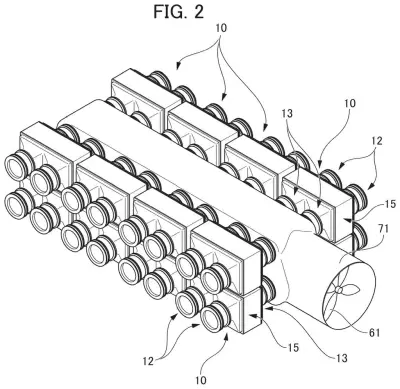
Honda's patent application describes a way to stop wasting it. The machine has many chambers, each at a different point in the soak-and-release cycle. A heat pump (think of the same idea as a fridge or air conditioner, which moves heat from one place to another) pulls heat out of the chamber that is finishing its release phase and delivers it to the chamber that is just starting.
The trick is a set of valves that can run the heat pump's fluid forward or backward. That lets one pump serve chambers that are not next to each other, so you don't need a separate heater for each one.
… an inversion mechanism that switches the heat medium flowing in the main pathway in a first flow direction to a second flow direction which is a reverse direction to the first flow direction …
Translation: A special valve flips the direction of the fluid to change how the system heats or cools.
How the heat pump reverses to pass heat along
The filing covers a heat medium circuit: a loop of pipes carrying a fluid (the heat medium) past several heat exchangers (devices that move heat in or out of something), driven by one compressor (a pump that squeezes the fluid so it gets hot). The exchangers are connected in a single line, and the fluid can pick up heat at one and drop it off at another.
The key part is an inversion mechanism: extra pipes and switching valves around the compressor that flip the fluid's direction of flow. The description says this is a low-cost way to reverse flow without a complicated device.
Other claims add more pieces:
- With three or more heat exchangers, each gets a bypass so the fluid skips any chamber that isn't taking part in the heat swap.
- An expansion valve lets the fluid expand and turn cold before it enters the chamber that needs cooling.
- The whole thing is packaged as a heat pump, and then as a carbon dioxide recovery device with several chambers that hold a material that grabs and releases CO2.
In the described example, the device has sixteen chambers running staggered cycles. The example uses about 5,669 seconds to soak up CO2 and 967 seconds to release it. A cooling chamber at the start of its soak phase is paired with a chamber about to start releasing.
… at least portion of thermal energy absorbed by the heat medium in one heat exchange unit is transferred to the other heat exchange unit …
Translation: Waste heat from one part of the system is captured and reused instead of being wasted.
Why Honda's heat trick matters for air capture
The practical goal is lower electricity use for direct air capture, a way of pulling CO2 straight from the atmosphere. Heating the capture material is a big energy cost, so recycling heat between chambers means the same amount of CO2 could be collected with less power. The filing says this raises the heat pump's efficiency rating (called COP, heat delivered per unit of electricity in).
This is a filing about the plumbing inside an industrial machine, not something you would buy. It is also still early: an examiner's first review rejected the claims as filed, which is routine and usually followed by amendments. The description says the recovered CO2 could be reused as fuel or materials, so it ties into Honda's wider interest in lower-carbon technology.
Honda's fifth filing we've tracked since November in our Honda coverage, following applications like holding updates for Wi-Fi and defining the word 'recently'.
Source: US 2026/0366778 A1 at the USPTO (PDF). Full patent text and figures are in the official publication.
Get our take in your Top Stories
Liked this breakdown? Add Patentlyze as a preferred source on Google, and our plain-English take shows up more often in your Top Stories the next time Honda patent news breaks.
Add Patentlyze on Google
One click.
There are more where this came from
We read the new patents from Big Tech, carmakers and more and send you the ones worth knowing. Plain English, free, every week.
The drawings · 15 sheets
15 drawing sheets from US 2026/0366778 A1 · click any drawing to enlarge


Show the other 7 sheets


More from Honda
All 8 Honda patents →
More in Energy
All 147 Energy patents →
X (Google)
Google Patents a Method for Locating Power Poles Using Multi-Angle Photos
Apple
Apple Files Patent for Wireless Chargers That Flag a Weak Power Adapter
Apple
Apple Patents a Magnetic Rubber Layer That Helps Trackpads Click With Less Power
Apple
No comments yet