
Honda
Honda · AI / ML · Filed May 14, 2025 · USPTO published Nov 19, 2026 · This week's release
Honda Files Patent for Software That Figures Out How Long 'Recently' Is
Saying you 'just' brushed your teeth means minutes ago. Saying you 'just' had a birthday can mean days ago. A new Honda filing tries to teach software that difference.
- Publication number
- US 2026/0368434 A1(US20260368434A1)
- Applicant
- Honda Motor Co., Ltd.
- Filed · Published
- May 14, 2025 · Nov 19, 2026
- Inventors
- Julian Eggert, Joerg Deigmoeller, Philipp Cimiano, Svenja Kenneweg
- Status when we published
- Examiner raised objections; the company can respond
- Document
- 14 claims
- US classification
- 704/9
- Examiner
- CHUNG, DANIEL WONSUK (Art Unit 2659)
What Honda's 'recently' translator actually does
Every time you tell a friend you just ate or recently called your mom, you expect them to know roughly how long ago you mean. A computer has no idea. Ask a home assistant 'Did I take my pills recently?' and it cannot search its memory until it has a real time window to look through.
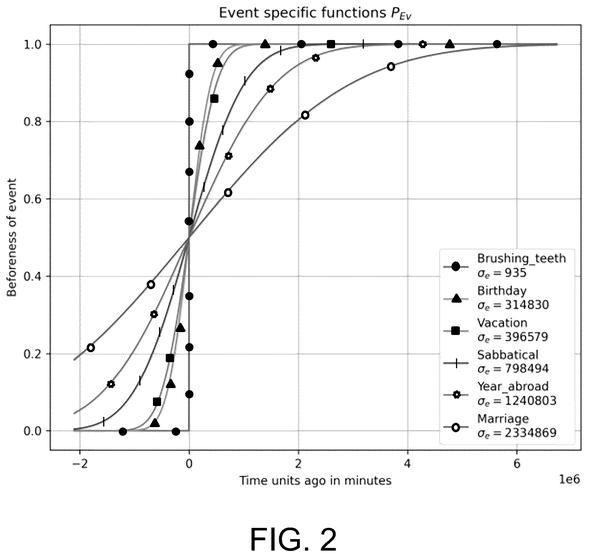
Honda's patent application is about turning that fuzzy word into a concrete range. The system reads the sentence, works out what kind of event it is about, and picks a time span that fits. 'Just' plus brushing your teeth means minutes. 'Just' plus a birthday can stretch to days.
The main example in the filing is an assistant for a person with cognitive impairment. That person can talk naturally instead of giving exact times, and the assistant then checks its log of what they did.
A system for mapping temporal expressions to quantitative time expressions, the system comprising: a memory; a processor configured to store information and to retrieve information from the memory; an input interface configured to acquire textual information, wherein the textual information includes at least one temporal expression; …
Translation: The system uses computer memory and processors to take text containing vague time words and process them.
How Honda splits the event from the word
The system takes in text, such as a typed or spoken sentence, containing a vague time word like recently, just, some time ago or long time ago. It works out the context, then outputs a specific time, such as an absolute time or date. The filing also covers the reverse: taking a precise time and picking the vague word a person would use.
Context can include how long the event usually lasts and how often it happens. Dependent claims add the user's personal state (the description gives stressed or relaxed) and cultural framing (how a person's background shapes how they read time words).
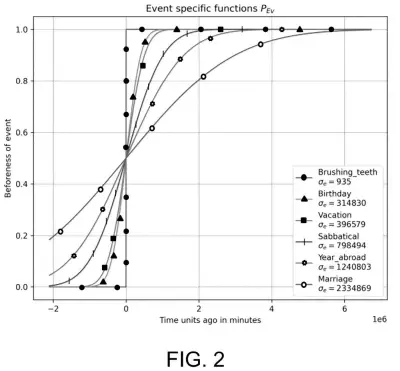
The filing's math model treats meaning as probability curves (the familiar bell shape, called a Gaussian distribution). It splits the problem into three inputs:
- The time word, which has its own curve
- The type of event, which has its own curve
- How much time has passed since the event
The curves were fitted to survey answers: 100 people per questionnaire rated sentences like 'Tom's birthday was 1 day ago. Tom had his birthday recently,' across six events and four words, about 16,800 data points. Splitting word from event means 6 events and 4 words need 10 fitted curves instead of 24, and 16 of each need 32 instead of 256. Average error was about 0.20 for both approaches. New words or events still need new survey data.
The processor is configured to determine a context in the acquired textual information, to respectively map the at least one temporal expression to at least one quantitative time expression based on the determined context.
Translation: It figures out the surrounding situation to translate vague words into specific numbers.
Why a pill question needs a fuzzy clock
If you ask a voice assistant whether you took your pills recently, it needs a real time window to search its log, and the right window depends on the event. Taking a daily pill is different from going on vacation. The filing's own example is support for a person with cognitive impairment, who would not have to give exact times. It also points to searching stored records by time using everyday speech.
The description says this approach avoids the personal conversion tables and large databases that earlier methods used. It also says large language models hold these time ideas only loosely, and this tries to spell them out in numbers. Early in review, an examiner rejected the claims as filed, which is routine and usually followed by amendments.
Honda's third filing since November in our Honda coverage follows patents for parking gap lights and a partial-charge battery swap station among the three we've tracked.
Source: US 2026/0368434 A1 at the USPTO (PDF). Full patent text and figures are in the official publication.
Get our take in your Top Stories
Liked this breakdown? Add Patentlyze as a preferred source on Google, and our plain-English take shows up more often in your Top Stories the next time Honda patent news breaks.
Add Patentlyze on Google
One click.
There are more where this came from
We read the new patents from Big Tech, carmakers and more and send you the ones worth knowing. Plain English, free, every week.
The drawings · 5 sheets
5 drawing sheets from US 2026/0368434 A1 · click any drawing to enlarge


More from Honda
All 8 Honda patents →
More in AI / ML
All 2,745 AI / ML patents →
Apple
Apple Files Patent for a Phone That Guesses Where You're Going Next
Microsoft
Microsoft Patents a Filter That Decides Which Files and Chats Its AI Reads
Apple
Apple Patents a Search Bar That Guesses What You Need Before You Type
Netflix
No comments yet