
IBM
IBM · AI / ML · Filed May 16, 2025 · USPTO published Nov 19, 2026 · This week's release
IBM Patents a Panel of AI Experts That Quiz Each Other About Broken Machines
IBM describes a software setup where AI characters playing a reliability engineer, a quality engineer and other experts interview each other, then turn the answers into a draft failure checklist for industrial equipment.
- Publication number
- US 2026/0368237 A1(US20260368237A1)
- Applicant
- International Business Machines Corporation
- Filed · Published
- May 16, 2025 · Nov 19, 2026
- Inventors
- Dhavalkumar C. PATEL, Christodoulos CONSTANTINIDES, Vivek SHARMA, Shuxin LIN, Nianjun ZHOU, Bharathi CHAUDHURY
- Status when we published
- Approved; patent expected soon
- Document
- 20 claims
- US classification
- 707/736
- Examiner
- HOANG, SON T (Art Unit 2169)
What IBM's panel of AI experts actually does
Ever tried to train a new coworker on how a machine can break? The expert knows the answers, but the newcomer doesn't know which questions to ask.
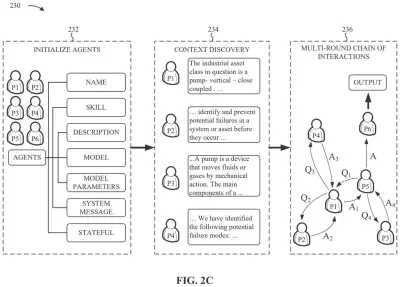
That gap is what this IBM patent application goes after. Companies building AI to predict equipment failures need expert knowledge, and today data scientists spend a lot of time working out what to ask the experts. IBM describes a system that skips that step. You tell it what kind of equipment you care about, say a wind turbine gearbox, and it creates a small cast of AI characters, such as a quality engineer, a reliability engineer and a subject matter expert.
Those characters question each other. One answers, another builds a follow-up on that answer, and the system weeds out repeats and weak questions along the way. What comes out is a catalog of questions and answers that other software can use, including a draft checklist of how the equipment might fail.
… collaboratively generating, by the plurality of AI agents, a second set of questions based on refinement of the first set of domain-specific questions and interactions among the plurality of AI agents …
Translation: The artificial intelligence agents work together to improve the questions by interacting with each other.
How the AI personas pass questions along
The system starts with a domain context: an asset class (a type of equipment), a problem type, or a data source. The filing's example is a wind turbine gearbox in predictive maintenance, meaning predicting when a part will need service. From that, it picks AI personas, each with a fixed role such as data scientist, subject matter expert, summarizer, question writer or question router. The filing says each one can run on a large language model (the AI behind chatbots).
A first batch of questions is generated from the input. Each question goes to the persona best suited to it, chosen by a role-specific classifier (a small AI model that decides who takes which question). The core claim is the next step: one agent's answer is used to seed a follow-up question from a different agent, over several rounds.
Quality checks between rounds, as the claims describe them:
- Filter out near-duplicates using semantic similarity (how close in meaning two questions are)
- Rank what is left by relevance to the domain
- Rewrite for clarity
- Validate with pre-trained classifiers that test whether each question is specific, unambiguous and new
Answers are stored next to their questions. An agent can then draft a failure modes and effects analysis (FMEA), a standard industry document listing how equipment can fail, what happens when it does, and what to do about it.
Why IBM wants machine-repair knowledge on tap
If you work near factories, power plants or fleets of machines, the pitch is faster groundwork for AI that predicts breakdowns. Instead of an engineer repeatedly interviewing a veteran technician, software could produce a first draft of what can go wrong with a pump or turbine. Fewer surprise failures would mean less downtime and lower repair costs, which is the benefit the filing points to.
The patent office has approved this application, and once IBM pays the final fee it should be issued as a granted patent. For now the filing describes software only, and it gives no test results, so how well the AI experts perform on real equipment is still unproven.
That makes this IBM's 26th filing we've tracked since May in our AI teams working together watch, following filings like one turning problems into math and one matching AI to each job.
Source: US 2026/0368237 A1 at the USPTO (PDF). Full patent text and figures are in the official publication.
Get our take in your Top Stories
Liked this breakdown? Add Patentlyze as a preferred source on Google, and our plain-English take shows up more often in your Top Stories the next time IBM patent news breaks.
Add Patentlyze on Google
One click.
There are more where this came from
We read every patent application Big Tech publishes and send you the ones worth knowing. Plain English, free, every week.
The drawings · 13 sheets
13 drawing sheets from US 2026/0368237 A1 · click any drawing to enlarge


Show the other 5 sheets


More from IBM
All 481 IBM patents →
More in AI assistant & agent
All 436 AI assistant & agent patents →
Microsoft
Microsoft Patents an AI Coordinator That Picks the Right Helpers for Each Question
Microsoft
Microsoft Patents a System That Gives Each Meeting Attendee Their Own Role-Specific AI Assistant
Nvidia
Nvidia Patents an AI That Routes Your Questions to a Panel of Specialist AIs
Microsoft
No comments yet