
IBM
IBM · AI / ML · Filed May 6, 2025 · USPTO published Nov 12, 2026 · This week's release
A New IBM Patent Shrinks Giant Databases Before an AI Tries to Read Them
An AI can only read so much at once, and a big company's database map can be far longer than that. IBM's filing trims the map down to just what your question needs.
- Publication number
- US 2026/0359668 A1(US20260359668A1)
- Applicant
- INTERNATIONAL BUSINESS MACHINES CORPORATION
- Filed · Published
- May 6, 2025 · Nov 12, 2026
- Inventors
- Rishabh Chakrabarti, Anupam Chakraborty, Jirí Petník, Miroslav Fokt
- Status when we published
- Waiting for an examiner
- Document
- 20 claims
- US classification
- 706/59
What IBM's database-trimming patent actually does
Imagine you ask a company's database, "Which people own a car and work at ABC?" That database is a giant web of people, cars, bank accounts and places, and before an AI can answer, someone has to hand it a map of everything in the web. If the map is too big, the AI runs out of room to read it, gets slower, costs more, and starts making mistakes.
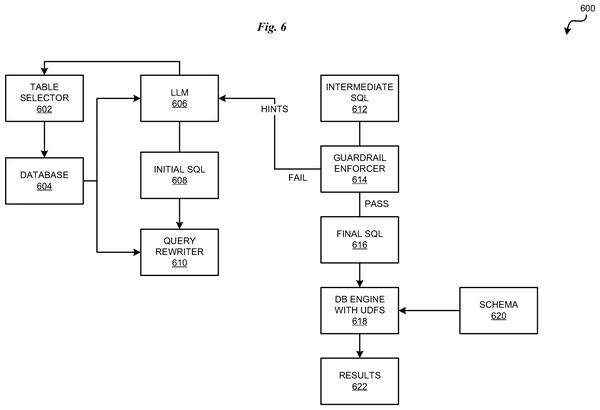
IBM's patent application tackles that by shrinking the map first. The system looks at your question, picks out the kinds of things you mentioned (people and cars, say), and finds the connections between them. Only that slice goes to the AI, which then writes the database search for you.
The filing's own example is crime analysis, where an investigator might ask who a suspect met last Sunday. The goal is faster, cheaper and more accurate answers from very large databases.
querying a very large knowledge graph by using a Large Language Model (LLM) by selecting only relevant nodes and edges in the very large knowledge graph; and optimizing a knowledge graph schema sent to the LLM to reduce token usage and improve query accuracy …
Translation: The system filters massive databases so language models only read the most important parts, saving data space and improving answers.
How IBM picks which pieces of the data to keep
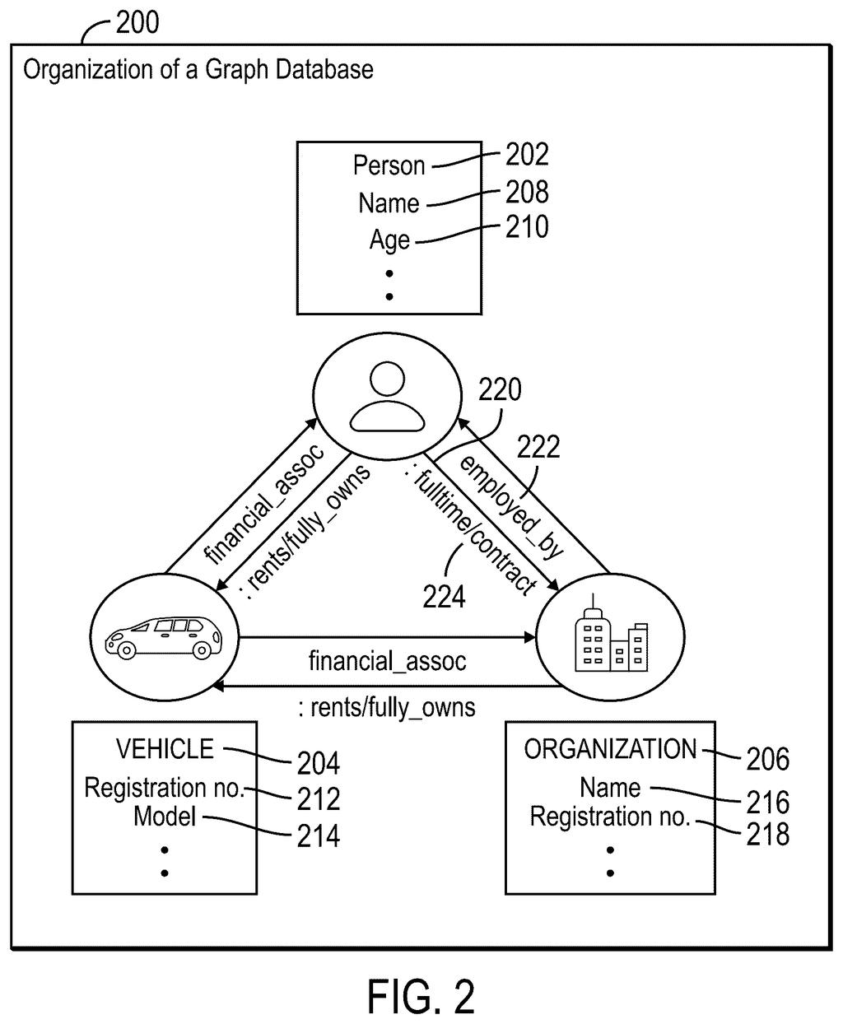
The patent is about a knowledge graph: a database that stores information as nodes (things like people, vehicles and organizations) and edges (the relationships between them, like "owns" or "works for"). To let an AI answer questions about it, the system gives a large language model (LLM) the graph's schema, meaning the list of node types, relationship types and attributes, but not the actual data. The LLM then writes a query in Cypher or AQL (languages for searching graph databases).
The trouble is size. The filing says an example graph with 31 node types uses about 26,000 tokens (the chunks of text an LLM reads, and often the unit it bills by). A client-scale graph with 270 entities could need 260,000, far past the 8K to 32K token limits the filing cites for current models. The claims cover graphs above a set number of nodes and edges, where the system:
- Has the LLM pick the relevant nodes from your question, passing only node names and attributes, in batches for very large graphs.
- Checks pairs of selected nodes and has the LLM choose the relevant edges when more than one connects them.
- Builds a reduced schema and uses it to generate the Cypher query.
The description also mentions depth-first search (a standard method for finding every path between two points in a network) as a way to find routes between the entities, and using outside context to sharpen the final query.
Operations are performed to optimize a knowledge graph schema sent to the LLM to reduce token usage and improve query accuracy, wherein the very large knowledge graph is a knowledge graph that has more than a predetermined number of nodes and edges.
Translation: It trims down oversized databases past a certain limit before feeding them to the AI.
Why shorter inputs could cut IBM customers' costs
If you've ever watched a chatbot lose the thread when it was handed too much at once, you know the idea: AI works best when it gets only what it needs. For businesses sitting on huge connected databases, such as supply chains, social networks or investigation records, trimming the input could mean quicker answers and a smaller bill, since the filing notes that costs follow token counts.
For IBM, which sells AI and data tools to large companies, this is a cost and accuracy fix aimed at business customers. You wouldn't see it directly. You would just notice, in theory, that a question put to a company's data tool comes back faster and goes wrong less often. The filing names no product.
IBM's 13th filing we've tracked in AI chip wars since July builds on one fixing chip flaws and one reshuffling compute mid-run to show a pattern of patching AI hardware in software.
Source: US 2026/0359668 A1 at the USPTO (PDF). Full patent text and figures are in the official publication.
Get our take in your Top Stories
Liked this breakdown? Add Patentlyze as a preferred source on Google, and our plain-English take shows up more often in your Top Stories the next time IBM patent news breaks.
Add Patentlyze on Google
One click.
There are more where this came from
We read every patent application Big Tech publishes and send you the ones worth knowing. Plain English, free, every week.
The drawings · 6 sheets
6 drawing sheets from US 2026/0359668 A1 · click any drawing to enlarge


More from IBM
All 470 IBM patents →
More in AI / ML
All 2,637 AI / ML patents →
Qualcomm
Qualcomm Patents a Way to Trim Down the Visual Data AI Has to Read in Any Video
DeepMind (Google)
Google DeepMind Files Patent for an AI That Rewrites Chip Instructions to Run Faster
Qualcomm
Qualcomm Files Patent to Pre-Arrange AI Data So Phone Chips Load It Faster
Nvidia
No comments yet