
IBM
IBM · AI / ML · Filed May 16, 2025 · USPTO published Nov 19, 2026 · This week's release
IBM Files Patent for Training AI on Made-Up Business Planning Problems
How do you train an AI on problems that come with no answer key? IBM's patent application says to mash real problems together, let the AI solve each one several ways, and keep only the answers that agree.
- Publication number
- US 2026/0368627 A1(US20260368627A1)
- Applicant
- International Business Machines Corporation
- Filed · Published
- May 16, 2025 · Nov 19, 2026
- Inventors
- Dzung Tien Phan, Vinicius Lima Silva, Dhavalkumar C. Patel, Ali Koc, Nianjun Zhou, Pavan Kapanipathi Bangalore, Luis A. Lastras-Montano, Jayant R. Kalagnanam
- Status when we published
- Waiting for an examiner
- Document
- 20 claims
- US classification
- 706/12
What IBM's made-up practice problems actually do
Every time a business asks an AI to find the cheapest delivery route or the best staff schedule, the request has to be turned from plain English into strict math code that a separate solver program can run. If the AI forgets a rule along the way, you get an answer that looks fine but breaks a requirement.
IBM's patent is about training that translator. Learning takes huge piles of examples, and real ones with checked answers are scarce. So the system takes a collection of real problems, randomly blends a handful of them into one new made-up problem, and has the AI write solver code for it in several programming languages.
Then every version gets run. When most of them reach the same answer, that answer is treated as correct and the example joins the training pile. By the filing's own math, 145 real problems mixed five at a time yield about 500 million practice problems.
… generating a synthetic natural language description defining a synthetic optimization problem from the natural language descriptions for the optimization problems in a subset of the subsets; …
Translation: The system invents entirely fictional business planning problems by mixing pieces of real ones together.
How IBM blends real problems into new ones
The claims cover a pipeline for building training data. It starts with a set of optimization problems (puzzles where you maximize or minimize something, like profit or cost, while obeying limits) written in plain English. The system picks random subsets of k problems out of n, then writes one synthetic description that merges each subset. The filing says the merged problems can come from different fields.
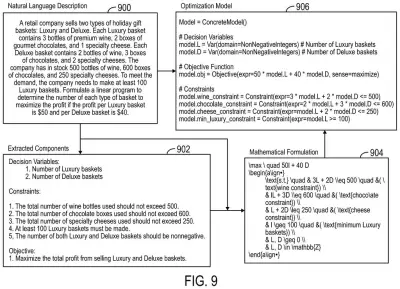
Next, a generative AI model reads that description and writes optimization models, which are code versions of the problem in different modeling languages (the filing names Pyomo, DOcplex and AMPL). A solver, meaning a separate program that calculates the best answer, runs each one. Training examples are made for models that reach the same answer, and one dependent claim requires a majority to agree.
Each example pairs the made-up description (input) with the code (output). The filing also covers training on the steps in between:
- Pulling out the decision variables (the things you can change) and the constraints (the rules you must follow)
- Writing a mathematical formulation from the description and those pieces
- Writing the final code in each language
The generative AI model processes the synthetic natural language description to generate optimization models in different optimization modelling languages implementing the synthetic optimization problem.
Translation: The artificial intelligence then translates those fake problems into multiple computer programming languages.
What this could mean for business planning tools
The practical payoff is for anyone who has a planning problem but no math degree. Today, turning a plain-English request into solver code often takes a specialist, and an AI doing the same job can miss a rule. A model trained on huge numbers of checked practice problems could get better at catching the rules you actually care about, though the filing gives no accuracy numbers.
For IBM, the interesting part is the shortcut. Training examples normally need people to supply the right answers. Here, several versions of the code vote, and the winner becomes the answer key. The filing says the trained model could run in the cloud or on a customer's own computer, which points to a back-office tool for companies rather than a phone feature.
That makes this IBM's 80th filing we've tracked in our AI guardrails race since May, alongside earlier work like plain-English security rules and AI judges for chatbot answers.
Source: US 2026/0368627 A1 at the USPTO (PDF). Full patent text and figures are in the official publication.
Get our take in your Top Stories
Liked this breakdown? Add Patentlyze as a preferred source on Google, and our plain-English take shows up more often in your Top Stories the next time IBM patent news breaks.
Add Patentlyze on Google
One click.
There are more where this came from
We read every patent application Big Tech publishes and send you the ones worth knowing. Plain English, free, every week.
The drawings · 9 sheets
9 drawing sheets from US 2026/0368627 A1 · click any drawing to enlarge


Show the other 1 sheets

More from IBM
All 481 IBM patents →
More in AI training & infrastructure
All 323 AI training & infrastructure patents →
Samsung
Samsung Patents a System That Makes AI Grade Its Own Homework
Salesforce
Salesforce's New Patent Grades AI Answers on Both Meaning and Exact Wording
Microsoft
Microsoft Patents AI That Catches and Fixes Bias in Legal Case Analysis
Salesforce
No comments yet