
Intel Patents Hardware That Finds the Right Memory Locations Faster Before a CPU Asks
Every time your processor looks up where data lives in memory, it risks a costly delay if that address isn't cached nearby. Intel is patenting a dedicated piece of circuitry that bets on which addresses you'll need next and grabs them early.
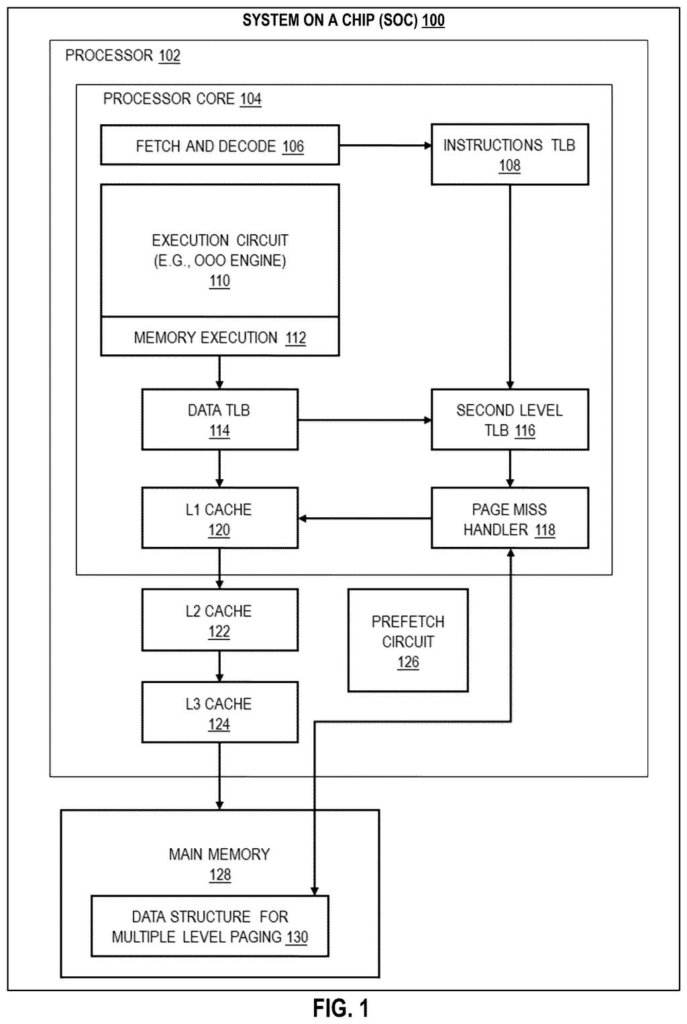
What Intel's page-table prefetch chip actually does
Every time your computer runs a program, the processor constantly asks: "Where in memory does this data actually live?" It keeps a small cheat sheet of recent answers (called a translation lookaside buffer, or TLB) to avoid looking that up every single time. When an answer isn't on the cheat sheet, the processor has to go hunting through a much slower set of tables stored in main memory, which stalls everything waiting.
Intel's patent describes a dedicated piece of hardware, a prefetch circuit, that watches for those "not in the cheat sheet" moments and immediately fetches not just the one address the processor asked for, but a bunch of neighboring address entries stored nearby in memory. The idea is that programs tend to access memory in runs, so if you needed one address lookup, you'll probably need the next few very soon.
The result: those follow-up lookups are already sitting in the fast cache by the time the processor asks, instead of triggering another slow trip to main memory. It's a bet on predictability, and for many workloads, that bet pays off.
… a page miss handler to, based on a miss of the virtual address in a translation lookaside buffer comprising a plurality of virtual address to physical address mappings, send a request to a data structure for multiple level paging …
Translation: When the processor fails to find a memory address translation, it searches a deeper multi-level paging structure.
How the prefetch circuit spots a miss and loads ahead
The patent centers on a chip-level component called a prefetch circuit that works alongside an existing piece of hardware called the page miss handler.
Here's the chain of events the patent describes:
- A running program generates a memory request using a virtual address (the address the program thinks the data is at, not where it physically sits in RAM).
- The chip looks in the translation lookaside buffer (TLB), a tiny, fast cache of recent virtual-to-physical address conversions. If the TLB doesn't have the answer, that's a "miss."
- The page miss handler then walks a multi-level data structure stored in system memory (called a page table) to find the correct physical address, and loads that mapping back into the TLB.
- Simultaneously, the new prefetch circuit detects that same TLB miss and fetches additional neighboring page table entries from memory into the cache, even though nobody asked for them yet.
Because page table entries for nearby virtual addresses are stored adjacent to each other in memory (packed into cache lines, which are fixed-size chunks fetched together), a single prefetch operation can pull in several future address mappings at once with little extra cost.
The claim specifically covers an apparatus, meaning Intel is patenting the hardware circuit itself, not just a software algorithm, which makes the coverage significantly more concrete.
… a prefetch circuit to, based on the miss of the virtual address in the translation lookaside buffer, cause a store of at least one other cache line of page table entries into the cache from the data structure for multiple level paging …
Translation: A prediction component proactively loads extra address translation data into the cache to speed up future lookups.
What this means for CPU memory performance
Address translation is one of those invisible taxes every modern processor pays constantly. As programs get larger and more complex (think virtual machines, large databases, AI inference workloads), TLB misses become more frequent and more expensive. Hardware that reduces those stalls without requiring any changes to software or the operating system has real appeal to data-center buyers especially.
For everyday users, this kind of improvement tends to show up as slightly smoother multitasking and faster cold-start performance for applications, rather than a dramatic speed jump in any single task. The chip does the work invisibly. Intel keeps filing on memory subsystem and cache efficiency in the processor space, and this filing fits that pattern: unglamorous plumbing that adds up across billions of cycles.
Intel's 43rd filing we've tracked since May in our AI chip wars, following one cutting wasted cache fetches and one on faster chip multiplication, adds another look at how the company is rethinking how chips handle data.
Claim 1 is broad. It claims any apparatus that combines an execution circuit, a page miss handler, and a prefetch circuit that triggers off a TLB miss to load neighboring cache lines. That's a high-level description of the behavior, not a narrow implementation detail.
If granted in its current form, that breadth could cover a wide range of hardware designs that prefetch page table entries in response to a TLB miss, regardless of how the prefetch circuit is built internally. That matters because TLB miss prefetching isn't a new idea in academic research, and the USPTO examiner will almost certainly push back with prior art. The final granted claim will probably be narrower.
As written, though, this is a real claim on real silicon behavior that Intel builds into its own processors. It's the kind of filing that consolidates ownership of an approach already inside shipping products, rather than staking out future territory.
There are more where this came from
We read every patent application Big Tech publishes and send you the ones worth knowing. Plain English, free, every week.
The drawings
35 drawing sheets from US 2026/0300185 A1 · click any drawing to enlarge


Want this weekly breakdown for a company we don't cover? Patentlyze Pro →
Be the first to weigh in