
Intel Patents a Lock-and-Unlock System for Sharing Hardware Between Virtual Machines
Running software in a virtual machine usually means losing direct access to physical hardware, and getting that access back requires swapping out drivers in awkward ways. Intel's new patent describes a hardware-level trick that lets the same device look like a virtual card to most software while revealing its true identity to the drivers that need it.
How Intel wants virtual and real drivers to coexist
When companies run many workloads on a single server, they use software called a "virtual machine" to make one physical computer look like many separate computers. The catch is that when hardware, like a networking card or a storage device, is shared this way, the software inside each virtual machine often can't use the card's full-featured, manufacturer-provided driver. It ends up using a slower, generic one instead.
Intel's patent describes a hardware middleman that sits between the virtual machine and the physical device. Normally, that middleman keeps the device "locked," presenting a virtual identity to whatever software asks for one. But when a trusted piece of software sends a request to a specific address, the middleman "unlocks" the device and lets the real hardware identity through, allowing the native driver to load and take control.
The result is that the same physical device can serve two roles: a generic shared resource for virtual machines, and a fully exposed piece of hardware for the software that needs to talk to it directly, without rebooting or reconfiguring anything.
intercept a read request to read an identifier of one of the physical I/O devices; and respond, responsive to the physical I/O device being in a locked state, to the read request with a value of the identifier associated with the virtual I/O device.
Translation: The system steps in when hardware is locked and gives out a fake ID instead of the real one.
How the locked/unlocked state controls what drivers see
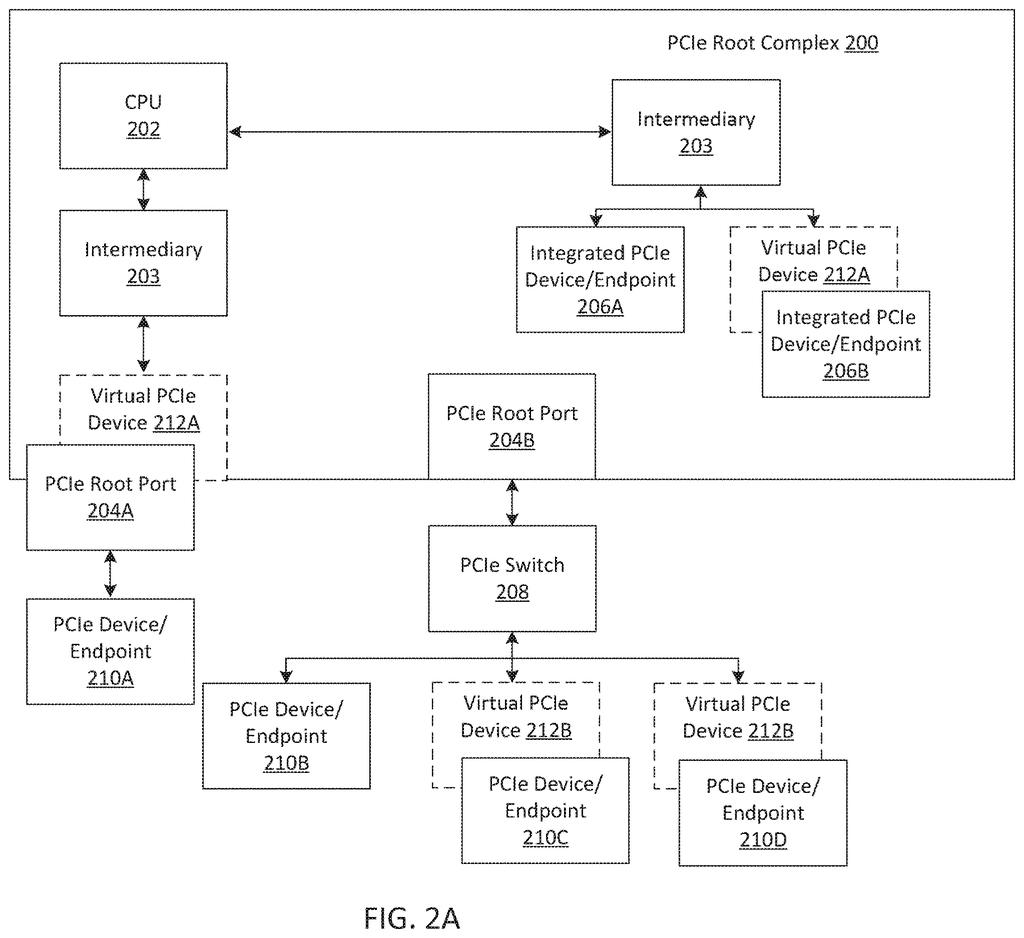
The patent describes an intermediary hardware block that sits on the path between a requesting piece of software (or virtual machine) and one or more physical I/O devices, connected over a PCIe fabric (the standard high-speed bus that links processors to cards like GPUs, network adapters, and storage drives).
By default, the physical device is in a locked state. When software sends a read request asking "what device is this?", the intermediary intercepts that request and returns the identifier of the virtual device instead. The physical card's real identity stays hidden, so the operating system loads a generic virtual driver, which is the normal behavior in virtualized environments.
The unlock mechanism works like a secret knock: a request to a predetermined address tells the intermediary to switch the device into an unlocked state. Now when the same "what device is this?" request arrives, the intermediary forwards it all the way to the physical hardware, which answers with its true identifier. That triggers the operating system to load the native manufacturer driver, giving software full, low-level access to the device's capabilities.
- Locked state: identifier reads return the virtual device's ID; native driver stays dormant.
- Unlocked state: identifier reads pass through to real hardware; native driver loads.
- The switch between states happens at the hardware layer, not in software, so no reboot or driver reinstall is required.
When a physical I/O device is locked, read requests to read an identifier of the physical device are blocked, and a value associated with the virtual I/O device is provided.
Translation: Locking the hardware hides its true identity from virtual machines until it is safe to share.
What this means for data center virtualization
For cloud providers and enterprise data centers, hardware virtualization is how they squeeze efficiency out of expensive servers. The persistent headache is that sharing a device across virtual machines almost always means giving up the optimized, manufacturer-written driver that makes that device perform at its best. You get broad compatibility or peak performance, rarely both at the same time.
Intel's approach, if it works as described, addresses that tradeoff at the hardware level rather than patching it in software. That matters because software-layer fixes add overhead and complexity that hardware-level fixes avoid. For your everyday experience, this is the kind of infrastructure work that determines whether cloud services run faster or cost less, even if you never see the device drivers involved.
Intel's 160th filing in our Intel coverage since May follows work like a notification-delay dashboard and a heat-aware charging circuit.
The problem Intel is attacking here is real and has cost the industry enormous engineering effort. Every major cloud provider has built elaborate software stacks, including SR-IOV, vDPA, and various paravirtualization schemes, specifically because getting native driver performance inside a virtual machine is genuinely hard. A hardware intermediary that handles the identity-switching transparently is a cleaner answer than most of those approaches.
The specific mechanism, a lock toggled by a request to a known address, is narrow in scope. It solves the driver-identity problem, but it does not address other reasons native drivers are tricky in virtual environments, like interrupt handling and memory mapping. So this is one piece of a larger puzzle, not a complete fix.
Still, the problem is significant enough that even a partial hardware solution is worth attention. Intel's long bet on data center virtualization infrastructure shows up repeatedly in its patent portfolio, and this filing fits that pattern. Whether the lock-and-unlock approach survives contact with real operating system behavior is the open question.
There are more where this came from
We read every patent application Big Tech publishes and send you the ones worth knowing. Plain English, free, every week.
The drawings
8 drawing sheets from US 2026/0300197 A1 · click any drawing to enlarge


Want this weekly breakdown for a company we don't cover? Patentlyze Pro →
Be the first to weigh in