
Hyundai & Kia
Hyundai & Kia · Automotive · Filed Apr 1, 2026 · USPTO published Nov 19, 2026 · This week's release
Kia Patents Using a Hydrogen Car's Fuel-Line Heater to Warm Your Cabin
Hydrogen fuel cell cars already carry a heater built for freezing mornings, but it mostly sits idle once the car warms up. Kia's patent application puts it to work heating you, too.
- Publication number
- US 2026/0364998 A1(US20260364998A1)
- Applicant
- Kia Corporation
- Filed · Published
- Apr 1, 2026 · Nov 19, 2026
- Inventors
- Sangyeop Lee, Myung Hoe Kim, Yangbo Kang, Seung Ho Lee, Sang Ku Hur, Kwang Woon Cho, Kwangok Han
- Status when we published
- Waiting for an examiner
- Document
- 20 claims
- US classification
- 165/200
What Kia's fuel cell cabin heater setup does
Ever sat shivering in a car, waiting for the heat to kick in? Hydrogen fuel cell cars have a version of that problem, and it's tougher: the fuel cell works poorly when it's cold, and the water it makes can freeze.
To fix that, these cars carry a built-in heater that quickly warms the liquid coolant flowing through the fuel cell. Once the car is up to temperature, though, that heater has little left to do. Meanwhile, helping warm your cabin has called for a separate, costlier high-voltage heater.
Kia's patent application puts the idle heater to work. Hot coolant from it flows through a side loop to the small radiator behind your dashboard vents, so one part warms both the fuel cell and you. A cheaper, lower-power backup heater can handle whatever heat is still missing.
… a cathode oxygen depletion (COD) heater provided on the second coolant line on an upstream side of the heater core.
Translation: The system uses a special startup heater normally meant for the fuel cells to also warm up the cabin air.
How hot coolant gets routed to your vents
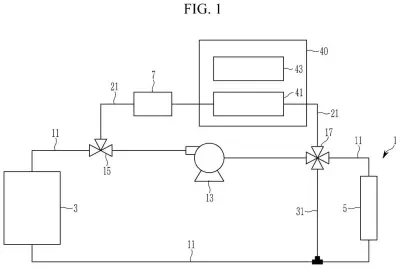
The filing describes a cooling system for a fuel cell car with two linked coolant loops. The main loop carries coolant past the fuel cell stack (the part that turns hydrogen and oxygen into electricity), a front-mounted radiator, and a water pump. A second loop branches off it and runs through the heater core, a small radiator in the climate control unit that warms the air blowing into the cabin.
The key addition is a cathode oxygen depletion (COD) heater, a coolant heater normally used to bring the stack up to temperature fast on a cold start. Here it sits on the second loop, just before the heater core, so the coolant it heats goes straight to the cabin.
Two valves steer the flow:
- Cold start: coolant is routed through the COD heater and kept away from the radiator, so it warms up quickly.
- Cabin heating: part of the coolant goes through the COD heater and heater core, while the rest keeps flowing through the fuel cell stack.
The heater is not simply run flat out. Its power is calculated from the gap between a target coolant temperature (set by the outside air and the cabin temperature you chose) and the temperature of the coolant coming in, along with the flow rate and the coolant's heat-carrying properties. The filing also describes a low-voltage electric air heater as a top-up.
The thermal management system includes a first coolant line through which a coolant is flowable, and a fuel cell stack, a radiator, and a water pump provided on the first coolant line.
Translation: The setup relies on a main liquid cooling loop that connects the fuel cells and radiator to circulate temperature.
Why Kia's heater reuse could cut costs
For you, the practical payoff is a heating system that could cost less to build and waste less electricity. The filing says the conventional setup needs a high-voltage electric heater to help warm the cabin. By using the heater the car already has, Kia describes swapping in a cheaper low-voltage one.
The design also tries to keep the fuel cell at its best operating temperature while it heats your cabin, which the filing ties to better efficiency and durability for the stack. It is a plumbing and control change, so you would notice it only as a car that warms up well in winter without a bigger energy bill. Whether any Kia vehicle ever uses it is not something the filing says.
Hyundai's 13th patent application we've tracked since November joins our Hyundai coverage that already includes coasting EVs before curves and spreading wear across hydrogen boosters.
Source: US 2026/0364998 A1 at the USPTO (PDF). Full patent text and figures are in the official publication.
Get our take in your Top Stories
Liked this breakdown? Add Patentlyze as a preferred source on Google, and our plain-English take shows up more often in your Top Stories the next time Hyundai & Kia patent news breaks.
Add Patentlyze on Google
One click.
There are more where this came from
We read the new patents from Big Tech, carmakers and more and send you the ones worth knowing. Plain English, free, every week.
The drawings · 3 sheets
3 drawing sheets from US 2026/0364998 A1 · click any drawing to enlarge


More from Hyundai & Kia
All 15 Hyundai & Kia patents →
More in Automotive
All 432 Automotive patents →
Nvidia
Nvidia Patents a Hidden Infrared System That Maps Your Car's Cabin in 3D
Nvidia
Nvidia Patents a Laser-Targeting System for Calibrating In-Cabin Sensors
GM
GM Files Patent to Heat EV Cabins With Heat From Your Brakes
Nvidia
No comments yet