
Hyundai & Kia
Hyundai & Kia · Automotive · Filed Feb 4, 2026 · USPTO published Nov 19, 2026 · This week's release
Kia Patents a Car Software Design Where Swapping a Part Won't Break the Code
Kia has filed a patent for stacking a car's software into layers, so changing a window motor or a brake part doesn't force a rewrite of the code above it. It reads like an org chart for a car's electronics, with each layer given one clear job.
- Publication number
- US 2026/0365127 A1(US20260365127A1)
- Applicant
- Kia Corporation
- Filed · Published
- Feb 4, 2026 · Nov 19, 2026
- Inventors
- Jae Won LEE, Soung Han NOH, Bong Kyu CHOI, In Sung JUNG, Jae Hyeon PARK
- Status when we published
- Waiting for an examiner
- Document
- 20 claims
- US classification
- 701/45
- Examiner
- TESSEMA, BESUFEKAD LEMMA (Art Unit 3665)
What Kia's layered car software actually does
Ever had a phone update break something that worked fine the day before? Cars are heading the same way. They now run on dozens of computers, and in many designs the software is tied tightly to the exact parts it controls. Change one part, and someone may have to rewrite code.
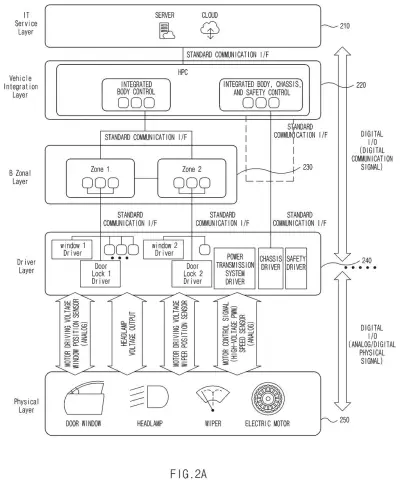
Kia's filing splits the car into stacked layers. At the bottom, small pieces of software called drivers run the actual parts, like window motors and brake actuators. Above them, zone controllers look after areas of the car (front, rear, cabin) and handle everyday things like lights, doors and climate. At the top, one central computer coordinates the whole car, including the serious jobs: power to the wheels, steering, braking and safety.
The layers talk to each other in fixed, standard message formats. So a new part only needs a new driver, and a software update doesn't require new hardware.
a physical layer associated with a plurality of circuits of the vehicle; a driver layer configured to perform operation and control of the physical layer; a zonal layer comprising a plurality of zone controllers configured to: perform zone control for respective predetermined zones of the vehicle …
Translation: The software is broken into distinct tiers handling hardware, basic controls, and regional zones.
How Kia's layers split up the car's jobs
The filing describes a vehicle built as a stack of layers, each linked to the next through a standardized interface (a fixed message format, such as the CAN, LIN or Ethernet networks cars already use). Because the messages stay the same, any one layer can be updated without touching the others.
From the bottom up:
- Physical layer: the actual devices, such as door actuators, headlamps, wipers, motors, and brake and steering actuators. It only performs physical actions.
- Driver layer: small pieces of software that run each device and react quickly on the spot. Swapping a part means changing only its driver.
- Zonal layer: zone controllers for areas like the front, rear or cabin, limited to body functions such as lighting, doors and climate.
- Vehicle integration layer: a central computer (a high-performance computer, or HPC) that directs the zone controllers and coordinates power delivery, the chassis (steering, suspension, braking) and safety systems.
The description says this fixes weak spots in modern zone-based designs, where a general-purpose controller struggles with split-second timing and braking control spread across several controllers adds delay. Here, those time-critical jobs sit in the central computer and the drivers.
An optional energy layer converts power between the car's voltage levels (12 V, 48 V and high voltage of 400/800 V) and the power grid. The central computer can also take requests, like a phone app asking whether a window is open, and pass them down through the layers.
… a layer-based software-defined vehicle architecture which includes a driver layer including a driver for performing an operation and control for a physical layer including each individual device of a vehicle …
Translation: This tiered software approach helps cars manage physical parts without breaking the underlying code.
Why swapping a car part could get easier
For you, the payoff would show up in how a car ages. If the software for each part lives in its own layer, a carmaker could push a new driver-assist feature, a better regenerative braking setup or a new wireless protocol over the air without redoing everything else. A repair that swaps in a different brand of sensor or actuator would only need a matching driver.
For Kia, the filing points to cost savings. The description says one hardware and software platform could cover sedans, SUVs and EVs, even when trims, left-hand or right-hand drive, and country-specific equipment differ. It also says a single central computer can enforce one security policy for the whole car, which matters as vehicles stay connected to the cloud.
Hyundai's third patent we've tracked since November in our Hyundai coverage follows a live sensor road map and a laser-check self-driving system.
Source: US 2026/0365127 A1 at the USPTO (PDF). Full patent text and figures are in the official publication.
Get our take in your Top Stories
Liked this breakdown? Add Patentlyze as a preferred source on Google, and our plain-English take shows up more often in your Top Stories the next time Hyundai & Kia patent news breaks.
Add Patentlyze on Google
One click.
There are more where this came from
We read the new patents from Big Tech, carmakers and more and send you the ones worth knowing. Plain English, free, every week.
The drawings · 6 sheets
6 drawing sheets from US 2026/0365127 A1 · click any drawing to enlarge


More from Hyundai & Kia
All 15 Hyundai & Kia patents →
More in Automotive
All 432 Automotive patents →
Honda
Honda Patents a Car That Holds Big Software Updates Until Wi-Fi Shows Up
IBM
IBM Files Patent to Pick the Right Moment for Your Car's Software Update
Google
Google Patents Car Software Where No Single Computer Is in Charge
Google
No comments yet