
Hyundai & Kia
Hyundai & Kia · Automotive · Filed Nov 5, 2025 · USPTO published Nov 19, 2026 · This week's release
Kia Files Patent for a Self-Driving System That Double-Checks What Its Laser Sensor Sees
A self-driving car's laser sensor sees the world as thousands of dots, and sometimes an AI mislabels flat pavement as something to dodge. A Kia patent application describes a second, rule-based ground check that referees the AI's labels.
- Publication number
- US 2026/0368906 A1(US20260368906A1)
- Applicant
- Kia Corporation
- Filed · Published
- Nov 5, 2025 · Nov 19, 2026
- Inventors
- Nam Gyun KIM
- Status when we published
- Waiting for an examiner
- Document
- 20 claims
- US classification
- 382/103
What Kia's laser-sensor cross-check actually does
Ever squinted at a dark patch on the road and wondered whether it was a puddle, a shadow or something you should brake for? A self-driving car has the same problem, only it works from thousands of laser dots instead of eyes.
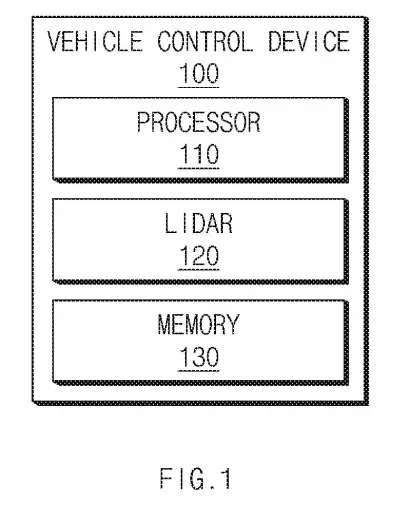
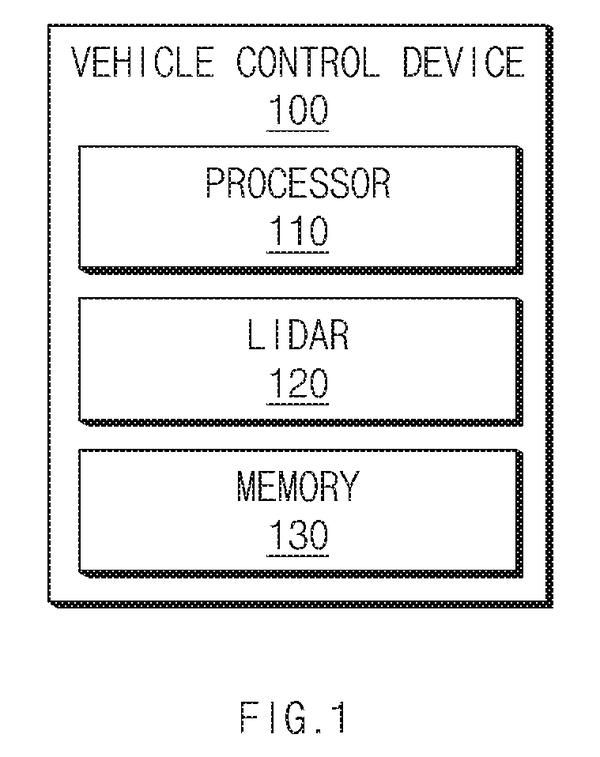
Kia's patent application describes a way to cross-check those dots. The car's laser sensor (called lidar) paints the surroundings as a cloud of points, and an AI labels each one: road, car, person. The catch is that the AI can slip up, especially on plain pavement. So the system runs a second, simpler ground check and uses it as a referee, particularly for things close to the car or when the AI isn't sure.
It also gives oddly shaped objects extra attention, and it tracks how far the car itself has moved so it can notice when its own sensor has drifted out of alignment.
… perform multi-class segmentation on the plurality of point data; recognize, based on the plurality of point data, a point that corresponds to a ground; perform a first fusing operation on a result of the multi-class segmentation and a result of recognizing the point that corresponds to the ground; …
Translation: The system categorizes sensor data and identifies where the ground is to better understand the environment.
How Kia's two fusion steps settle each label
The car's lidar (a laser sensor that fires pulses and times how long they take to bounce back) produces a cloud of points. A neural network performs multi-class segmentation, which means it puts a label such as road, car or person on every single point. Separately, a rule-based check works out which points belong to the ground. The filing says one option for tunnels is a slope-based check.
Two "fusing" steps then combine the answers:
- First fusion: decides each point's final label. In the filing's example, the ground check wins when an object is close (within 5 meters) or the AI's confidence is low (below 0.9). Otherwise the AI's label stands.
- Second fusion: merges the box drawn by an object-detection network with a box and an outline built from the labeled points. The outline captures shapes a plain box misses, like a side mirror or an open door. Oddly shaped objects the detector misses get a "SEG ONLY" flag and are tracked from the labels alone.
The first fusion's output also feeds odometry (an estimate of how far the car itself has moved), using fixed things like poles as anchors. That estimate lets the system correct sensor misalignment while driving. Objects and surroundings are then tracked frame to frame, and the results feed the car's driving decisions.
… perform a second fusing operation on a cuboid box for the object and an outline of the object; extract a feature point and odometry for the surrounding environment; …
Translation: It combines 3D shapes and outlines to track objects and measure how the vehicle moves.
What this means for Kia's self-driving sensors
If you ride in or share the road with a car that uses lidar, the practical stake is simple: mistakes in labeling cost you. A car that reads bare pavement as an obstacle may brake for nothing, and one that misses an oddly shaped object may not brake at all. The filing says using point-by-point labels is expected to hold up better against noisy data and against over- or under-labeling.
The patent describes a software layer, not a new sensor, so it could in principle sit on top of lidar hardware a carmaker already uses. The description mentions running the AI on an Nvidia Drive AGX system as one example. The patent names no specific Kia model or product, so treat it as a look at how the company approaches the problem of seeing the road.
Source: US 2026/0368906 A1 at the USPTO (PDF). Full patent text and figures are in the official publication.
Get our take in your Top Stories
Liked this breakdown? Add Patentlyze as a preferred source on Google, and our plain-English take shows up more often in your Top Stories the next time Hyundai & Kia patent news breaks.
Add Patentlyze on Google
One click.
There are more where this came from
We read the new patents from Big Tech, carmakers and more and send you the ones worth knowing. Plain English, free, every week.
The drawings · 7 sheets
7 drawing sheets from US 2026/0368906 A1 · click any drawing to enlarge


More from Hyundai & Kia
All 15 Hyundai & Kia patents →
More in Automotive
All 432 Automotive patents →
Intel
Intel Files Patent to Keep Self-Driving Cars' Laser Sensors From Confusing Each Other
Nvidia
Nvidia Files Patent to Help Self-Driving Cars Identify Pedestrians From Distance Sensors
Nvidia
Nvidia Patents a Voting System That Double-Checks Where a Self-Driving Car Thinks It Is
Nvidia
No comments yet