
Hyundai & Kia
Hyundai & Kia · Automotive · Filed Nov 20, 2025 · USPTO published Nov 19, 2026 · This week's release
Kia Files Patent to Spread Wear Evenly Across a Hydrogen Car's Voltage Boosters
In a fuel cell car's power unit, whichever small module switches on first ends up working hardest and wearing out first. Kia's filing describes a way to rotate that job.
- Publication number
- US 2026/0365047 A1(US20260365047A1)
- Applicant
- KIA CORPORATION
- Filed · Published
- Nov 20, 2025 · Nov 19, 2026
- Inventors
- Yoon Tae Kim, Woo Young Lee, Ki Wook Ohm, Joo Seung Lee, Hyeon Ju Jeong, Jae Ho Kim, Sae Kwon Chang, Jong Jun Lee
- Status when we published
- Waiting for an examiner
- Document
- 17 claims
- US classification
- 307/10.1
- Examiner
- AMAYA, CARLOS DAVID (Art Unit 2836)
What Kia's fuel cell power-sharing idea does
You're merging onto a highway in a fuel cell car and you press the accelerator. Somewhere under the floor, a power unit has to ramp up fast, then settle back down once you're cruising.
That unit is built from several identical small modules working side by side. The catch is that the module that always switches on first ends up working hardest and wearing out first, and once it fails, the whole unit has to be replaced. Kia's filing describes a way to share the load. Instead of always starting with module number one, the car starts with any module, then adds more one at a time as your power demand climbs, rotating around the group. When demand drops, it shuts them off in the same rotating fashion.
The goal is simple: every module gets roughly the same amount of use, so the whole unit lasts longer.
activating an arbitrary boost converter among the plurality of boost converters; determining an increase reference value based on a number of first target boost converters eligible for additional activation among the plurality of boost converters; …
Translation: The system randomly turns on one power booster and calculates when to activate the next ones based on availability.
How Kia rotates which power modules switch on
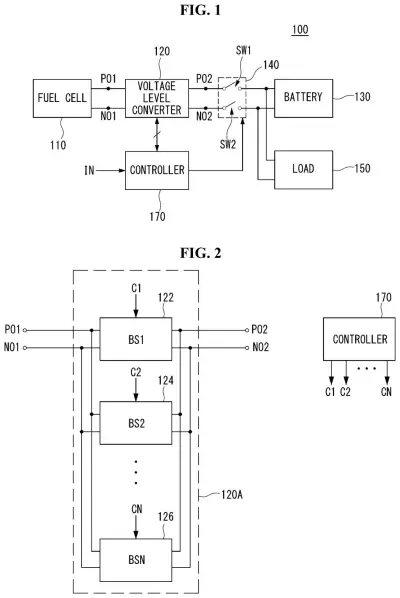
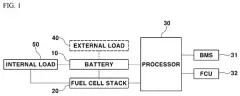
A fuel cell produces electricity at roughly 100 to 200 volts, while the car's high-voltage battery sits around 600 volts. A voltage level converter (the filing calls it an FDC) boosts one to match the other. Here it is built from several boost converters (small circuits that each raise voltage) wired in parallel. Splitting a 200 kW job across, say, four 50 kW units lets the car use cheaper parts, and it can run only as many units as the moment requires. The filing's examples: 70 kW of output means two units running, 140 kW means three.
The control method works in a loop:
- Switch on one arbitrary boost converter.
- Calculate an increase reference value, a bar that depends on how many units are still eligible to be switched on.
- If the power command value (the request sent down from the car's higher-level controller) meets or beats that bar, switch on one more unit.
- Repeat until no eligible units remain.
Going the other way, a matching decrease reference value decides when to switch units off. If the command falls to zero, the system decides whether to shut the converter down entirely.
In the filing's worked example, five units run with a threshold of 150. Starting at unit 3 with a demand of 200, the bar steps through 30, 37.5, 50 and 75, and units switch on in the order 3, 4, 5, 1, 2, wrapping around. When demand then falls to 20, units shut off in the order 3, 4, 5, 1. The next unit can be picked in sequence or at random.
… additionally activating one of the first target boost converters based on determining that a power command value of the voltage level converter is equal to or greater than the increase reference value; …
Translation: Another booster turns on automatically once the power demand reaches a certain threshold.
Why even wear could help fuel cell car owners
The filing's logic is simple: the converter lasts only as long as its most overworked part. The description points at the semiconductor switches inside each module, which wear out based on how often they switch. If one module is always first on and last off, it fails early, and replacing it means replacing the whole voltage converter. Spreading the use evenly stretches the life of the unit you'd otherwise pay to swap.
For you, that would show up as less wear on a costly piece of a fuel cell car's electrical system. The filing also says the threshold approach keeps things stable when the power request bounces around, as it does in stop-and-go traffic. It doesn't name a specific Kia vehicle, and it's a patent application, so it says nothing about what is on the road today.
Hyundai's 11th filing since November in our Hyundai coverage adds to a hydrogen thread that includes a power-recharging car and a charging timer.
Source: US 2026/0365047 A1 at the USPTO (PDF). Full patent text and figures are in the official publication.
Get our take in your Top Stories
Liked this breakdown? Add Patentlyze as a preferred source on Google, and our plain-English take shows up more often in your Top Stories the next time Hyundai & Kia patent news breaks.
Add Patentlyze on Google
One click.
There are more where this came from
We read the new patents from Big Tech, carmakers and more and send you the ones worth knowing. Plain English, free, every week.
The drawings · 5 sheets
5 drawing sheets from US 2026/0365047 A1 · click any drawing to enlarge


More from Hyundai & Kia
All 15 Hyundai & Kia patents →
More in Automotive
All 432 Automotive patents →
Toyota
Toyota Files Patent to Cut the Wait When You Summon Your Parked Car
Hyundai & Kia
Kia Files Patent for a Live Road Map Its Cars Draw From Their Own Sensors
GM
GM Files Patent for Car Echo Cancellation That Keeps Your Voice When Both Callers Talk
BMW
No comments yet