
Microsoft
Microsoft · AI / ML · Filed May 19, 2025 · USPTO published Nov 19, 2026 · This week's release
Microsoft Files Patent for an AI Ad Coach That Grades Its Own Advice
Microsoft's new patent application goes after a stubborn problem with AI business advice: people ignore it. Its answer is a second AI that predicts whether an advertiser will click the suggested button before the tip ever appears.
- Publication number
- US 2026/0368776 A1(US20260368776A1)
- Applicant
- Microsoft Technology Licensing, LLC
- Filed · Published
- May 19, 2025 · Nov 19, 2026
- Inventors
- Shao Tang, Zhipeng Wang
- Status when we published
- Rejected again; the company can still amend or appeal
- Document
- 18 claims
- US classification
- 705/14.43
- Examiner
- PATEL, DIPEN M (Art Unit 3621)
What Microsoft's ad-advice scoring filing does
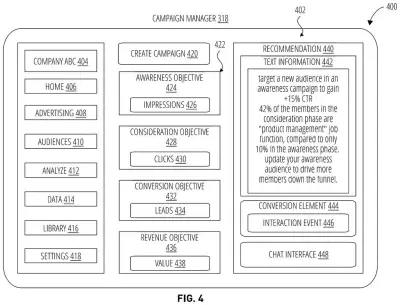
You're a marketing manager looking at your ad dashboard when a box pops up. It says to target a new audience for a 15% bump in clicks. The advice is clear and specific, and you hit "Dismiss" anyway.
Microsoft's filing says this happens a lot. The AI that writes the tip works in a vacuum. It has no idea that you care more about leads than clicks, or what you did with similar advice last month.
So the filing adds a checkpoint. After the first AI drafts a tip, a second AI predicts whether you will actually act on it. It bases that guess on your own past behavior and the state of your campaign. Tips that score high enough get shown, and the rest never reach you. When you do press the button, that click becomes new training material for the scorer.
… sending a prompt to a generative artificial intelligence (AI) model, the prompt comprising the set of performance metrics and instructions for the generative AI model to generate a recommendation …
Translation: The system feeds campaign numbers and instructions into an AI to get suggestions.
How the scoring model judges each AI tip
The system starts with a campaign's report card: numbers such as impressions (how many times an ad was shown), click-through rate, conversion rate (how many viewers take a desired step) and qualified leads. Those numbers go into a prompt, a written instruction, sent to a generative AI model (a text-writing AI, like a chatbot). The model replies with a recommendation: advice text plus a conversion element, meaning a button such as "Create Audience" that the advertiser can press.
Before anyone sees it, a reward model scores the draft. Claim 1 has it take in three things: context data about the campaign, action data about what this advertiser has done before, and the original prompt. It turns each into embeddings (numeric summaries of meaning) using a self-attention layer (a technique that weighs which parts of the input matter most) and a causal self-attention layer (the same idea, reading in order). A cross-attention layer then blends the summaries together, and the model outputs one score predicting whether the button will get pressed.
The draft is shown only if the score clears a threshold. The filing also describes these extras:
- Generating several drafts, ranking them by score, and showing the top one.
- Adding each button press to the training data so the scorer is retrained over time.
- Pulling in relevant documents to enrich the scorer's context.
- Training the advice writer and the scorer together.
… sending the recommendation to a reward model to generate a reward value for the recommendation, the reward value indicating whether the digital content information of the recommendation will cause the conversion element to generate an interaction event …
Translation: A second model evaluates the AI advice to predict if users will click on it.
What the final rejection means for Microsoft
If it works as described, an ad dashboard would show fewer tips you'd skip and more you'd act on, because each tip is screened against what you have done before. The filing's own example is a "Create Audience" suggestion promising a 15% click boost that an advertiser ignored, since their real goal was leads. The description sets this inside a professional networking platform's ad tool, though the claims are not limited to that.
A patent examiner has issued a final rejection of this application (status as of October 8, 2026). Microsoft can still amend the claims or appeal, so nothing here is settled. Treat it as a look at how the company thinks about making AI advice earn its place on your screen.
This is the 48th Microsoft filing we've tracked since May on AI models working in teams, following testing AI setups first and one model many specialties.
Source: US 2026/0368776 A1 at the USPTO (PDF). Full patent text and figures are in the official publication.
Get our take in your Top Stories
Liked this breakdown? Add Patentlyze as a preferred source on Google, and our plain-English take shows up more often in your Top Stories the next time Microsoft patent news breaks.
Add Patentlyze on Google
One click.
There are more where this came from
We read every patent application Big Tech publishes and send you the ones worth knowing. Plain English, free, every week.
The drawings · 14 sheets
14 drawing sheets from US 2026/0368776 A1 · click any drawing to enlarge


Show the other 6 sheets


More from Microsoft
All 681 Microsoft patents →
More in AI recommendation
All 91 AI recommendation patents →
Google
Google Files Patent for an AI Production Crew That Makes Ads for Each Audience
Samsung
Samsung Patents a System That Double-Checks Its Own Health Advice Before Sending It
Amazon
Amazon Patents a System That Makes Its AI Explain Its Own Decisions
Sony
No comments yet