
Microsoft
Microsoft · AI / ML · Filed May 19, 2025 · USPTO published Nov 19, 2026 · This week's release
Microsoft Files Patent for AI That Stops Advertisers From Overpaying for Web Ads
Every time a web page loads, advertisers fight in a split-second auction for the ad spot, and Microsoft's new patent application tries to help them win without overpaying. It uses one AI model trained on winning bids and another trained on losing ones.
- Publication number
- US 2026/0368781 A1(US20260368781A1)
- Applicant
- Microsoft Technology Licensing, LLC
- Filed · Published
- May 19, 2025 · Nov 19, 2026
- Inventors
- Ruby Tu, Shengjun Pan, Min Liu, Xi Xiong, Yi Zhang, Yuan Gao, Haipeng Gao
- Status when we published
- Rejected again; the company can still amend or appeal
- Document
- 19 claims
- US classification
- 705/14.71
- Examiner
- CIRNU, ALEXANDRU (Art Unit 3622)
What Microsoft's two-model ad bidding does
Imagine you're at an auction where you have to guess the lowest price that still wins, but you only ever get told what the winning bids looked like. Nobody shows you the bids that came up short. You'd probably pay too much just to be safe.
That is the situation behind many of the ads on the pages you load. Each time a page opens, an automatic auction runs in milliseconds for the ad slot, and the advertiser's software has to name a price instantly. Microsoft's patent application describes two AI models: one learns from past winning bids and sets a ceiling, the other learns from past losing bids and sets a floor.
The final price lands somewhere in between, and it shifts based on how recent auctions went. Lose one and the next bid creeps up; win one and it creeps down. The goal is to pay just enough to win, and no more.
… generating a bid upper boundary value for a prediction interval based on the input vector using a first machine learning (ML) model, the first ML model trained on a first set of training datapoints, wherein each first training datapoint comprises an accepted bid from a first set of auctions …
Translation: The system uses one AI model trained on past winning bids to figure out the maximum amount you should consider paying.
How the floor and ceiling prices get set
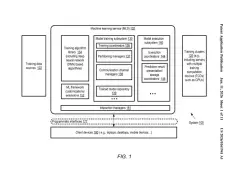
The patent application covers a method for an advertiser's bidding software (called a demand-side platform, or DSP, a service that buys ad space on behalf of companies). When a web page loads, the software receives a bid request: details about the page, the ad slot, and the visitor's device and context, bundled into a list of numbers (an input vector).
Two machine learning models then each produce one end of a price range:
- Accepted bid model: trained on bids that won past auctions. It sets the upper boundary, a price likely high enough to win.
- Rejected bid model: trained on bids that lost. It sets the lower boundary, a price below which a bid probably fails.
Bid selection logic then picks one price from inside that range. An exploration parameter (a dial that decides whether to lean toward the high end or the low end) is adjusted using live auction results and performance numbers. If the last bid lost, the dial moves up; if it won, it moves down. The claims also cover the last steps: getting notified of a win and sending the ad to appear as the page loads.
The filing also describes training the models with a custom scoring rule (a loss function, the formula that tells a model how wrong its guess was) that punishes some kinds of wrong guesses more heavily than others. It says the two models could also be merged into one.
Why ad overbidding costs advertisers real money
If it works, advertisers would stop paying more than they have to for the same ad spots. The filing's own example imagines a day with over 2.3 billion auctions, where an advertiser won about 141.9 million of them and paid roughly $6.2 million. Winning the same number in cheaper tiers could have cost about $1.25 million, a cut of over 70%. That is an illustration from the company, not a measured result.
The patent office has issued a final rejection of this application, so nothing here is approved. Microsoft can still amend the claims or appeal. Even if it never becomes a granted patent, the filing shows how Microsoft approaches the problem of overpaying in automated ad auctions.
That makes this Microsoft's 33rd filing we've tracked under AI training and infrastructure since May, following work on adding specialties to one model and stopping game sharpening AI.
Source: US 2026/0368781 A1 at the USPTO (PDF). Full patent text and figures are in the official publication.
Get our take in your Top Stories
Liked this breakdown? Add Patentlyze as a preferred source on Google, and our plain-English take shows up more often in your Top Stories the next time Microsoft patent news breaks.
Add Patentlyze on Google
One click.
There are more where this came from
We read every patent application Big Tech publishes and send you the ones worth knowing. Plain English, free, every week.
The drawings · 10 sheets
10 drawing sheets from US 2026/0368781 A1 · click any drawing to enlarge


Show the other 2 sheets


More from Microsoft
All 681 Microsoft patents →
More in AI training & infrastructure
All 323 AI training & infrastructure patents →
IBM
IBM Patents Photo Inspection You Set Up With One Example and a Sentence
Google
Google Patents an AI System That Builds New Ads From Your Existing Logos and Colors
Intel
Intel Patents a Chip That Shuts Off Its Own Processing Units During AI Tasks
Amazon
No comments yet