
Microsoft
Microsoft · AI / ML · Filed May 14, 2025 · USPTO published Nov 19, 2026 · This week's release
Microsoft Patents a Second AI That Catches the First One's Made-Up Facts
Microsoft's filing puts one AI to work as a proofreader for another, tagging each shaky sentence with an error type and a score before a third step rewrites it.
- Publication number
- US 2026/0368153 A1(US20260368153A1)
- Applicant
- Microsoft Technology Licensing, LLC
- Filed · Published
- May 14, 2025 · Nov 19, 2026
- Inventors
- Robert Tyler Kazuo DESJARDINS, Chungheong GOOI, Chujie HE, Qiang GAN
- Status when we published
- Approved; patent expected soon
- Document
- 20 claims
- US classification
- 707/691
- Examiner
- RAAB, CHRISTOPHER J (Art Unit 2156)
What Microsoft's AI fact-checker actually does
Today, a chatbot can answer a question using your documents and still slip in a made-up detail, like a wrong number or a claim your files never made. Developers spend huge effort fine-tuning the instructions they give these bots, but Microsoft's filing says even careful wording can't promise the mistakes disappear.
So the patent adds a second AI as a proofreader. After the first AI writes its answer, the proofreader reads it one sentence at a time and checks each one against your original question and the source material. Shaky sentences get a label, a type of error and a score for how likely they are to be wrong.
Then a rewriter fixes only the flagged sentences, using the same source material, and leaves the rest alone. The system can even show you the first answer right away, then warn you that a corrected version is on the way.
… a hallucination identifier that receives the model-generated output from the first language model and identifies a first candidate hallucination within the model-generated output using the user query and the associated context, wherein the hallucination identifier comprises a second language model different from the first language model …
Translation: A second AI reviews the first AI's work against the original query and data to spot made-up facts.
How the checker tags and rewrites bad sentences
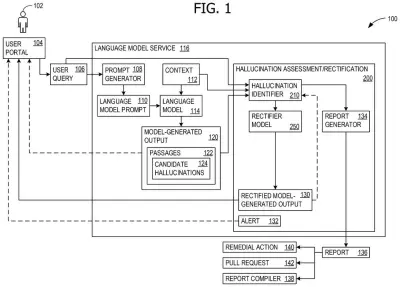
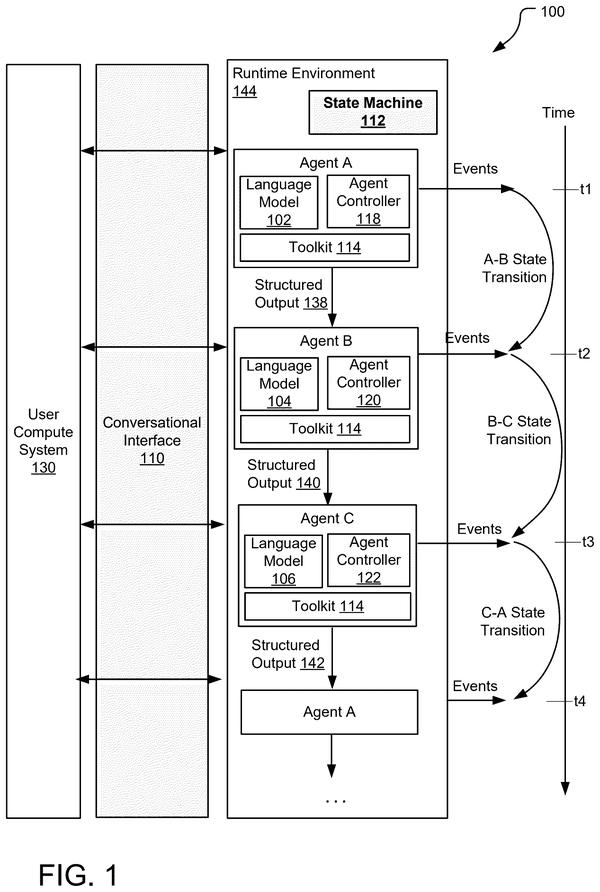
The system has three roles. A first language model (the chatbot-style AI) answers a user's question using supplied source material, called context. A hallucination identifier, which the claims say must be a second, different language model, then reads that answer passage by passage (roughly sentence by sentence) and compares it with the question and the source material.
For each passage it finds suspicious, it attaches a tag with a category and a score. The filing's categories are contextual consistency (details that clash with the source), numeric accuracy (wrong numbers), and internal coherence (the answer contradicting itself). The checker also writes out its reasoning, which the filing calls an inner monologue, and marks clean passages as clear. In the filing's example, a request to argue that a basketball player deserves MVP, based on a stats dataset, produced an answer where five of seven sentences were flagged.
A rectifier model then gets a prompt (its instructions) built from the flagged passage, its tag, the original question and the source material. It rewrites flagged passages, leaves clean ones intact, and sends the result to the user.
The filing also describes variations:
- The rewritten answer can go back to the checker for another round, until a quality bar is met.
- The original answer can be shown first, with an alert that a corrected version is coming, to cut waiting.
- Without the rewriter, the tags can feed a report used to decide whether to ship an AI update, or to compare how different prompt wordings affect errors.
An LLM-based rectifier is prompted with the hallucination tags and uses the context and the original query to replace the tagged phrases of the original model-generated output.
Translation: A final correction step uses the error tags to rewrite and fix the flawed sentences.
Why a second AI checking the first matters
If you use AI at work to summarize reports or draft documents from your own data, a built-in proofreading step could mean fewer invented figures slipping through. It also takes some pressure off developers, because the filing says careful prompt writing can't promise a fix for every question people might ask. The same tagging can also score how often an AI makes things up, which could help decide whether an update is ready to ship.
The patent office has approved this application and Microsoft has paid the fee to have it issued, so it should become a granted patent soon. The filing doesn't name a product, so where this checking step would show up is unknown.
This is the 52nd Microsoft filing we've tracked since May on AI teams working together, after one on cutting costs by trimming specialist parts and one on handing off to a specialist mid-chat.
Source: US 2026/0368153 A1 at the USPTO (PDF). Full patent text and figures are in the official publication.
Get our take in your Top Stories
Liked this breakdown? Add Patentlyze as a preferred source on Google, and our plain-English take shows up more often in your Top Stories the next time Microsoft patent news breaks.
Add Patentlyze on Google
One click.
There are more where this came from
We read every patent application Big Tech publishes and send you the ones worth knowing. Plain English, free, every week.
The drawings · 19 sheets
19 drawing sheets from US 2026/0368153 A1 · click any drawing to enlarge


Show the other 11 sheets


More from Microsoft
All 681 Microsoft patents →
More in AI / ML
All 2,738 AI / ML patents →
IBM
IBM Patents a System That Picks the Right AI to Fix Your Broken Code
Adobe
Adobe Wins a Patent for Two AIs That Take Turns Editing and Critiquing Your Video
Samsung
Samsung Files Patent for One AI Model That Handles Many Editing Jobs
IBM
No comments yet