
Microsoft
Microsoft · AI / ML · Filed May 8, 2025 · USPTO published Nov 12, 2026 · This week's release
Microsoft Files Patent for Turning Bad Ad Matches Into Lessons for Its Search AI
When a search ad lands on the wrong product, Microsoft's filing treats that complaint as raw material. AI helpers turn each one into a whole batch of new practice problems for the system that matches ads to searches.
- Publication number
- US 2026/0359712 A1(US20260359712A1)
- Applicant
- Microsoft Technology Licensing, LLC
- Filed · Published
- May 8, 2025 · Nov 12, 2026
- Inventors
- Xinyu HU, Simiao ZUO, Yeyun GONG, Qiang LOU, Jian JIAO, Denis Xavier CHARLES, Eren MANAVOGLU
- Status when we published
- Waiting for an examiner
- Document
- 20 claims
- US classification
- 706/12
What Microsoft's ad-matching patent actually does
Imagine you sell restaurant menu covers online and pay for search ads. Someone types "restaurant menu covers," but the search engine ties your ad to "restaurant menu holders," a different product. Nobody clicks, and you may still pay for the appearance.
This Microsoft patent application describes a way to fix that without humans writing thousands of fresh examples by hand. Advertisers flag the bad matches. AI helpers then write a short note explaining why each one is wrong, sort the notes into types of mistakes (wrong brand, wrong product, wrong intent), and invent many new examples of each type.
The matching system is then retrained on that pile of examples. The goal is simple: fewer ads that make no sense next to what you typed, and fewer wasted dollars for the businesses paying for them.
… an explanation for the particular initial pair specifying a reason why the particular submitted query fails to match the particular identified item …
Translation: The system writes down why the search engine gave a bad ad result.
How bad ad matches become training examples
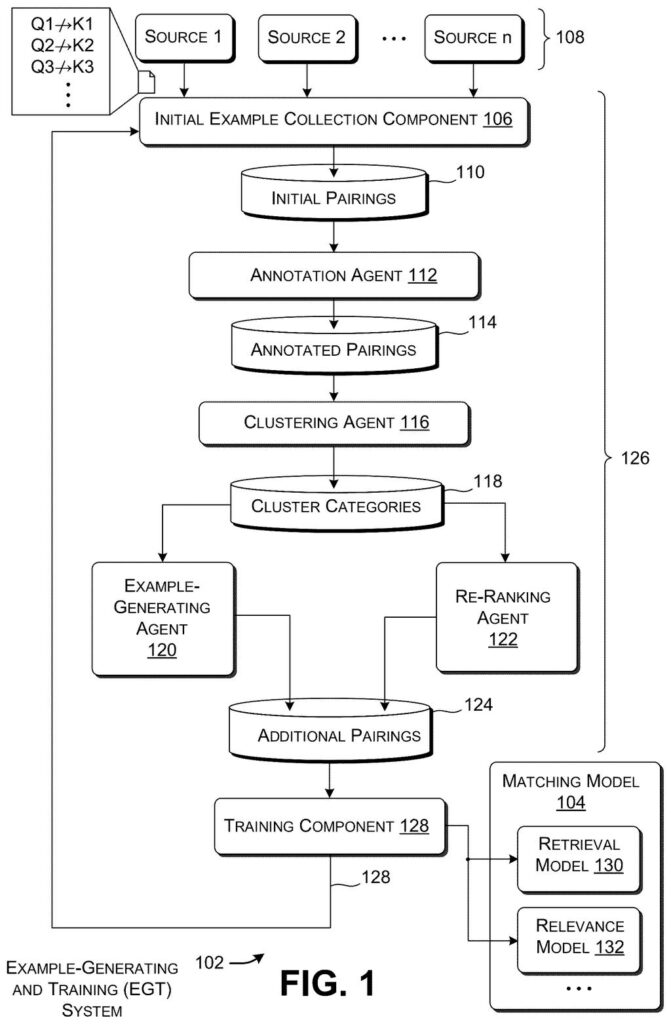
The filing covers a multi-step pipeline for retraining a matching model, the software that pairs a search query with advertiser keywords. It starts with real mistakes: query and keyword pairs that advertisers report as bad matches.
Three helper programs, which the filing says can be language models reached through standard software connections (APIs), then do the work:
- Annotation: writes a plain explanation for each bad pair, such as "the keyword is about a Bank of America card, while the query is about UMB bank."
- Clustering: groups the explained pairs into categories like brand mismatch or product mismatch. It works in batches of about 100, assigns each pair to categories with a confidence percentage, and merges categories that overlap, repeating until the groupings settle.
- Example generation: writes new bad pairs that fit each category. A separate re-ranking helper can also dig up matching mistakes from existing query logs. The filing says this can produce several million extra pairs.
Finally, the model is retrained with those pairs treated as hard negatives (wrong answers that look tempting, so they teach the most). The filing adds that the loop can repeat on a schedule, for example monthly. Its charts report better precision and fewer brand mismatches after training.
A technique for training a machine-trained matching model (“matching model”) includes a multi-stage process for generating training examples.
Translation: The patent outlines a step-by-step method to teach the search AI using its own mistakes.
Why wrong-product ads cost advertisers real money
The practical effect lands in search ads. If your searches get matched to the wrong brand or product, you see clutter that has nothing to do with what you wanted. Advertisers, meanwhile, pay for impressions nobody acts on. Fixing the matching model attacks both problems at once.
The bigger point is about effort. Collecting enough good examples to retrain a model is slow and expensive, and this filing describes automating much of that work, starting from a small set of human-reported errors. The same loop could in principle work wherever a model matches one thing to another, and the filing mentions document topics as one example.
Microsoft's 80th filing in the Language AI work we've tracked since May adds to a run that includes one on keeping layouts in rewrites and one on fact-checking before summaries.
Source: US 2026/0359712 A1 at the USPTO (PDF). Full patent text and figures are in the official publication.
Get our take in your Top Stories
Liked this breakdown? Add Patentlyze as a preferred source on Google, and our plain-English take shows up more often in your Top Stories the next time Microsoft patent news breaks.
Add Patentlyze on Google
One click.
There are more where this came from
We read every patent application Big Tech publishes and send you the ones worth knowing. Plain English, free, every week.
The drawings · 10 sheets
10 drawing sheets from US 2026/0359712 A1 · click any drawing to enlarge


Show the other 2 sheets


More from Microsoft
All 646 Microsoft patents →

More in AI / ML
All 2,637 AI / ML patents →
Salesforce
Salesforce Patents a Way to Automatically Grade and Kill Bad AI Search Results
Meta
Meta Patents a Search System That Matches Queries to Learning Goals Before Fetching Results
Google
Google Patents a Way to Train Search AI on Full User Sessions, Not Just Clicks
Google
No comments yet