
Microsoft
Microsoft · AI / ML · Filed May 19, 2025 · USPTO published Nov 19, 2026 · This week's release
A New Microsoft Patent Judges Whether You Watched a Video Long Enough to Count
Thirty seconds of watching can mean a lot or almost nothing, depending on how long the video is. Microsoft's patent builds a feed-ranking score around that simple fact.
- Publication number
- US 2026/0368535 A1(US20260368535A1)
- Applicant
- Microsoft Technology Licensing, LLC
- Filed · Published
- May 19, 2025 · Nov 19, 2026
- Inventors
- Arpita Vats, Ghulam Ahmed Ansari, Mohit Rajkumar Kothari, Fengyu Zhang
- Status when we published
- Waiting for an examiner
- Document
- 20 claims
- US classification
- 706/21
What Microsoft's long-watch score actually does
Every time you stop scrolling to watch a video, the feed has to guess what that pause means. Did you enjoy it, or did you just get stuck?
Microsoft's patent tackles one piece of that guess. Thirty seconds on a ten-second clip says something very different from thirty seconds on a ten-minute talk, so a single cutoff for "watched a long time" misleads the system. Instead, the filing sorts videos by length, looks at how long people usually watch videos like that one, and sets the bar at a high mark, such as the top 10 percent.
Those bars get refreshed as viewing habits change. A trained model then predicts whether you will clear the bar for a given video, and the feed uses that prediction to decide how high the video appears. The filing describes this inside a professional networking service with profiles, posts and job listings.
… a binary value for a long dwell metric, wherein the binary value is set to a first binary value when a dwell time for the video is greater than or equal to an adaptive threshold value and a second binary value when the dwell time for the video is less than the adaptive threshold value.
Translation: It decides with a simple yes or no whether you stayed on the video past a dynamically calculated time limit.
How the bar for a long view moves by length
The filing covers training a deep neural network (a layered prediction program) to guess whether a viewer will have a "long dwell" on a video. Dwell time just means how long you stay on something. Each training example pairs video details, including its length, with a viewer ID and a label of 1 or 0: did the viewer stay at least as long as an adaptive threshold?
The threshold is the distinctive part. The system sorts videos into length buckets (the filing's example runs from 1 to 10 seconds up to 600 plus) and calculates percentile marks of watch time for each combination of viewer type, content type and bucket. In one worked example, the 90th percentile mark is 60 seconds, so a view of 60 seconds or more is labeled 1. The marks are recalculated over a set time period.
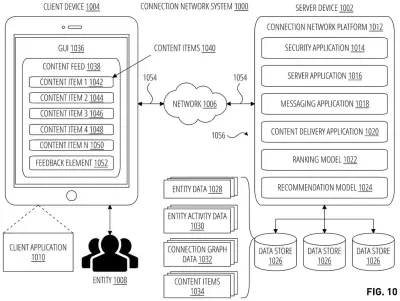
During training, the model's guess is compared with the real label, and the gap (called the loss) is used to adjust its internal settings, round after round. The filing says the model can be built from multi-gate mixture-of-experts parts, meaning several specialist sub-networks whose outputs are weighted by gates, so one model can predict likes, shares and watch time together.
Once trained, it takes a viewer ID plus video details, outputs the long dwell score, turns that into a ranking score, and shows the video in the feed accordingly.
What this means for short videos in your feed
For you, the effect would show up in what the feed puts first. If a platform judges every video against one fixed watch time, long videos win by default and short clips get pushed down. The filing says as much: a fixed cutoff can steer a model toward longer videos over short ones. A bar that adjusts by length aims to give a 20-second clip the same fair shot as a 10-minute one.
It also covers people who rarely like or comment. The filing points out that many users simply read and watch, so watch time is often the only signal available about them. Because the score feeds into ranking with an adjustable weight, the platform can turn up or down how much lingering counts next to likes and shares. The filing does not say what that weight would be.
This is the 11th Microsoft filing we've tracked in AI recommendation since May, joining one on a self-tuning social feed and one on a self-grading ad coach.
Source: US 2026/0368535 A1 at the USPTO (PDF). Full patent text and figures are in the official publication.
Get our take in your Top Stories
Liked this breakdown? Add Patentlyze as a preferred source on Google, and our plain-English take shows up more often in your Top Stories the next time Microsoft patent news breaks.
Add Patentlyze on Google
One click.
There are more where this came from
We read every patent application Big Tech publishes and send you the ones worth knowing. Plain English, free, every week.
The drawings · 11 sheets
11 drawing sheets from US 2026/0368535 A1 · click any drawing to enlarge


Show the other 3 sheets


More from Microsoft
All 681 Microsoft patents →
More in AI recommendation
All 91 AI recommendation patents →
Google
Google Files Patent for Ranking Which Data Actually Makes an AI Model Better
Google
Google Patents an AI System That Controls How Fast Your Content Feed Loads
Meta
Meta Files Patent for an AI Feed That Aggregates Rival Social Platforms
OpenAI
No comments yet