
Microsoft
Microsoft · AI / ML · Filed May 17, 2025 · USPTO published Nov 19, 2026 · This week's release
A New Microsoft Patent Teaches Your Social Feed to Tune Itself by Trial and Error
Microsoft's patent borrows from evolution: it randomly tweaks how much a feed values clicks, likes and shares, then keeps the versions that survive testing.
- Publication number
- US 2026/0368629 A1(US20260368629A1)
- Applicant
- Microsoft Technology Licensing, LLC
- Filed · Published
- May 17, 2025 · Nov 19, 2026
- Inventors
- Antonio G ALONSO, David GOLLAND, Mohit R KOTHARI, Ghulam Ahmed ANSARI
- Status when we published
- Waiting for an examiner
- Document
- 20 claims
- US classification
- 706/12
What Microsoft's self-tuning feed ranking does
Imagine your social feed has a mixing board behind it. One slider controls how much the feed cares about clicks, another about likes, others about comments, shares and how long you linger on a post. Someone has to decide where each slider sits, and today that is often done by hand, with limited precision.
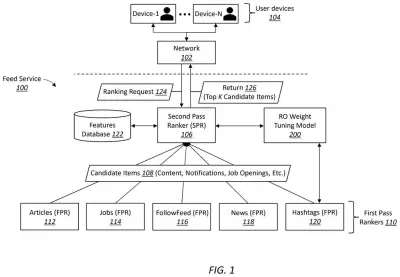
Microsoft's patent describes a way to let software do the adjusting. It nudges one slider by a small random amount, tests how the new mix would have ranked posts, and keeps the versions that score best. Then it repeats, over and over, a bit like breeding better and better recipes.
Two twists matter. Each slider gets its own limit on how far it can jump in one round, and the scoring corrects for the fact that rare actions like shares get drowned out by common ones like lingering.
A meta block encoder generates, at a first cadence decoupled from the request, a meta embedding of an entity-specific meta feature of the entity.
Translation: A background process constantly updates background profiles separate from your live requests.
How the patent mutates and scores feed weights
The claims cover a method for tuning a multi-objective model, meaning one that predicts several things at once, such as the chance you will click, like or comment on a post. Each prediction is multiplied by an importance weight, and those results add up to a post's final ranking score.
The system starts with a set of initial weights, then generates weight mutations: copies in which exactly one weight is raised or lowered by a random amount. That amount is capped by a non-global epsilon, which is a limit on how far a weight may drift per round (called a generation). The twist is that each objective learns its own cap, instead of every objective sharing one.
Every mutated version gets a fitness score, a measure of how well it would have ranked past content. The best one is selected and ramped, which means put into live use.
The dependent claims and description add more:
- Keeping the weights adding up to one while they change.
- Pushing positive goals (like shares) up and negative ones (like hides) down.
- Debiasing rewards with an inverse log rate, so rare actions count for more than common ones.
- Scoring each user session separately, plus one score for everything else.
The description also mentions other trial-and-error methods, such as genetic crossover and hill climbing, as variations.
Why a feed that adapts mid-visit matters to you
Every post you see was ranked by a score, and that score depends on how much importance the system gives each action: a click, a like, a comment, a share. Set those importances badly and your feed fills with whatever is easiest to measure, such as long posts that keep you lingering. The filing's fixes aim at that: lifting rarer actions like shares, and judging each sign-on separately so the feed can respond to what you are doing right now, like job hunting one week and networking the next.
For Microsoft, the filing describes a large feed service for a connections network, where the tuning step decides which ranking model goes live. It lists job postings, articles and connection suggestions as content. No product is named, and the patent describes a method, not a launch.
This is the tenth Microsoft filing in our AI recommendation coverage since May, joining an ad advice grader and a self-checking content filter.
Source: US 2026/0368629 A1 at the USPTO (PDF). Full patent text and figures are in the official publication.
Get our take in your Top Stories
Liked this breakdown? Add Patentlyze as a preferred source on Google, and our plain-English take shows up more often in your Top Stories the next time Microsoft patent news breaks.
Add Patentlyze on Google
One click.
There are more where this came from
We read every patent application Big Tech publishes and send you the ones worth knowing. Plain English, free, every week.
The drawings · 9 sheets
9 drawing sheets from US 2026/0368629 A1 · click any drawing to enlarge


Show the other 1 sheets

More from Microsoft
All 681 Microsoft patents →
More in AI recommendation
All 91 AI recommendation patents →
Meta
Meta Files Patent for an AI Feed That Aggregates Rival Social Platforms
Meta
Meta Patents a Shared Social Media Session That Merges Two Users' Feeds in Real Time
Google
Google Patents an AI System That Controls How Fast Your Content Feed Loads
Google
No comments yet