
Microsoft
Microsoft · Input & haptics · Filed May 14, 2025 · USPTO published Nov 19, 2026 · This week's release
Microsoft Patents a Touchpad That Learns Where Your Palm Likes to Rest
A laptop touchpad that watches where a touch begins, and how it moves, to decide whether it was your finger or your palm. Microsoft's patent application also has it learn your habits over time.
- Publication number
- US 2026/0367737 A1(US20260367737A1)
- Applicant
- Microsoft Technology Licensing, LLC
- Filed · Published
- May 14, 2025 · Nov 19, 2026
- Inventors
- Lior ZAGIEL, Roei Shlomo MENASHOF, Oren ISTRIN
- Status when we published
- Examiner raised objections; the company can respond
- Document
- 20 claims
- US classification
- 345/173
- Examiner
- LUBIT, RYAN A (Art Unit 2626)
What Microsoft's palm-rejecting touchpad does
Every time you type on a laptop, the base of your palm brushes the touchpad, and sometimes your cursor leaps somewhere you never meant in the middle of a sentence. The usual fix is a fixed rule about what counts as a palm. Some people simply switch the touchpad off while they type.
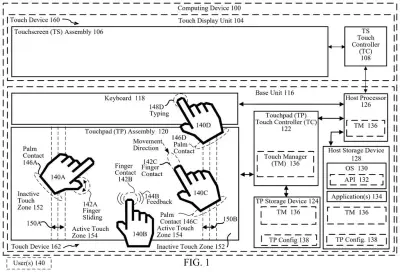
Microsoft's patent application describes a touchpad that treats the edges differently from the middle. A touch that starts in the middle is accepted quickly. A touch that starts near the edge gets a closer look over several moments before the touchpad decides whether it was a finger or a palm.
The edge zone also moves. Land a palm there and the zone widens. Use the middle with a finger and it shrinks back. Over time the touchpad learns your habits, such as resting a palm while your thumb moves the cursor.
… a determiner configured to determine a final classification of the touch event based at least on one of the first classification or the second classification.
Translation: It uses multiple classification steps to figure out what kind of touch just happened.
How the touchpad shifts its edge zones
The system treats every touch as a stream of frames, which are sensor snapshots taken about 100 times a second. For each frame it builds a small data record covering things like where the touch landed, its size, its pressure and how fast it is moving.
Two classifiers (software judges that label a touch as a finger or a palm) then weigh in. The first looks at a single frame, including where the touch began. The second looks at several frames in a row and can also use the first one's verdict. A determiner makes the final call. By default, the description has a touch that is at least 90% likely to be a finger accepted right away, while anything less certain waits for more frames.
The touchpad also keeps an edge band, an inactive zone, where touches get extra scrutiny. A touch that begins there and drifts toward the middle looks like a palm, according to the description. Confirm a palm and the zone grows. Confirm a finger and it shrinks back, giving you more usable surface.
Finally, an adapter learns from your habits, including when you undo something the touchpad got wrong. If you rest your palm while moving the cursor with your thumb, it can learn to accept that pattern faster and stop widening the edge zone.
Classification and zoning logic are customizable based on learned user behaviors, thereby improving touch classification and touch zone accuracy for user touch events.
Translation: The touchpad learns your habits over time to get better at ignoring your palms.
Why this matters for typing on your laptop
If you have ever watched your cursor jump mid-sentence, this is the problem being targeted. The filing says a fixed palm rule forces people to change how they hold their hands, or to switch the touchpad off while typing. A touchpad that adjusts to you could let you rest your hands naturally, and the description adds that ignoring false touches saves battery power.
Nothing here names a product, though the filing lists Microsoft Surface devices among the laptops it could run on. It is also early: the examiner's first review rejected the claims as filed, which is routine and usually followed by amendments, so the final scope could change.
This is the tenth Microsoft filing in input and haptics we've tracked since May, joining earlier work on a swappable thumbstick and tuning device vibrations.
Source: US 2026/0367737 A1 at the USPTO (PDF). Full patent text and figures are in the official publication.
Get our take in your Top Stories
Liked this breakdown? Add Patentlyze as a preferred source on Google, and our plain-English take shows up more often in your Top Stories the next time Microsoft patent news breaks.
Add Patentlyze on Google
One click.
There are more where this came from
We read every patent application Big Tech publishes and send you the ones worth knowing. Plain English, free, every week.
The drawings · 6 sheets
6 drawing sheets from US 2026/0367737 A1 · click any drawing to enlarge


More from Microsoft
All 681 Microsoft patents →
More in Hardware
All 2,355 Hardware patents →
Sony
Sony Patents a Pen-Shaped Device That Tugs Your Fingertip to Fake Weight in VR
Tesla
A New Tesla Patent Gives Robot Fingers Cables That Work Like Tendons
Apple
Apple Patents a Dial That Buzzes Harder as You Near a Setting's Limit
Apple
No comments yet