
Nvidia
Nvidia · Software · Filed Jul 27, 2026 · USPTO published Nov 19, 2026 · This week's release
Nvidia Files Patent for Building Talking Avatars Like a Flowchart
Nvidia has filed a patent application for building a talking avatar like a flowchart: drag boxes onto a canvas, draw arrows between them, and the avatar reacts to what visitors say, do or touch.
- Publication number
- US 2026/0367880 A1(US20260367880A1)
- Applicant
- NVIDIA Corporation
- Filed · Published
- Jul 27, 2026 · Nov 19, 2026
- Inventors
- Pascal Joël Bérard, Christian Eduard Schueller, Riccardo Roveri, Severin Klingler
- Status when we published
- Waiting for an examiner
- Document
- 20 claims
- US classification
- 717/105
- Parent application
- Continuation of 18/309,967 (filed May 1, 2023)(18309967)
What Nvidia's avatar flowchart builder does
Imagine you run a hotel and want a talking avatar on a lobby screen that greets guests, answers questions and helps them book a room. Today, building that usually means hiring programmers, because every new question or reaction has to be written in code.
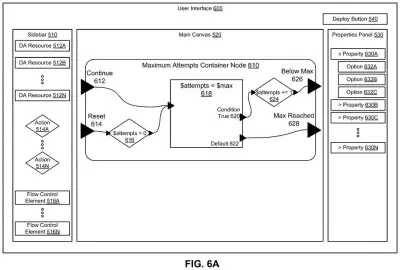
Nvidia's patent application describes a flowchart-style builder that cuts most of that out. You drag pre-made building blocks, such as "greet the visitor" or "ask a multiple-choice question," onto a canvas and draw arrows between them. Each arrow says "if this happens, go there next." The trigger can be something the visitor says, a wave in front of a camera, or a tap on a touchscreen.
When you press deploy, the whole flowchart is packaged into a program the avatar's screen can run. You design the conversation, and the software handles the code.
… generating a graph that defines an execution flow for the plurality of multi-modal digital avatar resources, the graph including: a plurality of nodes individually corresponding to a multi-modal digital avatar resource of the plurality of multi-modal digital avatar resources, and a plurality of directional edges connecting the plurality of nodes …
Translation: Creating a flowchart of connected steps that controls how the digital avatar behaves and responds.
How boxes and arrows steer an avatar's replies
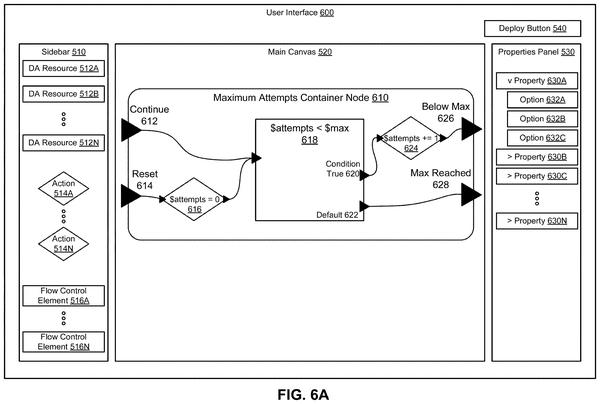
The filing describes a way to assemble a digital avatar's behavior as a graph, which is a set of boxes (called nodes) joined by one-way arrows (called directional edges). Each box is a resource: one episode of the conversation, such as greeting someone or asking a multiple-choice question.
Each arrow is a conditional transition. It fires only when a particular modal input event happens, meaning a signal from one of the avatar's senses. The filing lists three types:
- Audio events, like a person speaking into a microphone
- Motion events, like someone stepping in front of a camera
- Tactile events, like a touchscreen tap
Each box has an event handler (a small listener that waits for a chosen event and decides what to do). It can play a sound, animation, graphic or text, change a stored value, or hand control to another box. Branches of the flowchart can be active, sleeping (some listeners still on) or inactive (none listening). One example in the filing counts failed attempts and sends the avatar down a different path once a limit, such as 3 tries, is reached.
When the creator hits deploy, a compiler (a program that turns a design into runnable instructions) packages the boxes and the graph into one bundle for the device to run.
… a first directional edge associated with a transition of the execution flow from the first node to the second node conditioned on an event handler of the first node responding to an occurrence of the first modal input event …
Translation: Moving from one step in the flowchart to the next only after the avatar reacts to a specific user action.
What this means for businesses running avatars
If you have used a kiosk or website chat window that answers questions, this filing aims at making those easier and cheaper to build and change. The patent's own background says avatar creators usually have to team up with programmers for each new use. A visual builder with templates, such as the restaurant ordering or hotel reservation templates it mentions, could let a business adjust what an avatar says without a code change.
For Nvidia, the application describes a toolkit for people who build avatars on an avatar-building platform, and the description says the avatar's AI parts can run on GPUs, the company's core chips. It is a patent application, not a product, and nothing in it says when or whether anything will ship.
This is the 30th Nvidia filing we've tracked since May on text to 3D characters, building on earlier work like the lip sync fix and the single photo head avatar.
Source: US 2026/0367880 A1 at the USPTO (PDF). Full patent text and figures are in the official publication.
Get our take in your Top Stories
Liked this breakdown? Add Patentlyze as a preferred source on Google, and our plain-English take shows up more often in your Top Stories the next time Nvidia patent news breaks.
Add Patentlyze on Google
One click.
There are more where this came from
We read every patent application Big Tech publishes and send you the ones worth knowing. Plain English, free, every week.
The drawings · 22 sheets
22 drawing sheets from US 2026/0367880 A1 · click any drawing to enlarge


Show the other 14 sheets


More from Nvidia
All 665 Nvidia patents →
More in Software
All 814 Software patents →
Nvidia
Nvidia Patents an AI Method for Turning 3D Scans Into Usable Digital Models
Nvidia
Nvidia Files Patent for Turning One Photo Into a Moving 3D Head Avatar
Nvidia
Nvidia Files Patent to Make Animated Characters Change Mood Mid-Sentence
Nvidia
No comments yet