
Qualcomm Patents a System That Fills In Missing Details on Rough 3D Maps
Automated 3D models of the real world are often full of blurry, low-detail objects, think a smudged blob where a fire hydrant should be. Qualcomm's new patent describes a way to automatically look up what that object should look like and replace the rough version with something accurate.
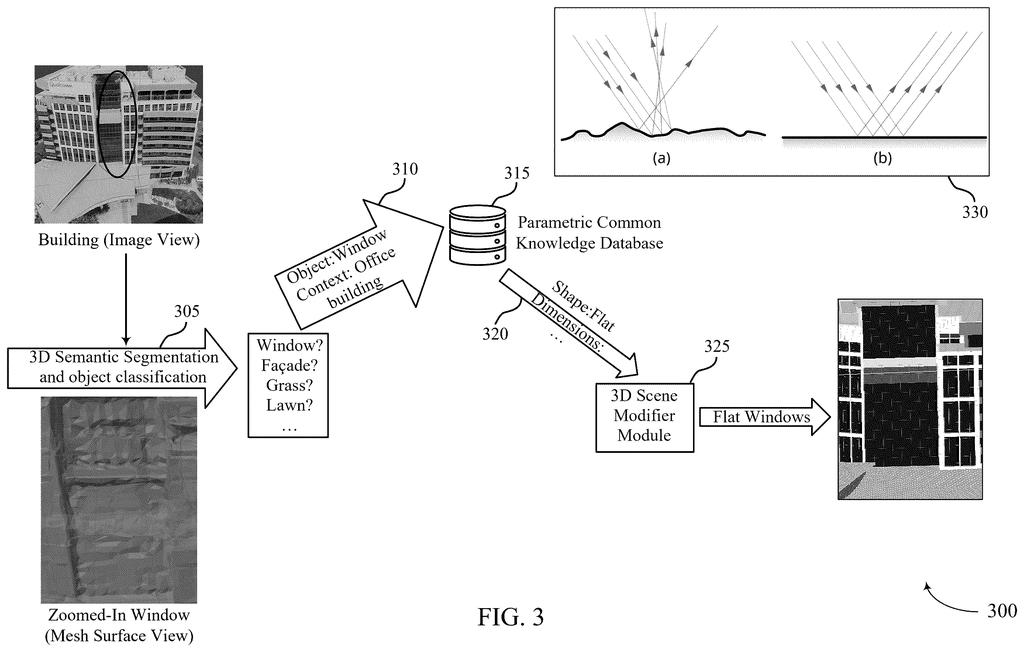
How Qualcomm's 3D model fix-up system actually works
Imagine you're looking at a 3D map of your neighborhood and everything looks like it was built out of clay, the trees are lumpy green blobs, the mailbox is just a blue rectangle. The system described in this patent would automatically notice those rough objects and look them up in a database of correctly shaped, properly sized real-world things, then swap in a much better version.
The key idea is using context. The system doesn't just recognize an object in isolation; it considers where that object is, what's around it, and what type of geographic area it belongs to. A bench in a park is different from a bench at a bus stop, and the system uses that surrounding information to pick the right replacement from its library.
For Qualcomm, which makes chips for phones, cars, and AR headsets, this kind of technology could sit inside a device and improve 3D scenes in real time without needing a trip to a remote server.
… generate, in accordance with the context and scene information, an updated model of the first three-dimensional object, wherein the updated model of the first three-dimensional object comprises one or more first parameters associated with physical properties of the first three-dimensional object that are modified …
Translation: The system updates a 3D object's physical properties based on surrounding context.
How the parametric database patches incomplete 3D objects
The patent describes a pipeline with three main steps.
- Extract context: The system starts with an existing 3D scene, which might come from a camera scan, a lidar sensor, or a mapping service. It pulls out information about a specific object, what type of thing it appears to be, where it sits in the scene, and what surrounds it (a street, a park, another building).
- Query a parametric database: A parametric database is essentially a library of object templates, each described by adjustable measurements, height, width, material reflectivity, color. Using the context gathered in step one, the system searches that library for the best-matching template and retrieves its precise physical properties.
- Rebuild the object: The rough object in the original model is replaced with an updated version whose parameters (shape, size, surface detail) now match what the database says that object should look like in that specific setting.
The result is a higher-quality 3D scene where objects that were vague or poorly captured get replaced with accurate, detailed stand-ins. The patent specifies that the scene can include a geographic area as context, which suggests the system is designed for city-scale or outdoor mapping scenarios, not just indoor room scanning.
Critically, the processing is described as happening on-device, meaning it could run on Qualcomm's own chips rather than requiring cloud connectivity.
… obtain, from an original model of the scene, context and scene information associated with a first 2D object included in the scene.
Translation: It starts by gathering context about a basic object found within the original scene.
What this means for mapping and augmented reality
For anyone using augmented reality, autonomous driving software, or urban digital-twin tools (virtual replicas of real cities used for planning and simulation), the quality of 3D models is a constant bottleneck. Capturing perfect geometry for every fire hydrant, bench, and lamppost in a city is expensive and time-consuming. A system that automatically upgrades rough objects using a reference library could cut that cost significantly and make high-quality 3D environments more practical to build and maintain.
Qualcomm sits in an interesting position here because it supplies chips for AR headsets, smartphones, and car computers, all platforms that need real-time 3D scene understanding. This patent suggests the company is thinking about how to make that processing faster and more accurate at the chip level, not just in the cloud. Coverage of this and similar AR and chip-level processing filings is part of what Big Tech patent news from companies like Qualcomm tracks as the race for on-device spatial computing heats up.
That makes this Qualcomm's 28th filing we've tracked since July in the self-driving sensing race, joining one using a 3D graphics trick and one fixing mismatched cameras.
The core idea here is simple enough: when a phone or headset builds a 3D map of a scene, it looks up a reference library to fill in details that its camera missed or got wrong. No new chip is required, which means this could arrive as a software update or a developer tool running on hardware that already exists.
What has to exist first is the hard part. The library of real-world object templates this system depends on would need to be large, accurate, and compact enough to live on a device rather than a distant server, and building that library is its own years-long project.
The shortest path to a product is probably inside professional mapping or augmented reality development tools, not a consumer feature anyone would notice by name. That makes it useful as infrastructure, but only once the surrounding pieces are already in place.
Get our take in your Top Stories
Liked this breakdown? Add Patentlyze as a preferred source on Google, and our plain-English take shows up more often in your Top Stories the next time Qualcomm patent news breaks.
There are more where this came from
We read every patent application Big Tech publishes and send you the ones worth knowing. Plain English, free, every week.
The drawings
11 drawing sheets from US 2026/0253355 A1 · click any drawing to enlarge


Want this weekly breakdown for a company we don't cover? Patentlyze Pro →
Be the first to weigh in