
Qualcomm
Qualcomm · Display · Filed Mar 31, 2025 · USPTO published Nov 19, 2026 · This week's release
Qualcomm Patents a Hardware Fix for Graphics That Sharpen Only Where You Look
Qualcomm has filed to move a clunky graphics chore out of software and into the chip: correcting pixel positions when a scene is drawn sharp only where you look.
- Publication number
- US 2026/0368843 A1(US20260368843A1)
- Applicant
- QUALCOMM Incorporated
- Filed · Published
- Mar 31, 2025 · Nov 19, 2026
- Inventors
- Maxime DESCOS, Brian ELLIS
- Status when we published
- Examiner raised objections; the company can respond
- Document
- 20 claims
- US classification
- 345/501
- Examiner
- PARK, HYORIM NMN (Art Unit 2615)
What Qualcomm's foveated patching actually fixes
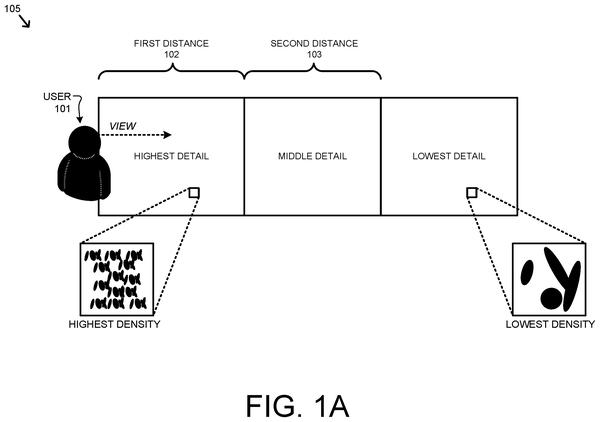
A VR headset draws a sharp picture right where your eyes are pointing and a rougher one everywhere else, because you can't see fine detail out in the corners anyway. That shortcut, called foveated rendering, saves the chip a lot of work. It also creates a bookkeeping headache.
When the chip shrinks part of a scene, the position of each small patch of pixels no longer matches what the app expects, because app code assumes it is working on the full-size picture. Today, the graphics driver (the software that sits between an app and the chip) rewrites those positions. The filing calls that chore tedious and fragile.
Qualcomm's patent has the graphics chip do the correction itself, in hardware, using a few stored numbers for each section of the screen. You would never see it happen. You would just get the shortcut with less software scaffolding behind it.
… adjust, at a graphics processor and based on the resolution scale and the set of offsets, a set of initial coordinates of the fragment to obtain a set of patched coordinates of the fragment; …
Translation: The graphics chip changes the image positions using scale and offset data.
How the render backend rewrites pixel positions
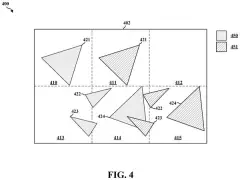
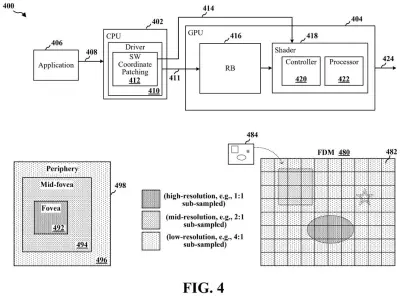
The claims cover three steps on a graphics processor. For a fragment (a small patch of pixels), it obtains a resolution scale and a set of offsets tied to foveation. It then adjusts the fragment's original coordinates using those numbers to produce "patched" coordinates, and outputs an indication of them.
The filing describes the inputs in a bit more detail:
- Resolution scale: full resolution, downscaled by two, or downscaled by four.
- Offsets: location shifts for the fragment, plus an offset drawn from a fragment density map (a map from the app saying which screen areas get how much detail).
- Per-view offsets: separate values for each viewpoint, such as the left and right eye.
In the described design, the screen is split into bins (tiles drawn one at a time). Each bin has its own hardware registers (small built-in storage slots) in the render backend, the part of the GPU that writes out final pixel colors. The filing's formula subtracts the fragment's offset from its coordinates, multiplies by the scale factor, then subtracts the density-map offset to get full-size coordinates.
The result goes to the shader (the part that handles lighting, color and texture) or is saved in memory. The example registers cover up to six views, and the filing says the idea extends beyond two dimensions.
A graphics processor may obtain, for a fragment of image data, a resolution scale and a set of offsets associated with foveation.
Translation: The system reads scaling and offset details for each piece of the image.
What Qualcomm's chip-level fix means for headsets
Foveated rendering matters most on devices with tight power and performance limits, such as headsets and phones, both of which the filing lists. If the chip corrects positions itself, a driver no longer has to patch app code behind the scenes, and the chip's maker has less delicate software to keep working.
The filing also says the old method widens the safety and security surface (more driver code that could go wrong) and slows things down. For you, the best case is graphics that run with less overhead, though the filing gives no figures. The examiner's first review rejected the claims as filed, which is routine and usually followed by amendments.
This is the 19th Qualcomm filing we've tracked since July in the GPU rendering race, building on one on prefetching data and one on reshuffling data mid-load.
Source: US 2026/0368843 A1 at the USPTO (PDF). Full patent text and figures are in the official publication.
Get our take in your Top Stories
Liked this breakdown? Add Patentlyze as a preferred source on Google, and our plain-English take shows up more often in your Top Stories the next time Qualcomm patent news breaks.
Add Patentlyze on Google
One click.
There are more where this came from
We read every patent application Big Tech publishes and send you the ones worth knowing. Plain English, free, every week.
The drawings · 8 sheets
8 drawing sheets from US 2026/0368843 A1 · click any drawing to enlarge


More from Qualcomm
All 637 Qualcomm patents →
More in Display
All 741 Display patents →
Intel
Intel Patents a GPU Memory System That Fetches Only the Texture Tiles a Scene Actually Needs
Intel
Intel Patents a Technique to Smooth Rough Edges on 3D Graphics Lines
Nvidia
Nvidia Patents a Parallel Processing Approach for 360-Degree Image Math
Nvidia
No comments yet