
Qualcomm
Qualcomm · Wearable · Filed May 14, 2025 · USPTO published Nov 19, 2026 · This week's release
Qualcomm Patents Earbuds That Warm Your Ears in Cold Weather
Your earbuds could come with a built-in heater for your ears. Qualcomm's patent application describes sensors that switch on warmth when your ear gets cold, plus a warning if your body temperature drops too far.
- Publication number
- US 2026/0370996 A1(US20260370996A1)
- Applicant
- QUALCOMM Incorporated
- Filed · Published
- May 14, 2025 · Nov 19, 2026
- Inventors
- Guruprasad KAMBAPPA SHANMUKAPPA, Sourabh MALI, Jothi Prakash VAIRAKANI, Parthasarathy GOVINDASAMY
- Status when we published
- Examiner raised objections; the company can respond
- Document
- 20 claims
- US classification
- 381/55
- Examiner
- MOONEY, JAMES K (Art Unit 2695)
What Qualcomm's heated earbud patent does
Ever had your ears go numb on a freezing walk to work, with earbuds in that felt like tiny ice cubes? Qualcomm's patent application goes after that problem by building a heater into the earbud or headphone itself.
One temperature sensor checks how warm your ear is, and a second one checks the air outside. If your ear is running cold, a thin heating layer switches on and warms the part touching you. If you're already comfortable, or it's warm indoors, the heater stays off to save battery.
There's a safety side too. If your temperature sinks toward a level that could signal hypothermia, the device can speak up and tell you to find warmth. And if the gadget itself gets too hot, it cuts the heat.
a first temperature sensor configured to generate first sensor data that indicates a first temperature associated with an ear of a user …
Translation: A sensor measures how cold your ear is.
How the earbud decides when to turn on heat
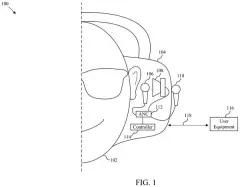
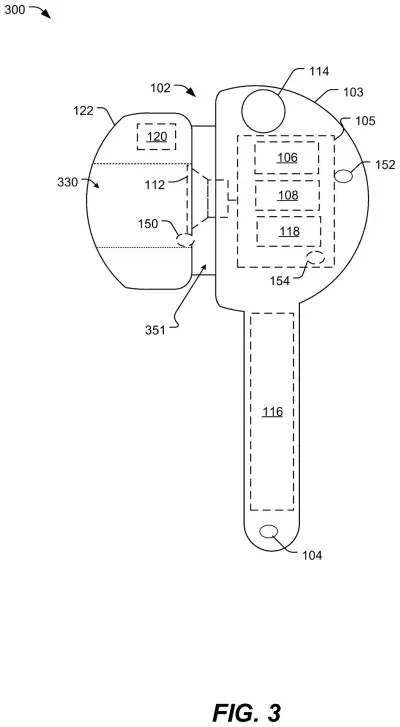
The core of the claims is simple: a temperature sensor reads the temperature near your ear, a heating element makes heat, and a processor compares the reading to a threshold and decides whether to turn the heat up, down or off.
The filing describes several versions of the parts. The ear sensor can be an infrared sensor (a sensor that reads heat without touching) aimed at the ear canal. A second sensor, a thermistor (a small part whose electrical resistance changes with temperature), reads the outside air. The heater can be graphene or carbon fiber, built into the housing, an in-ear tip, or the padding of an over-ear cup. Power is adjusted with pulse width modulation (switching current on and off very fast to control how much heat comes out).
The filing gives examples:
- At -5 °C (23 °F) outside with a normal ear reading of 36.5 °C, it warms the earbud to about 38 °C.
- Indoors at 18 °C with a normal reading, the heater stays off to save power.
- If the device itself reaches around 40 °C, power to the heater is cut or reduced.
- At -10 °C with an ear reading of 34.8 °C, it heats and sends a hypothermia alert.
A moisture sensor can trigger heat when condensation builds up inside, and a battery sensor can shut the heater off when power runs low.
… control the heat element based on a result of a comparison associated with the first temperature and a threshold …
Translation: The device turns on the heater when the temperature drops too low.
What heated ear gear means for winter users
If this ever shipped in a product, the pitch is easy to picture: earbuds, over-ear headphones or hearing aids that stay comfortable on a winter commute, a run or an outdoor job. The filing also says gentle warmth could cut down earwax buildup, which it describes as common in cold weather. The hypothermia alert turns a comfort feature into a basic safety feature for you.
The filing lists earbuds, hearing aids, headsets and AR and VR headsets as possible homes, with a phone or smartwatch as a companion. It is still an application: the examiner's first review rejected the claims as filed, which is routine at this stage and usually followed by amendments, so nothing here is approved.
This is the 11th Qualcomm filing in our wearable tech coverage we've tracked since July, joining earlier applications like one guiding you to your car and one silencing earbud mics.
Source: US 2026/0370996 A1 at the USPTO (PDF). Full patent text and figures are in the official publication.
Get our take in your Top Stories
Liked this breakdown? Add Patentlyze as a preferred source on Google, and our plain-English take shows up more often in your Top Stories the next time Qualcomm patent news breaks.
Add Patentlyze on Google
One click.
There are more where this came from
We read every patent application Big Tech publishes and send you the ones worth knowing. Plain English, free, every week.
The drawings · 9 sheets
9 drawing sheets from US 2026/0370996 A1 · click any drawing to enlarge


Show the other 1 sheets

More from Qualcomm
All 637 Qualcomm patents →


More in Hardware
All 2,355 Hardware patents →
Samsung
A New Samsung Patent Turns Smart Rings Into a Stylus for Phone Drawing

Samsung
Samsung Patents a Fix for Watches That Misread Altitude When You Flip Your Wrist
Apple
Apple Files Patent for a Watch Where the Glass Curves Into the Case

Samsung
No comments yet