
Roborock
Roborock · Robotics · Filed Jul 3, 2025 · USPTO published Nov 19, 2026 · This week's release
Roborock Patents a Robot Vacuum That Notices When You Pick It Up or Push It
Pick up a robot vacuum and set it down somewhere else, and it can lose track of where it is. Roborock's patent application gives it a way to notice, by checking its angle against its own wheel counts.
- Publication number
- US 2026/0367633 A1(US20260367633A1)
- Applicant
- Beijing Roborock Innovation Technology Co., Ltd.
- Filed · Published
- Jul 3, 2025 · Nov 19, 2026
- Inventors
- Yansheng Niu
- Status when we published
- Examiner raised objections; the company can respond
- Document
- 15 claims
- US classification
- 701/70
- Examiner
- MARC, MCDIEUNEL (Art Unit 3656)
- Parent application
- National Stage Entry of PCT/CN2023/138444 (filed Dec 13, 2023)(PCTCN2023138444)
What Roborock's moved-robot detector actually does
Every time you pick up a robot vacuum and set it down in another room, the robot faces a problem. Its map says it is in the kitchen, but it is now by the front door. Roborock's filing says a sudden move like a carry, a push or a kick is something robots can't effectively detect today, and it throws off their sense of where they are.
The patent's fix is a sanity check. The robot knows how far each wheel has turned, so it can work out how much it should have turned. If its sensors report an angle change outside that expected range, something outside the robot moved it.
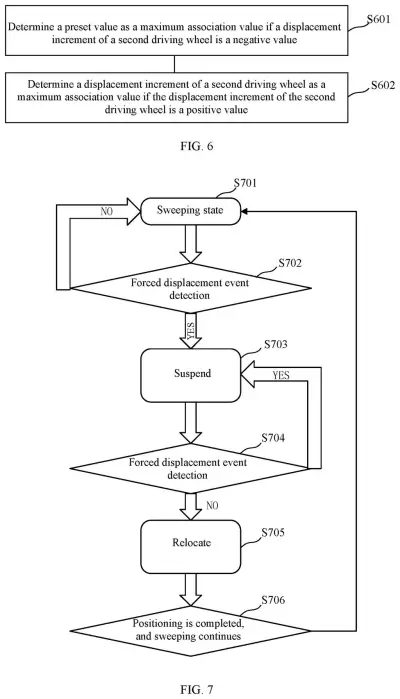
When that happens, the robot stops cleaning, waits to see whether it is being handled again, then scans the room, matches what it sees against its saved map, and picks up where it left off.
… determining an inclination angle change range of the robot when the robot is not affected by an external force according to displacement increments of the two driving wheels and a distance between the two driving wheels …
Translation: It calculates what normal tilting looks like based on how much the wheels turn.
How wheel counts reveal a robot was carried
Claim 1 covers a three-step check for a robot with at least two driving wheels:
- Measure how much the robot's angle changes while it moves.
- Predict the angle change that wheel motion alone could explain, using how far each wheel traveled (read by an odometer, a wheel-travel counter) and the spacing between the wheels.
- Compare the two. A measured change outside the predicted range means the robot was forcibly displaced.
The predicted range has a lower and an upper bound. Forward wheel travel counts as positive and backward travel as negative. Each bound mixes one wheel's travel with the other's, divided by the wheel spacing. Wheel slip is built in: a slipping wheel is allowed to count for anywhere between its full travel and a preset value, set at 0 in the description.
In the filing's example, both wheels log 2, the wheels sit 23.9 cm apart, and the predicted range is about -4.79 to 4.79 degrees. The measured change is 11 degrees, so the robot is flagged. That angle can come from a gyroscope (a rotation sensor), a millimeter-wave radar, or camera frames.
After a flag, the description has the robot pause its job and wait a preset time (1 minute in one example). It then scans the room and matches the scan to its saved map before resuming.
… when the tilt angle variation is beyond the tilt angle variation range, determining that the robot is forcibly displaced …
Translation: If the robot tilts more than expected, it knows someone is picking it up or pushing it.
Why a robot vacuum needs to know it was moved
If you carry a robot vacuum to another room mid-job, the filing says its sense of its own position gets thrown off and its work suffers. Catching the move lets the robot stop, re-check its saved map and carry on, so you spend less time rescuing a confused cleaner.
The cost angle is the selling point. The filing says it uses standard readings, such as a gyroscope angle and wheel odometers, so no new sensor is needed and the math stays light. One caution: the examiner's first review rejected the claims as filed, which is routine at this stage and usually followed by amendments, and the application has not been granted.
Source: US 2026/0367633 A1 at the USPTO (PDF). Full patent text and figures are in the official publication.
Get our take in your Top Stories
Liked this breakdown? Add Patentlyze as a preferred source on Google, and our plain-English take shows up more often in your Top Stories the next time Roborock patent news breaks.
Add Patentlyze on Google
One click.
There are more where this came from
We read the new patents from Big Tech, carmakers and more and send you the ones worth knowing. Plain English, free, every week.
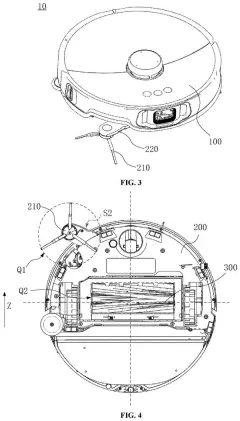
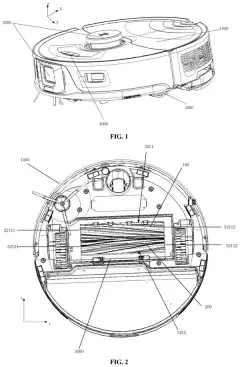
The drawings · 4 sheets
4 drawing sheets from US 2026/0367633 A1 · click any drawing to enlarge


More from Roborock
All 7 Roborock patents →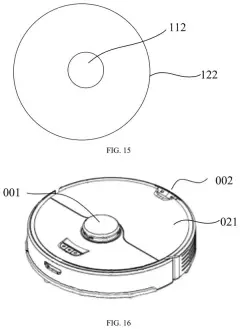
More in Gear
All 26 Gear patents →
Roborock
Roborock Patents a Robot Mop Cloth With Zones That Shake Loose Stubborn Stains
Google
Google Patents a Robot Planner That Checks the Room Before Each Step
Samsung
Samsung Patents a Robot Vacuum Mop That Springs Back After Hitting Furniture
SharkNinja
No comments yet