
Roborock
Roborock · Robotics · Filed Jul 3, 2025 · USPTO published Nov 19, 2026 · This week's release
Roborock Patents a Robot Mop Cloth With Zones That Shake Loose Stubborn Stains
Roborock's new filing treats a mop cloth like a small team: one zone shakes loose the stubborn stains, a second goes back over the spot, and a still section wipes up the mess.
- Publication number
- US 2026/0363515 A1(US20260363515A1)
- Applicant
- Beijing Roborock Technology Co., Ltd.
- Filed · Published
- Jul 3, 2025 · Nov 19, 2026
- Inventors
- Lidong Zhao, Caiyun Hu
- Status when we published
- Waiting for an examiner
- Document
- 18 claims
- US classification
- 15/98
- Parent application
- National Stage Entry of PCT/CN2023/140729 (filed Dec 21, 2023)(PCTCN2023140729)
What Roborock's two-zone mop cloth does
Every time your robot mop rolls over a dried-on spill, it has to do two jobs: loosen the gunk, then soak up the mess. Most mop pads handle that as a single job. This Roborock filing splits the pad into zones so each job gets its own part of the cloth.
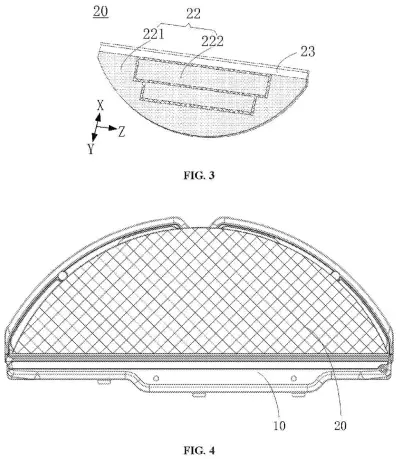
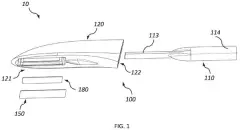
The cloth in the patent is one piece of fabric with a fixed area that stays put and several movable areas that sit over small plates shaking back and forth. In one version, the front zone is bigger and does the rough work of breaking up stubborn stains. A smaller zone behind it goes over the same spot again. The still part at the back then wipes up the loosened dirt and the cleaning water.
The cloth also attaches with separate hook-and-loop patches, so the shaking parts don't tug on the still part.
a cleaning layer, comprising a fixed area and a plurality of movable areas, wherein the plurality of movable areas are distributed in a front-rear direction of the cleaning device.
Translation: The pad is divided into stationary parts and multiple moving sections lined up from front to back.
How the cloth splits scrubbing from wiping
The patent covers a cleaning cloth for a robot that has a vibration cleaning function, meaning small plates under the cloth shuttle back and forth at high frequency. The cloth is one piece, but its cleaning layer is divided into a fixed area and a plurality of movable areas (zones that sit over the vibrating plates) lined up in the front-to-back direction of the robot. A second independent claim covers the robot itself: a wiping assembly with a fixing plate and several vibration plates, with each movable zone sitting on its own plate.
The description explains how the zones are meant to share the work:
- In one version, the front movable zone is larger and acts as a "disintegration area" for stubborn stains.
- A smaller rear movable zone keeps going as a "consolidation area" with targeted vibration wiping.
- The fixed area behind them soaks up the loosened dirt along with the cleaning solution.
For attachment, the adhesive layer is split into separate parts: one for the fixed area and one for each movable area, so the shaking zones don't interfere with the still one. The filing says these can be hook-and-loop fastener surfaces. The cleaning layer is a blend of polyester and chinlon (a nylon-type fiber) at a mass ratio of 7:2 to 7:4, chosen to hold more water. A guide strip on one edge keeps the soft cloth from wrinkling.
Why a cloth change matters for robot mops
If you own a robot mop, you know the pad matters nearly as much as the robot. This filing treats the cloth as part of the cleaning system, with zones matched to the plates underneath, so the vibration goes where the scrubbing is meant to happen. The filing says splitting the work this way improves cleaning, though it gives no test numbers.
There is a practical side too. Because the cloth attaches with hook-and-loop patches, you can swap it for a clean one, and when the layers are stitched together, the adhesive layer can be reused after the cloth wears out. The description lists mopping robots, robot vacuums and window-cleaning robots as possible hosts.
Roborock's third filing we've tracked in our home tech coverage since November follows one on a compact spinning mirror and one on detecting lifts and pushes.
Source: US 2026/0363515 A1 at the USPTO (PDF). Full patent text and figures are in the official publication.
Get our take in your Top Stories
Liked this breakdown? Add Patentlyze as a preferred source on Google, and our plain-English take shows up more often in your Top Stories the next time Roborock patent news breaks.
Add Patentlyze on Google
One click.
There are more where this came from
We read the new patents from Big Tech, carmakers and more and send you the ones worth knowing. Plain English, free, every week.
The drawings · 7 sheets
7 drawing sheets from US 2026/0363515 A1 · click any drawing to enlarge


More from Roborock
All 7 Roborock patents →
More in Gear
All 26 Gear patents →
Roborock
Roborock Patents a Robot Vacuum With a Hard Front Brush and a Soft Rear One
Samsung
Samsung Patents a Robot Mop That Drops Its Own Dirty Cloth
Lutron
Lutron Files Patent for a Wall Keypad With Separate Setup Buttons
Philips Hue
No comments yet