
Roborock
Roborock · Robotics · Filed Jun 27, 2025 · USPTO published Nov 19, 2026 · This week's release
Roborock Files Patent for a Robot Mop That Shakes Several Cleaning Pads at Once
Roborock's patent swaps one shaking mop pad for several linked plates that all scrub together, driven by a single back-and-forth rod.
- Publication number
- US 2026/0363509 A1(US20260363509A1)
- Applicant
- Beijing Roborock Technology Co., Ltd.
- Filed · Published
- Jun 27, 2025 · Nov 19, 2026
- Inventors
- Pan CHENG
- Status when we published
- Waiting for an examiner
- Document
- 15 claims
- US classification
- 15/21.1
- Parent application
- National Stage Entry of PCT/CN2023/140744 (filed Dec 21, 2023)(PCTCN2023140744)
What Roborock's multi-plate mop actually does
A robot mop rolls across your kitchen floor, dragging a damp cloth over a dried coffee ring. If the cloth only covers a small patch, stubborn spots can take several passes. Roborock's filing says existing cleaning robots have low cleaning efficiency, and its answer is to make more of the mop move.
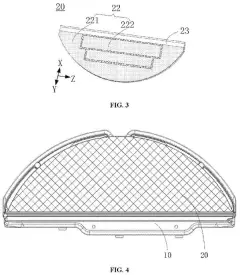
Instead of one shaking pad, the design uses two or more flat plates side by side, each carrying a cloth. Small rods link the plates, so when a drive rod shakes one of them, the others move along with it. The plates slide back and forth quickly, a bit like scrubbing a counter with both hands at once.
In one version, neighboring plates slide in opposite directions, which cancels out some of the side-to-side shaking so the machine stays steadier. In another, all the plates move the same way together.
… a connecting rod is disposed between two adjacent vibration plates, the two adjacent vibration plates are capable of moving synchronously through the connecting rod …
Translation: A linking bar connects neighboring cleaning plates so they move together in sync.
How one rod shakes several mop plates at once
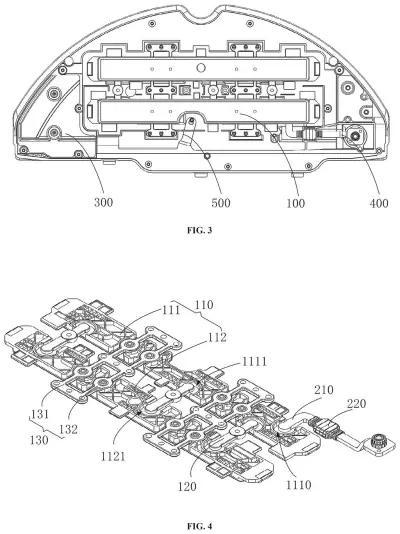
The claim covers a wiping mechanism with two main parts. The first is a set of two or more flat vibration plates (the pieces that hold the cleaning cloths), with a small connecting rod between each neighboring pair so they move together. The second is a vibration assembly: a vibration device (the description says it may be a motor) plus a drive rod that slides back and forth in a set direction. That rod pushes on a connecting part, such as a groove, on one plate, and the linked plates follow.
The filing describes two layouts:
- Opposite directions: a connecting rod pivots on a small shaft fixed to a bottom plate. When one plate slides one way, the rod swings and pushes the other plate the opposite way, which balances the left and right forces. Because there is a small gap around the rod ends, the second plate lags a hair behind the first.
- Same direction: the rods are fixed to both plates, so they move in lockstep with no delay.
The description also adds some extras. Springy reset arms pull the plates back to their starting spot and speed up each stroke as they spring back. Hook-and-loop fasteners hold the cloths in place, and water nozzles can wet the cloths or feed them cleaning solution. A rubber sleeve on the drive rod reduces jitter.
The shaking speed can also change with the floor. On even ground the robot can shake slower and use less water. On uneven ground it can shake faster and use more water.
The vibration assembly includes a vibration device and a vibration connecting rod. One end of the vibration connecting rod is connected to the vibration device, and the other end of the vibration connecting rod is in a transmissive connection with the connecting part.
Translation: A motor drives a connecting rod to power the shaking motion of the plates.
What this means for your robot mop's scrubbing
If you own a mopping robot, the part that matters is how much floor the cloth actually works on. Roborock's design spreads the shaking across several plates, so more of the mop surface scrubs at the same moment. The filing says this increases the vibration area and improves cleaning efficiency and effect, though it gives no test numbers.
The idea is not tied to one product type. The description says it could go in a mopping or scrubbing robot, a robot vacuum, or a window cleaning robot. It also mentions a quick-release fit, which would make the mop module easier to remove and fix. It is a filing for a part, so you should not read it as a sign of any particular upcoming Roborock model.
Roborock's sixth filing in the home tech work we've tracked since November adds to a run that includes a brush cover latch design and a swinging side brush.
Source: US 2026/0363509 A1 at the USPTO (PDF). Full patent text and figures are in the official publication.
Get our take in your Top Stories
Liked this breakdown? Add Patentlyze as a preferred source on Google, and our plain-English take shows up more often in your Top Stories the next time Roborock patent news breaks.
Add Patentlyze on Google
One click.
There are more where this came from
We read the new patents from Big Tech, carmakers and more and send you the ones worth knowing. Plain English, free, every week.
The drawings · 6 sheets
6 drawing sheets from US 2026/0363509 A1 · click any drawing to enlarge


More from Roborock
All 7 Roborock patents →
More in Gear
All 26 Gear patents →
Roborock
Roborock Patents a Robot Vacuum With a Hard Front Brush and a Soft Rear One
Samsung
Samsung Patents a Robot Mop That Drops Its Own Dirty Cloth
Samsung
Samsung Files Patent to Start Heating Mop Water Before the Robot Gets Home
Samsung
No comments yet