
Roborock
Roborock · Robotics · Filed Jun 27, 2025 · USPTO published Nov 19, 2026 · This week's release
Roborock Patents a Robot Vacuum With a Hard Front Brush and a Soft Rear One
Roborock's robot vacuum patent gives its two brushes opposite jobs: a rigid one up front to knock dust out of carpet, and a spongy-cored one behind to roll it up.
- Publication number
- US 2026/0363504 A1(US20260363504A1)
- Applicant
- Beijing Roborock Technology Co., Ltd.
- Filed · Published
- Jun 27, 2025 · Nov 19, 2026
- Inventors
- Pan CHENG, Ming LIU, Xiang LIN
- Status when we published
- Waiting for an examiner
- Document
- 19 claims
- US classification
- 15/3
- Parent application
- National Stage Entry of PCT/CN2023/115332 (filed Aug 28, 2023)(PCTCN2023115332)
What Roborock's two-brush robot vacuum does
Every time your robot vacuum rolls from the kitchen tile onto the living room rug, it faces two very different jobs. Dust on tile is easy to sweep up, but dust buried in carpet has to be shaken loose first.
Roborock's patent application splits the work between two brushes. The front brush has a hard core, so it hits the floor firmly and knocks stubborn dust, paper scraps and sticky bits free. The brush behind it has a soft, springy core that rolls the loosened debris up and guides it toward an air opening that leads to the dust bin.
The filing says many two-brush vacuums use two soft brushes, which are costly to make and lose their shape over time. Roborock's mix aims for strong cleaning, durability and lower cost in the same machine.
a first roller brush arranged in a first direction, wherein the first roller brush comprises a first filler arranged in an axial direction of the first roller brush, and the first filler is an elastic member …
Translation: The first brush features a flexible internal core that can bend or compress.
How the hard brush and soft brush share a duct
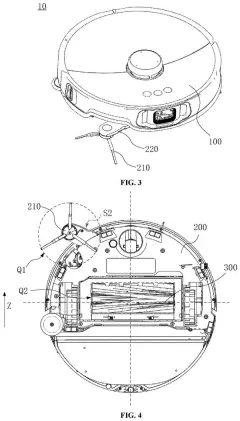
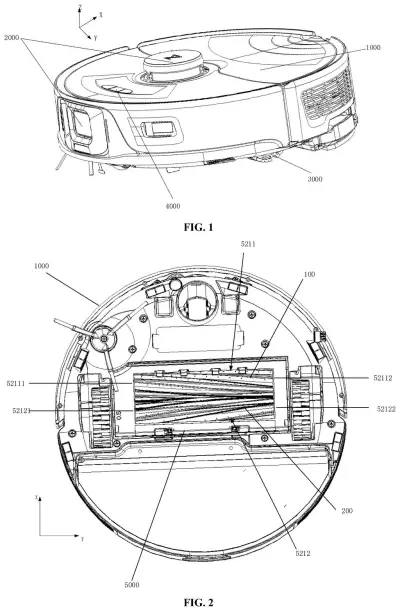
The claims cover a cleaning module with two roller brushes lying side by side across the width of the machine. The rear brush has an elastic filler (a compressible core, like sponge or foam, that squeezes under pressure and springs back). The front brush has a rigid shaft component (a hard core, such as plastic or metal, that does not squash). Debris meets the hard brush first, then the soft one.
Between the two brushes sits an opening to an air duct (the passage fan suction uses to pull debris into the dust box, and to pull it back out during a dust-collecting task). The filing describes several ways to place that opening and set the brush heights:
- The opening's front edge sits just behind the front brush's centerline, no farther back than that brush's rear edge.
- The opening faces the soft brush, which covers more of the opening than the hard one.
- The hard brush rides higher than the soft one to cut tapping noise on hard floors, or lower for long-pile carpet, with softer bristles to keep noise down.
The two brushes spin in opposite directions at the same speed, and their bristles overlap in the middle. That forms a moving, diamond-shaped pocket of air that gathers debris toward the opening. Spiral and V-shaped bristle layouts are described as options.
… the second roller brush includes a second shaft component arranged in an axial direction of the second roller brush, and the second shaft component is a rigid member …
Translation: The second brush is built around a stiff, inflexible center rod.
What a hard front brush means for carpet
For you, the payoff would be one robot that copes with both a rug and a hardwood hall. A hard front brush taps dust out of carpet, and a soft rear brush sits low to block debris from slipping out behind it. The filing also aims to cut clogging, including when the brushes reverse to empty the dust box.
For Roborock, the angle is cost and wear. The filing says dual soft brushes are complex to make, pricey and prone to losing shape, so putting a hard core in one of them could make a sturdier, cheaper pair. It is a hardware change to a part you already buy as a consumable, with no app or software behind it.
Roborock's seventh patent application in home tech filings we cover since November follows earlier work on a mop with shaking pads and a self-checking brush cover.
Source: US 2026/0363504 A1 at the USPTO (PDF). Full patent text and figures are in the official publication.
Get our take in your Top Stories
Liked this breakdown? Add Patentlyze as a preferred source on Google, and our plain-English take shows up more often in your Top Stories the next time Roborock patent news breaks.
Add Patentlyze on Google
One click.
There are more where this came from
We read the new patents from Big Tech, carmakers and more and send you the ones worth knowing. Plain English, free, every week.
The drawings · 11 sheets
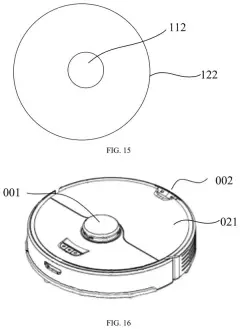
11 drawing sheets from US 2026/0363504 A1 · click any drawing to enlarge


Show the other 3 sheets


More from Roborock
All 7 Roborock patents →
More in Gear
All 26 Gear patents →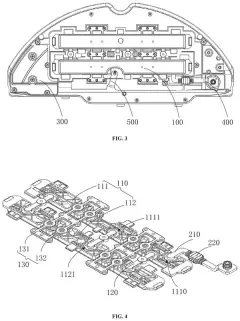
Roborock
Roborock Files Patent for a Robot Mop That Shakes Several Cleaning Pads at Once
SharkNinja
SharkNinja Patents a Single Valve That Pours Your Seltzer and Releases Leftover Gas
Lutron
Lutron Patents a Clip-On Frame That Turns Old Wall Switches Into Smart Controls
Philips Hue
No comments yet