
Roborock
Roborock · Robotics · Filed Jul 3, 2026 · USPTO published Nov 19, 2026 · This week's release
Roborock Files Patent for a Robot Vacuum Side Brush That Swings Out
Robot vacuums are famous for pushing crumbs around the edges of a room. Roborock's new filing describes a side brush on a swing arm that can reach in toward the roller or reach out to cover fresh floor.
- Publication number
- US 2026/0363514 A1(US20260363514A1)
- Applicant
- Beijing Roborock Technology Co., Ltd.
- Filed · Published
- Jul 3, 2026 · Nov 19, 2026
- Inventors
- Pan CHENG, Jiansheng WU, Chang MI
- Status when we published
- Waiting for an examiner
- Document
- 10 claims
- US classification
- 15/3
- Parent application
- Continuation of PCT/CN2025/070588 (filed Jan 3, 2025)(PCTCN2025070588)
What Roborock's swing-arm side brush actually does
Today, most robot vacuums rely on a spinning side brush to flick debris toward a roller brush in the middle, which does the real pickup. The side brush sits in one fixed spot, so the area it can cover is fixed too.
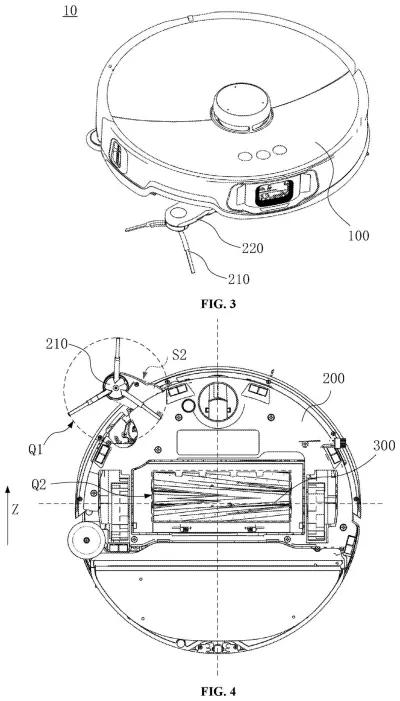
Roborock's filing puts that side brush on a swing arm. Tucked in (the retracted position), the brush's circle of sweeping overlaps the roller's path, so crumbs get handed straight to the roller. Swung out (the extended position), the two sweeping zones separate and the brush reaches more floor, such as farther toward walls and corners.
The idea is simple: one vacuum that can either funnel debris inward or stretch outward, depending on the arm's position.
… a first cleaning module, which is disposed on the device body and comprises a first cleaning head, the first cleaning head being able to form a first cleaning area during operation …
Translation: The vacuum includes a primary cleaning part that covers a specific zone as it works.
How the side brush and roller brush share the work
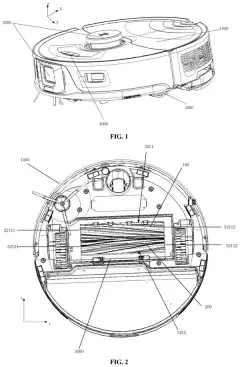
The filing describes a round robot vacuum with two cleaning modules. The first holds a side brush (a small spinning brush with three claws) on a swing arm. The second holds a roller brush, a cylinder that sits in the middle of the underside and rolls debris into a suction channel powered by a fan.
The key claim is about geometry. Each brush sweeps its own area, and when both run at once those areas either partly overlap or don't overlap at all. With the arm retracted, they overlap, so debris the side brush kicks up lands in the roller's path. With the arm extended, they don't overlap, and the machine covers more ground.
The claims also pin down where the parts sit:
- The arm's pivot sits slightly farther from the vacuum's center line than the roller's inner end, by a margin of 5% to 20%.
- On a round body, the pivot sits 30% to 40% of the body's diameter back from the center line along the direction of travel.
- The pivot sits 10% to 30% of the diameter off to the side.
The description gives example sizes: a body 320 to 380 mm wide, a side brush spinning at 500 to 3,000 rpm, and an arm that swings across 20 to 120 degrees.
… the first cleaning module comprises a first cleaning head, and a first cleaning area can be formed when the first cleaning head works …
Translation: One cleaning assembly operates to cover its own specific cleaning zone.
Why a swinging brush matters for your floors
If you own a robot vacuum, the weak spot is usually where the floor meets the wall, and in corners. A brush that can reach outward when needed targets exactly that, and a brush that tucks inward helps the roller catch what the side brush flings.
The filing doesn't name a product, and it doesn't claim any cleaning-performance numbers. It also covers only the mechanical layout, not smarter navigation. Whether this ever reaches a shelf is unknown, but it shows where one maker is looking for gains: moving parts, not just more suction.
Roborock's fourth filing we've tracked in our home tech coverage since November follows earlier applications like one on zoned mop cloths and one on a compact spinning mirror.
Source: US 2026/0363514 A1 at the USPTO (PDF). Full patent text and figures are in the official publication.
Get our take in your Top Stories
Liked this breakdown? Add Patentlyze as a preferred source on Google, and our plain-English take shows up more often in your Top Stories the next time Roborock patent news breaks.
Add Patentlyze on Google
One click.
There are more where this came from
We read the new patents from Big Tech, carmakers and more and send you the ones worth knowing. Plain English, free, every week.
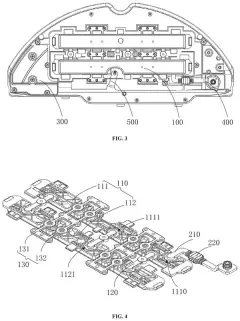
The drawings · 5 sheets
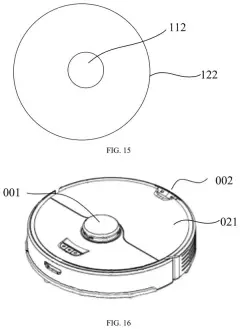
5 drawing sheets from US 2026/0363514 A1 · click any drawing to enlarge


More from Roborock
All 7 Roborock patents →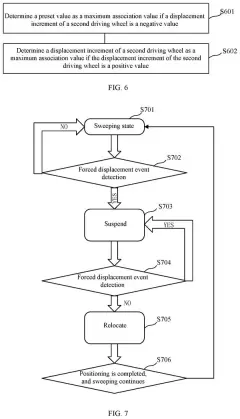
More in Gear
All 26 Gear patents →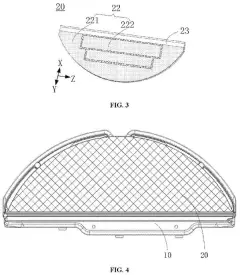
Roborock
Roborock Patents a Robot Mop Cloth With Zones That Shake Loose Stubborn Stains
Samsung
Samsung Patents a Tilted-Hair Brush Design for Robot Vacuums
Samsung
Samsung Files Patent to Let Your Phone Teach Your Robot Vacuum
Samsung
No comments yet