
Samsung
Samsung · AR / VR · Filed Feb 7, 2025 · USPTO published Nov 19, 2026 · This week's release
Samsung Files Patent So AR Content Can Adjust to Your Phone or Glasses
Samsung's filing takes on a problem AR apps will hit sooner or later: the same 3D experience has to run on devices of very different strength. Its answer is to have the network quiz your device first, then hand it a version that fits.
- Publication number
- US 2026/0370704 A1(US20260370704A1)
- Applicant
- Samsung Electronics Co., Ltd.
- Filed · Published
- Feb 7, 2025 · Nov 19, 2026
- Inventors
- Sungryeul RHYU, Hyunkoo YANG
- Status when we published
- Examiner raised objections; the company can respond
- Document
- 9 claims
- US classification
- 709/219
- Examiner
- MEKY, MOUSTAFA M (Art Unit 2457)
- Parent application
- National Stage Entry of PCT/KR2023/011861 (filed Aug 10, 2023)(PCTKR2023011861)
What Samsung's AR capability check actually does
You put on a pair of AR glasses and open an app that makes a virtual character bounce off your living room wall. The glasses are a few years old, and the app was built for something much newer. Today, that mismatch can mean choppy video or an app that simply won't run.
Samsung's patent describes a way for the network to ask your device what it can handle before the content starts. Your glasses report things like battery level, field of view and how many 3D shapes they can draw per second. The service then picks a version of the experience that fits, sometimes with a nearby server doing the heavy lifting.
If your battery drops or your device heats up halfway through, the system can notice and switch you to a lighter version, so the experience stays roughly the same for you.
a media player (MP) comprising a capability processing function (CPF), and a media session handler (MSH) connected to the media player.
Translation: The device uses specialized software components to handle media playback and device capabilities.
How the network compares your device to the bar
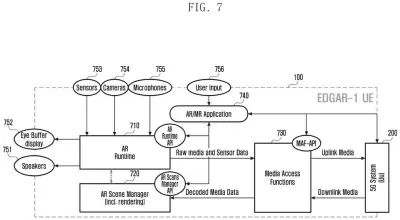
The patent builds on 5G media streaming. A server called an application function (AF, the network's stand-in that manages a service on behalf of the app maker) sends your device a checklist called a capability reporting parameter set (CRPS). The checklist names the things to measure and the minimum value each one needs.
On the device side, the claims describe a media player with a capability processing function, a measuring component that tracks what the whole device can do. A media session handler (the piece that talks to the network) passes the checklist to the player, collects the measured values, and sends a filled-in report back to the AF.
The AF then compares each reported value to two numbers: a mandated value (the minimum needed) and a boundary value (a warning line). For example, the filing describes a mandated 30 frames per second with a boundary of 15.
If the device falls short, the claims have the AF ask the app maker for a different process flow (a different recipe of steps, where some may run on an edge server instead of your device). Once it has one, it sends the device a new media player entry. The filing lists items such as:
- Battery level
- Field of view
- Whether the device can map the room around you
- Whether it can tell where you are looking
… receiving a report message including capability values of the terminal in response to the report request message; compiling service access information on the basis of the capability values of the terminal; …
Translation: The network asks the device what it can do and then builds a profile to deliver matching content.
Why Samsung's AR check matters for older devices
For you, the practical effect would be AR content that adjusts itself rather than failing on a device that is too old or too weak. The filing describes high-spec content running on a network server today and on future headsets alone, without app makers rebuilding the experience each time hardware improves.
It also gives app makers a way to publish one service with several versions and let the network pick. The examiner's first review rejected the claims as filed, which is routine at this stage and usually followed by amendments, so the final scope may change.
That makes this Samsung's 87th filing we've tracked in our AR glasses race watch since May, adding to earlier applications like one pulling real screens into view and one filtering accidental touches.
Source: US 2026/0370704 A1 at the USPTO (PDF). Full patent text and figures are in the official publication.
Get our take in your Top Stories
Liked this breakdown? Add Patentlyze as a preferred source on Google, and our plain-English take shows up more often in your Top Stories the next time Samsung patent news breaks.
Add Patentlyze on Google
One click.
There are more where this came from
We read every patent application Big Tech publishes and send you the ones worth knowing. Plain English, free, every week.
The drawings · 14 sheets
14 drawing sheets from US 2026/0370704 A1 · click any drawing to enlarge


Show the other 6 sheets


More from Samsung
All 1,662 Samsung patents →
More in AR / VR
All 713 AR / VR patents →
Qualcomm
A New Qualcomm Patent Lets VR Controllers Change Their Lights to Stay Visible
Google
Google Patents Smart Glasses That Size Up Objects From the Way You Hold Them
Qualcomm
Qualcomm Files Patent to Let Underpowered AR Glasses Join 3D Calls Using Network Power
Google
No comments yet