

Samsung
Samsung · AR / VR · Filed May 22, 2026 · USPTO published Nov 12, 2026 · This week's release
Samsung Patents AR Glasses That Ignore Touches You Didn't Mean to Make
Samsung's AR glasses would check whether you meant to touch them before acting on it. One version even listens to your brainwaves for the tell.
- Publication number
- US 2026/0358922 A1(US20260358922A1)
- Applicant
- SAMSUNG ELECTRONICS CO., LTD.
- Filed · Published
- May 22, 2026 · Nov 12, 2026
- Inventors
- Md. Sazzad Hissain KHAN, Aba KOWSER
- Status when we published
- Waiting for an examiner
- Document
- 20 claims
- US classification
- 345/173
- Parent application
- Continuation of PCT/KR2024/014980 (filed Oct 2, 2024)(PCTKR2024014980)
What Samsung's accidental-tap filter actually does
Every time you push your hair behind your ear, you risk brushing the side of your smart glasses and pausing a movie or closing your map. Add a crowded subway, where a stranger's elbow or a friend's hand could do the same thing.
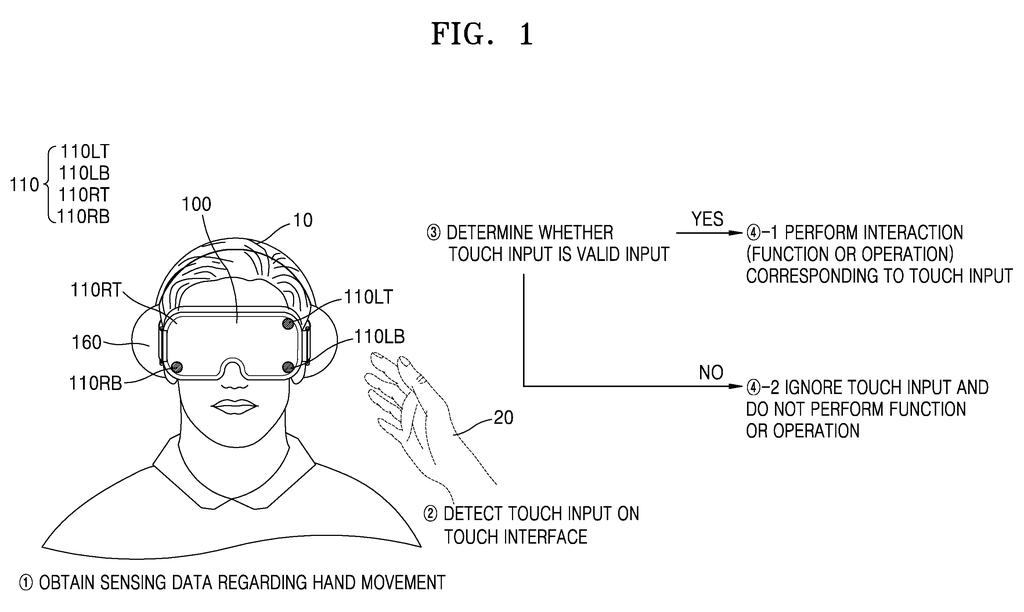
Samsung's patent application describes AR glasses that check whether a touch makes sense before they act on it. The glasses watch your hand with their cameras, and a tap only counts if it arrives shortly after you raise your hand toward the frame. A touch that comes out of nowhere gets ignored.
The filing also describes other checks: a smartwatch that reports where your hand is, a brainwave sensor, and a motion sensor that notices when you're just adjusting the glasses. Any one of these can act as the gatekeeper.
… determine whether a touch input received through the touch interface is a valid input based on the hand movement, and determine whether to perform an interaction corresponding to the touch input based on a result of the determination regarding the valid input.
Translation: The glasses figure out if you meant to touch them by watching how your hand is moving.
How the glasses decide a tap was on purpose
The core idea is a gatekeeper between your finger and the glasses' response. When the touch pad or button on a head-mounted display registers a tap, the device first checks sensor data about your hand. If the check fails, the tap is ignored.
The filing describes several ways to run that check:
- Camera plus AI. Cameras film your hand and arm, and an AI model marks joints like the wrist and elbow as tracking points (called feature points). When those points show a hand-raising motion, a tap counts only if it lands within a preset window afterward. The filing mentions up to six cameras.
- Depth camera. It measures how far away your hand is, and a sharp drop in that distance reads as a raised hand.
- Wearable signals. A smartwatch sends ultra-wideband or Bluetooth signals so the glasses know where your hand is. One example: a tap counts only if your hand is within 5 centimeters.
- Brainwaves. An EEG sensor (which reads electrical activity from your head) looks for error-related negativity, a brain response to something not matching your expectation. The glasses briefly hold back their response, roughly 50 to 100 milliseconds, and a deliberate tap shows that surprise.
- Motion sensor. The longer, bigger vibration of you adjusting the glasses marks a touch as invalid.
Why a stray touch on AR glasses is a real problem
Smart glasses are worn on your face and used out in the world, and touch controls sit right where your hands and hair already go. The filing's own examples are ordinary ones: a family member pausing your movie, a stranger closing your navigation app in a crowd, another player bumping the frame during a VR game. An ignored accidental touch means fewer interruptions while you're wearing the thing.
There's a security angle too. The filing says blocking outside touches helps keep personal information from being exposed. If glasses like these reach the mainstream, a way to tell your taps from everyone else's would become a basic expectation rather than an extra.
Samsung's 85th filing we've tracked in the AR glasses race since May follows work like deeper phone photos in VR and posters turned into live scenes.
Source: US 2026/0358922 A1 at the USPTO (PDF). Full patent text and figures are in the official publication.
Get our take in your Top Stories
Liked this breakdown? Add Patentlyze as a preferred source on Google, and our plain-English take shows up more often in your Top Stories the next time Samsung patent news breaks.
Add Patentlyze on Google
One click.
There are more where this came from
We read every patent application Big Tech publishes and send you the ones worth knowing. Plain English, free, every week.
The drawings · 23 sheets
23 drawing sheets from US 2026/0358922 A1 · click any drawing to enlarge


Show the other 15 sheets


More from Samsung
All 1,629 Samsung patents →
More in AR / VR
All 690 AR / VR patents →
Sony
Sony Files Patent for Slimmer Display Glasses That Track Where You Look
Sony
Sony Patents AR Glasses That Turn Real Objects Transparent When They Block Your View
Meta
AR Glasses Learn to Dodge Real-World Objects in New Meta Patent
Google
No comments yet