
Samsung Patents a Chip-Level Random Number Generator That Builds Entropy in Steps
Every secure transaction, encrypted message, and password relies on truly random numbers, and generating them inside a constrained chip is harder than it sounds. Samsung's latest patent describes a method for doing exactly that without overwhelming the hardware.
How Samsung's step-by-step random number trick works
Every time your phone encrypts a file or your bank app logs you in, the device needs a genuinely unpredictable number to start the process. Generating that number takes raw randomness from the real world, called entropy, plus a series of mathematical steps to shape it into something cryptographically useful.
The problem is that some chips, especially smaller security chips or dedicated cryptographic processors, can only handle a limited amount of data in any single operation. If the pool of entropy you need to process is larger than what the chip can chew in one go, you have a problem. Samsung's patent describes a method where the chip processes entropy in small, manageable chunks, feeding each result into the next step rather than trying to digest everything at once.
The end result is a random number that is just as secure as one generated from a single large operation, but produced in a way that works within tight hardware limits. It is a plumbing fix, not a fundamental reinvention, but plumbing is what keeps cryptography from leaking.
receive, from an entropy source, for each of at least some crypto operation sequences among a plurality of crypto operation sequences, an entropy input having a size smaller than or equal to a reference size of a reference seed material that may be processed at one time during a crypto operation …
Translation: The chip takes in small chunks of raw randomness piece by piece rather than all at once.
Inside the chained crypto operation loop
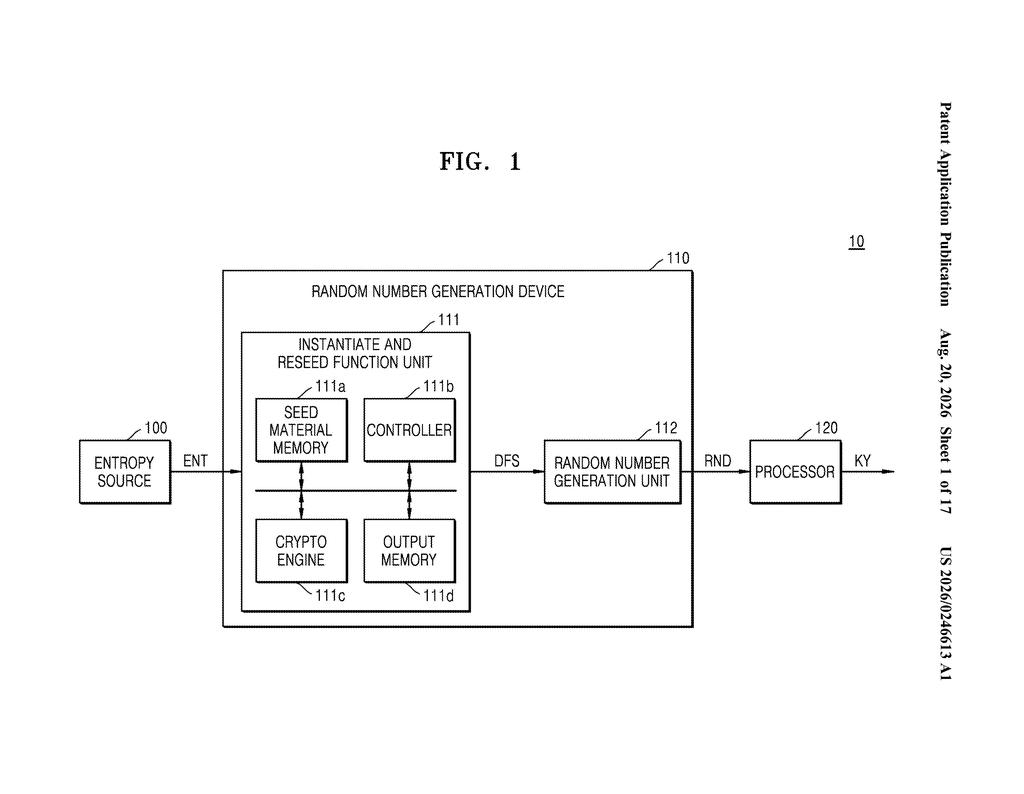
The patent describes a random number generation device built around two cooperating blocks of logic.
The first block, called the instantiate and reseed function logic, handles the seeding process. A seed is the starting material a random number generator uses to produce unpredictable output. Here, the seed material is larger than what the chip's cryptographic engine can process in a single operation. Rather than requiring oversized hardware, the logic breaks the job into a sequence of crypto operations, each one consuming a chunk of input (an entropy input) that is small enough for the hardware to handle. Critically, each step also takes in the result of the previous step, so the outputs are chained together. This chaining is what ensures the final result captures all the entropy, even though no single step saw all of it at once.
Once all the steps are done, the block emits a derivation function signal, which is essentially a compact representation of the accumulated internal state. Think of it as a summary of everything the chip learned from all those entropy chunks.
The second block, the random number generation logic, takes that derivation function signal and produces the actual random number data that the rest of the system uses for encryption, key generation, or other security functions.
The design targets compliance with standards like NIST SP 800-90A, which specifies how cryptographic random number generators should behave, while fitting within hardware that cannot process full-sized seed material in one shot.
… repeatedly perform the crypto operation, based on a seed material configured to be processed at one time during the crypto operation in a current crypto operation sequence and an operation result in a previous crypto operation sequence …
Translation: It builds up strong security step by step by combining current data with results from past operations.
What this means for secure chips and encryption hardware
For most users, random number generation is invisible infrastructure. But it is load-bearing infrastructure: break it, and encrypted communications, digital signatures, and secure boot processes all become vulnerable. A chip that cannot properly seed its random number generator is a chip with a structural security weakness, no matter how strong the rest of the cryptography is.
Samsung makes some of the world's most widely deployed security chips, including the Secure Element chips found in payment cards, smartphones, and IoT devices. A hardware-friendly approach to seeding random number generators matters most in those constrained environments, where memory and processing width are fixed by cost and power budgets. For readers tracking Big Tech patent news in the cryptographic hardware space, this filing signals that Samsung is working to keep its security silicon standards-compliant even as those standards push toward larger seed sizes that older architectures were not designed to accommodate.
Samsung's 1085th filing we've tracked since May joins our Samsung coverage alongside 5G shared AI training and camera flicker detection.
The technology Samsung patented here does not require building anything new from scratch. The security chips it needs already exist in Samsung's product line, and the invention is really just a change to the software instructions those chips follow.
A team could go from approval to a finished, tested product in months, not years. The hard part is checking that it works correctly, not designing new hardware.
Get our take in your Top Stories
Liked this breakdown? Add Patentlyze as a preferred source on Google, and our plain-English take shows up more often in your Top Stories the next time Samsung patent news breaks.
There are more where this came from
We read every patent application Big Tech publishes and send you the ones worth knowing. Plain English, free, every week.
The drawings
17 drawing sheets from US 2026/0246613 A1 · click any drawing to enlarge


Want this weekly breakdown for a company we don't cover? Patentlyze Pro →
Be the first to weigh in