
Samsung
Samsung · Memory & storage · Filed Jul 16, 2026 · USPTO published Nov 19, 2026 · This week's release
Samsung Files Patent to Keep Laser Depth Sensors From Missing Light That Arrives Together
Lidar sensors can miss a second flash of light that lands while the first one is still being counted. Samsung's patent application recovers both hits with simple arithmetic on a single shared wire.
- Publication number
- US 2026/0367231 A1(US20260367231A1)
- Applicant
- Samsung Electronics Co., Ltd.
- Filed · Published
- Jul 16, 2026 · Nov 19, 2026
- Inventors
- Yibing Michelle WANG, Chunji WANG, Hongyu Wendy WANG, Tze-Ching FUNG
- Status when we published
- Waiting for an examiner
- Document
- 20 claims
- US classification
- 356/5.01
- Parent application
- Division of 17/807,686 (filed Jun 17, 2022)(17807686)
What Samsung's overlapping-light fix actually does
Ever tried to hear two people clap at the exact same instant? You hear one clap, and you'd never guess there were two. Lidar sensors, the laser rangefinders that measure distance by timing how long light takes to bounce back, run into a version of this problem.
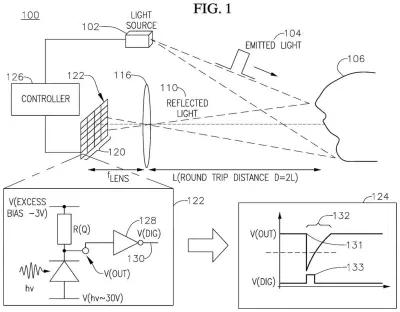
These sensors use tiny detectors that each catch a single particle of light, then go briefly blind. Samsung's answer is to wire several detectors to one shared output line, which saves chip space. The catch is that overlapping hits merge into one longer blip.
Here's the trick: every blip is supposed to be a known, fixed length. If the merged blip runs longer than that, the sensor knows at least two hits landed close together, and it can work backward from the end of the blip to find when the later one arrived. You get both timestamps instead of one.
combining pulses from at least two photodetectors to form a combined pulse; calculating a leading edge timestamp t 1 of the combined pulse; calculating a trailing edge timestamp t 2 of the combined pulse …
Translation: It merges signals from multiple detectors and tracks the exact start and end times of the combined pulse.
How the sensor times the last light hit
The sensor is built from single-photon avalanche diodes (SPADs, detectors sensitive enough to react to one particle of light). Each SPAD outputs a square pulse of fixed width, called w, when it fires. It then has a short dead time during which it can't register another photon. Missing photons in that window is called pile-up, and it distorts the measured shape of the returning laser pulse.
The filing combines the pulses from at least two detectors using an OR function (the output is on if any input is on) and sends the result down a shared readout line. A time-to-digital converter (TDC, a circuit that stamps the exact time of each pulse edge) records the leading edge timestamp t1 and the trailing edge timestamp t2 of the combined pulse.
The logic then compares the two:
- If t2 minus t1 is greater than w, two or more photons overlapped. It outputs t1 (the first arrival) and t2 minus w (the last arrival).
- If t2 minus t1 is less than or equal to w, it outputs just t1.
The claims also cover grids of detector groups, with one shared line per row, and pulse widths anywhere from 1 picosecond to 1 microsecond. The recovered timestamps feed a histogram that estimates the distance.
… returns the leading edge of the arrival of the first photon and the leading edge of the arrival of the last photon, if at least two photons are received during an overlapping pulse width …
Translation: It captures both the earliest and latest arriving light when multiple photons hit at the same time.
Why one shared wire matters for Samsung's sensors
For you, this is about the distance sensors that go into things like cars and robots. The filing says the goal is an accurate sensor that uses less energy and less chip area than current methods. Smaller, simpler sensor chips could mean cheaper parts and less power drain.
Samsung's description compares four layouts. It says its version comes close to the original laser pulse shape using one readout line, while independent detectors need more lines and a bulkier design. The claims are methods for the circuit logic, so this is a chip-level improvement you would never see directly. You would only notice it as better depth sensing.
That makes this Samsung's 27th filing we've tracked in our Memory & storage coverage since May, a group that includes a wireless charger alignment alert and a shared battery for storage drives.
Source: US 2026/0367231 A1 at the USPTO (PDF). Full patent text and figures are in the official publication.
Get our take in your Top Stories
Liked this breakdown? Add Patentlyze as a preferred source on Google, and our plain-English take shows up more often in your Top Stories the next time Samsung patent news breaks.
Add Patentlyze on Google
One click.
There are more where this came from
We read every patent application Big Tech publishes and send you the ones worth knowing. Plain English, free, every week.
The drawings · 9 sheets
9 drawing sheets from US 2026/0367231 A1 · click any drawing to enlarge


Show the other 1 sheets

More from Samsung
All 1,662 Samsung patents →
More in Hardware
All 2,355 Hardware patents →
Microsoft
Microsoft Files Patent for Squeezing More Data Into Glass Storage Plates
Sony
Sony Patents a LiDAR Sensor That Recovers Faster After a Blinding Flash of Light
Apple
Apple Patents a Light-Based Memory System for High-Powered Computing
Google
No comments yet