
Samsung
Samsung · Software · Filed Oct 15, 2025 · USPTO published Nov 19, 2026 · This week's release
Samsung Patents a Fix So Your Watch Can Answer Its Voice Assistant Without Pausing Your Show
Ask your TV a question mid-movie and it may stop the movie to answer you. Samsung's patent application has the screen step aside and lets another nearby device do the listening.
- Publication number
- US 2026/0369276 A1(US20260369276A1)
- Applicant
- Samsung Electronics Co., Ltd.
- Filed · Published
- Oct 15, 2025 · Nov 19, 2026
- Inventors
- Changbeom LIM, Gajin SONG, Hoseon SHIN
- Status when we published
- Waiting for an examiner
- Document
- 15 claims
- US classification
- 704/275
- Parent application
- National Stage Entry of PCT/KR2023/014177 (filed Sep 19, 2023)(PCTKR2023014177)
What Samsung's TV-sits-out voice patent does
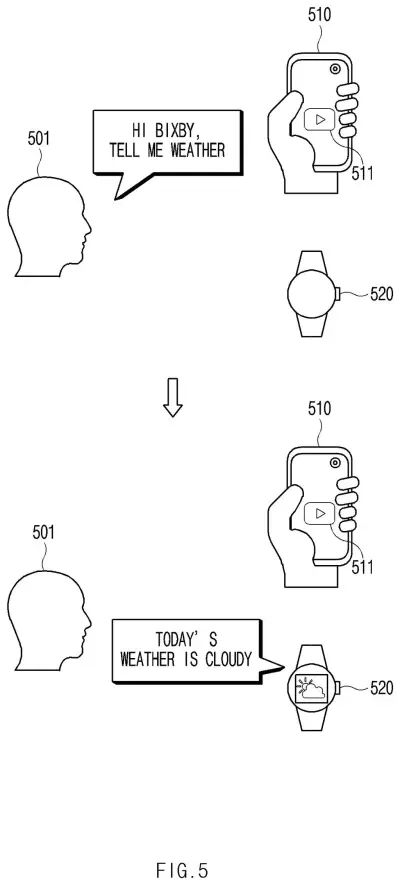
Every time you say a wake word to a voice assistant while a show is playing, the device you're watching on may stop the show so it can listen and answer. Ask for the weather mid-movie, and your movie is suddenly gone.
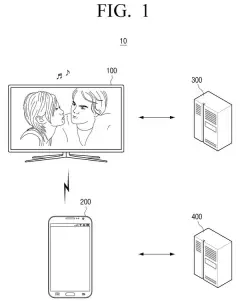
Samsung's patent application describes a fix. When a screen is playing something and hears you, it checks whether another device that could handle the request is nearby, such as a watch or a smart speaker. If there is one, the screen sits out the job of listening, and the other device takes it.
The show keeps playing while the watch or speaker answers. When the show ends, the screen goes back to being a possible listener. If nothing else is around, it behaves as it does today and answers you itself.
… configure the electronic device not to be selected as a listener device receiving a user utterance in the MDE based on a determination that the environment is the MDE; and receive a user utterance as the listener device based on a determination that the environment is not the MDE.
Translation: It decides whether your watch or another nearby screen should answer you.
How a playing screen decides to stop listening
The patent covers a device with a microphone, speaker, display and wireless connection. When it hears you speak, it first checks whether it is playing video or audio. If it isn't, it simply listens, as usual.
If content is playing, the device decides whether it is in a multi-device environment (a space with other gadgets that could take over the voice assistant's work). The claim allows two ways to decide, either one or both:
- It finds another device connected over Bluetooth or Wi-Fi that can act as a listener.
- It finds another device registered to the same user account in the same place, judged by network details and location data such as GPS.
If the answer is yes, the device removes itself from the wake-up competition (when several devices hear "Hi Bixby," each reports how well it heard you, and the best one wins). Playback continues. The description says the device skips calculating and broadcasting its score, and asks to rejoin once playback ends.
A separate claim covers a server doing the same job. After another device hears you, the server picks which device carries out the request. It favors a device other than the one playing, but falls back to the playing device if nothing else can do the job. The description adds that a request like "play Netflix" can still go to the playing device, since you probably want to change what's on that screen.
… recognize whether content is being played back through the display or the speaker, if content is being played back, recognize whether there is at least one first external electronic device connected to the electronic device through the communication circuit …
Translation: The system checks if your device is currently playing a movie or music.
Why your show might stop getting interrupted
The practical payoff is small but easy to feel: asking a question stops interrupting what you're watching. If you have a TV, a smart speaker and a watch in the same room, several devices can already hear "Hi Bixby," so the choice of which one answers matters more as homes fill up with gadgets.
For Samsung, which makes TVs, wearables, speakers and appliances, a rule like this ties its own devices together. The filing's examples include a smart speaker, a smart TV, a smart refrigerator and a wearable, and the voice assistant it names is Bixby. It is an application, so nothing here says when or whether it would ship.
This is the 1648th Samsung filing in our Samsung coverage since May, adding to a run that includes one on organizing AI models and one on tracking them.
Source: US 2026/0369276 A1 at the USPTO (PDF). Full patent text and figures are in the official publication.
Get our take in your Top Stories
Liked this breakdown? Add Patentlyze as a preferred source on Google, and our plain-English take shows up more often in your Top Stories the next time Samsung patent news breaks.
Add Patentlyze on Google
One click.
There are more where this came from
We read every patent application Big Tech publishes and send you the ones worth knowing. Plain English, free, every week.
The drawings · 15 sheets
15 drawing sheets from US 2026/0369276 A1 · click any drawing to enlarge


Show the other 7 sheets


More from Samsung
All 1,662 Samsung patents →
More in Software
All 814 Software patents →
Google
Google Patents a System That Decides Which of Your Devices Should Answer You
Apple
Apple Patents a Watch Face That Uses a Moving Indicator to Track Elapsed Time
Apple
Apple Patent Reveals Incoming Video Calls That Stream Footage Before You Answer
Apple
No comments yet