
Samsung
Samsung · Networking · Filed Jun 11, 2025 · USPTO published Nov 19, 2026 · This week's release
Samsung Patents a Filing Cabinet for the AI Models Inside Mobile Networks
Before AI models can run across cell networks, someone has to keep track of them. Samsung's patent application describes a registry that gives each model an ID, a description card and a place on the shelf.
- Publication number
- US 2026/0370563 A1(US20260370563A1)
- Applicant
- Samsung Electronics Co., Ltd.
- Filed · Published
- Jun 11, 2025 · Nov 19, 2026
- Inventors
- Chadi KHIRALLAH, Ezeddin Al HAKIM, Mahmoud WATFA
- Status when we published
- Waiting for an examiner
- Document
- 15 claims
- US classification
- 709/221
- Examiner
- CHOU, ALAN S (Art Unit 2451)
- Parent application
- National Stage Entry of PCT/KR2023/019572 (filed Nov 30, 2023)(PCTKR2023019572)
What Samsung's AI model registry actually does
Phones and cell networks are starting to run AI models for jobs like managing connections and tracking position, and every time one of those models gets shipped back and forth, it costs signal traffic, battery and computing power. On top of that, the filing lists open questions: how to save a trained model, what to store with it, and how to find the best one later.
Samsung's answer is a record keeper. A phone sends in a model along with a description card: what it's for, how big it is, how accurate it tested. The keeper assigns an ID number, files everything away, and tells the phone it worked. Later, a device can ask for the best match, such as a model for handling devices on the move that scored above 95 percent accuracy.
You would never see any of it. It would sit in the network's plumbing, helping your phone and its network agree on which AI model to use.
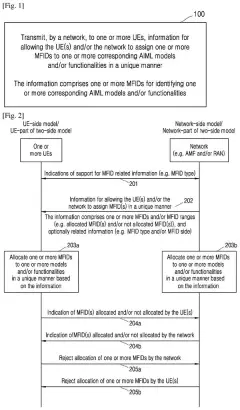
receiving, from a user equipment (UE), a request to register an AI/ML model or functionality, the request including metadata related to the AI/ML model or functionality; assigning an identifier (ID) to the AI/ML model or functionality; and storing information on the AI/ML model or functionality and the related metadata.
Translation: The system takes in a new AI model from a phone, gives it an ID tag, and saves its details.
How a phone registers an AI model with the network
The patent describes a new network component, called a Model Learning Controller in the description, that acts as the record keeper for AI/ML models (machine-learning programs trained to make predictions). The claims cover its basic loop: it receives a registration request from a user equipment (the phone or other device), assigns the model an identifier, and stores the model's information along with the metadata (descriptive details) that came with the request.
The claimed metadata can include:
- What the model is used for, plus its inputs and outputs
- Accuracy and other performance numbers
- Size, including the number of layers and parameters (the adjustable numbers inside a model)
- Whether it was trained or runs on the device side or the network side, online or offline
IDs can be global or local. The stored record can include the model's architecture, its weights (the learned numbers), how long it stays valid, and when and where it was registered.
Dependent claims add two more steps. A device can send an update message to change a registered model, and it can send a selection request, which the manager answers by identifying a matching registered model. The description also covers subscribing to changes and configuring models, plus options like averaging the weights of several stored models into one. Those extras are described but not claimed. The manager can live almost anywhere: a base station, a core network function, a server, or even a phone.
What a shared AI model catalog could mean for 5G
For you, the benefit would be indirect. If phones and networks lean on AI to manage connections, locate devices or save power, a shared catalog could stop them from re-sending the same models over and over, which the filing links to signal traffic, battery and computing costs. A phone could also ask for a model fitted to its situation, such as a certain area or a type of device.
For Samsung, the filing ties closely to work in 3GPP, the industry group that writes mobile network standards and has been studying how to handle AI models in 5G and 6G. A published application does not mean any standard will adopt it, though.
This is the 97th Samsung filing we've tracked since May in our 5G and network push watchlist, following one that blocks apps by location and one that predicts connection trouble.
Source: US 2026/0370563 A1 at the USPTO (PDF). Full patent text and figures are in the official publication.
Get our take in your Top Stories
Liked this breakdown? Add Patentlyze as a preferred source on Google, and our plain-English take shows up more often in your Top Stories the next time Samsung patent news breaks.
Add Patentlyze on Google
One click.
There are more where this came from
We read every patent application Big Tech publishes and send you the ones worth knowing. Plain English, free, every week.
The drawings · 12 sheets
12 drawing sheets from US 2026/0370563 A1 · click any drawing to enlarge


Show the other 4 sheets


More from Samsung
All 1,662 Samsung patents →
More in Networking
All 516 Networking patents →
Samsung
Samsung Patent Covers AI/ML Data Reporting Methods for 5G Dual Connectivity Networks
Samsung
Samsung Patents a Signalling Traffic Monitoring Control System for 5G Networks
Samsung
Samsung Patents Finer QoS Traffic Prioritization for 5G and 6G Networks
Samsung
No comments yet