
Samsung Patents a Way to Compress AI Image Generators Without Wrecking Their Output
AI image generators are too big and slow for most phones. Samsung is patenting a method to squeeze them down while keeping the output quality close to the original.
What Samsung's diffusion model compression actually does
Ever wonder why AI image tools on your phone look worse than the ones on a desktop? The short answer is size. The models that power AI image generation are enormous, and shrinking them enough to fit on a phone usually means they start producing blurry or distorted results.
Samsung's patent describes a process to compress these models in stages. First, a full-size model is compressed using a standard technique. Then, instead of treating the entire image-generation process as one block, the system breaks it into chunks of time steps (the individual rounds of refinement an AI uses to build an image). The compressed model gets fine-tuned separately for each chunk, using the original big model as a quality reference. Finally, those fine-tuning adjustments get compressed too.
The result is a smaller, faster model that has been carefully coached, section by section, to stay as close as possible to what the original would have produced. Think of it as shrinking a recipe while taste-testing each component against the original dish.
… dividing time steps of the second diffusion model into a plurality of time step groups; obtaining a third diffusion model by adjusting a weight of the second diffusion model for each time step group of the plurality of time step groups; …
Translation: The system breaks the image generation process into chunks so it can fine-tune model weights step by step.
How the three-model pipeline shrinks weights in stages
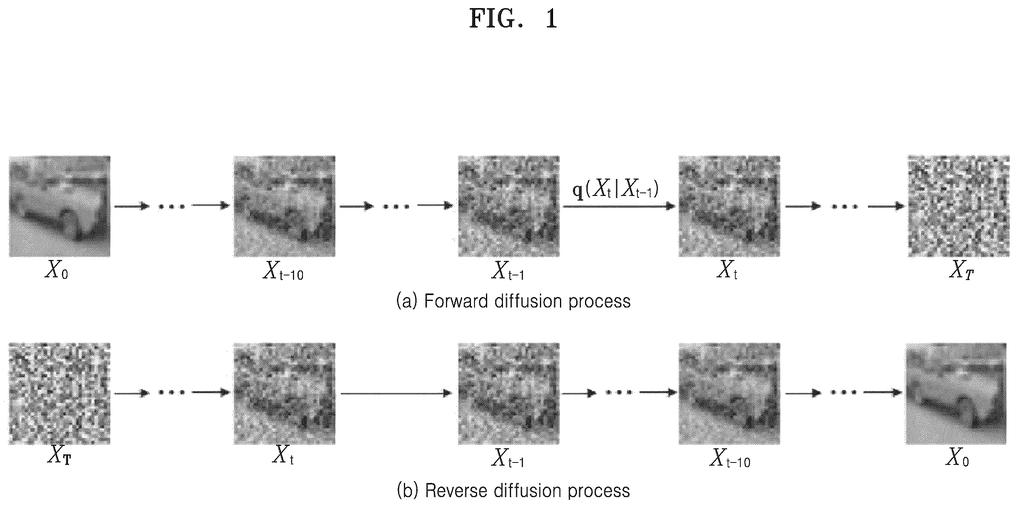
Diffusion models generate images by starting with random noise and gradually refining it over many steps until a clear image emerges. Each step is called a time step, and a typical model might run hundreds of them. These models are large and computationally expensive, which is why running them on a phone or a small chip requires compression.
The patent lays out a three-phase pipeline:
- Post-training quantization (PTQ): The original full-precision model (called the first diffusion model) is compressed by reducing the numerical precision of its internal weights. This is a standard efficiency trick, but it often degrades output quality.
- Time-step group fine-tuning: The compressed model's time steps are divided into groups. For each group, the weights are adjusted independently, letting the model specialize within different phases of the image-generation process. This produces a third model whose adjustments are tracked as a separate set of adjustment parameters (essentially a record of how much each weight changed).
- Quantizing the adjustments: Those adjustment parameters are themselves compressed, producing the final quantized model.
The key insight is using the original, uncompressed model's output as a training signal during fine-tuning. The compressed model is coached to match what its larger predecessor would have produced, group by group, keeping quality degradation in check at each stage.
… training the third diffusion model using an output of the first diffusion model, to adjust adjustment parameters of the third diffusion model, wherein the adjustment parameters of the third diffusion model reflect a change of a weight of the third diffusion model with respect to a weight of the second diffusion model; …
Translation: The compressed model learns by comparing its work against the original uncompressed AI to keep quality high.
What this means for AI image tools on phones and chips
For you, this matters most if you use AI image tools on a phone or any device that isn't a powerful desktop workstation. Better compression techniques mean those tools could produce higher-quality results without needing a cloud connection or a GPU the size of a textbook.
Samsung has been filing around on-device AI efficiency for some time, and this patent fits that pattern. The approach targets diffusion models specifically, which power tools like Stable Diffusion and similar image generators. If this technique makes it into Samsung's hardware or software stack, it could close some of the quality gap between on-device AI image generation and cloud-based alternatives.
Samsung's 38th filing we've tracked in AI image and video since May adds to a run that includes one turning chats into images and one grading its own edits.
The patent describes a purely software process, which means it could in principle run on hardware Samsung already ships. No new chip is required, just a smarter compression pipeline that squeezes an image-generation model down to a size that fits comfortably on a phone.
The interesting engineering choice is treating the model's internal steps as distinct groups rather than one uniform object. Image generation works in stages, and early stages do very different work than late ones, so compressing each group separately gives the software a finer instrument than a blanket approach would.
The shortest route to a product is folding this into the software layer that runs Samsung's on-device AI features, where smaller models mean faster generation and lower battery drain. Whether the quality improvement over simpler compression is large enough for a user to notice is the one question the document leaves open.
There are more where this came from
We read every patent application Big Tech publishes and send you the ones worth knowing. Plain English, free, every week.
The drawings
11 drawing sheets from US 2026/0300702 A1 · click any drawing to enlarge


Want this weekly breakdown for a company we don't cover? Patentlyze Pro →
Be the first to weigh in