
Samsung
Samsung · AI / ML · Filed Apr 13, 2026 · USPTO published Nov 19, 2026 · This week's release
Samsung Files Patent for Training a Small AI to Summarize Right on Your Device
Samsung's filing has a giant AI play strict teacher to a tiny one, grading its summaries on five checks until it is good enough to run on a TV or phone by itself. When training ends, the teachers go home and only the small AI ships.
- Publication number
- US 2026/0368446 A1(US20260368446A1)
- Applicant
- Samsung Electronics Co., Ltd.
- Filed · Published
- Apr 13, 2026 · Nov 19, 2026
- Inventors
- Yuexi Zhang
- Status when we published
- Waiting for an examiner
- Document
- 20 claims
- US classification
- 704/9
- Parent application
- Claims priority from a provisional application 63808447 (filed May 19, 2025)
What Samsung's grader-trained summarizer does
Imagine you walk in halfway through a TV show and ask your television for a quick recap. A huge AI in a data center could write a great one, but it is far too big to live inside the TV. The small AI that does fit tends to write clumsy summaries, often copying sentences straight from the subtitles.
Samsung's patent application describes a way to train that small AI so it writes better recaps. During practice, the small AI writes a summary, and a much bigger judge AI grades it from 1 to 5 on things like whether it got the characters and plot right and whether it just copied lines. A second big AI then writes an improved version, and the small one learns to move toward it.
When training is done, the big helpers are dropped. Only the small AI is left, which is what makes it light enough for a device you own.
… dynamically adjusts preferences used to influence summaries generated by the language AI model and provides real-time feedback for a generated summary created by the language AI model based on a training input.
Translation: It updates how summaries are tailored while the system is actively learning from new examples.
How a big AI judge coaches the small one
The patent covers a way to train a small language model (an AI that reads and writes text) so it summarizes well while staying compact enough for a phone or TV. The training borrows several larger AIs as helpers. A large expert model reads the input and lists its key points, called rationales. The small model is taught to produce both those key points and the final summary.
Next comes scoring. A large judge model grades each summary from 1 to 5 on five checks:
- Character grounding: does it name the right characters?
- Plot grounding and plot correctness: does it describe the story accurately?
- Conciseness and completeness: is it short without leaving things out?
- Duplication and repetition: does it avoid copying lines from the source?
The judge answers a short series of questions before scoring, and its suggestions are merged into one overall note. In the feedback step, another expert model uses that note to write a better summary on the spot. The small model is then nudged toward it using direct preference optimization (a training method that rewards the preferred answer over the rejected one). These preferences are generated fresh at each step instead of being written in advance.
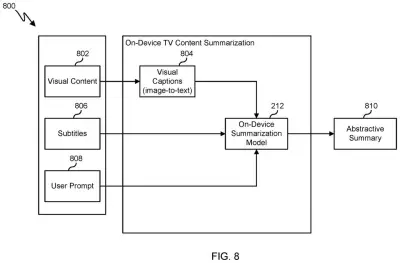
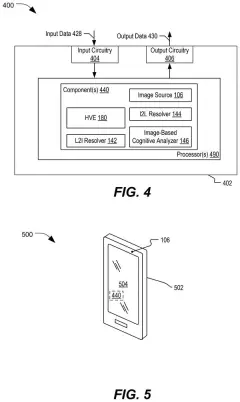
After training, only the small model is kept. The filing also describes adding a visual understanding model, and shows a TV example that combines descriptions of what is on screen with subtitles.
… trained using a combination of a summary generation operation, a scoring operation, a feedback operation, and a summary re-generation operation.
Translation: The AI learns by repeatedly writing, grading, correcting, and rewriting its own summaries.
Why on-device summaries need a small model
If you have ever asked a gadget for a quick recap, you have run into the tradeoff this filing targets. The biggest AI models write good summaries, but they are too large for the memory of a phone or TV and too slow for live use. Small models fit, but they tend to write weak summaries or copy lines straight from the source.
Samsung's approach spends the heavy computing during training, then ships only the small model. The filing's own example is a TV that summarizes live content using subtitles and on-screen descriptions, and it lists phones, watches, glasses and appliances as other possible homes. For you, the payoff would be recaps that show up fast on the device in front of you.
This is the 30th Samsung filing we've tracked since June in our on-device AI privacy watch, following applications for reading resumes and ID cards and sharing medical details after a crash.
Source: US 2026/0368446 A1 at the USPTO (PDF). Full patent text and figures are in the official publication.
Get our take in your Top Stories
Liked this breakdown? Add Patentlyze as a preferred source on Google, and our plain-English take shows up more often in your Top Stories the next time Samsung patent news breaks.
Add Patentlyze on Google
One click.
There are more where this came from
We read every patent application Big Tech publishes and send you the ones worth knowing. Plain English, free, every week.
The drawings · 10 sheets
10 drawing sheets from US 2026/0368446 A1 · click any drawing to enlarge


Show the other 2 sheets


More from Samsung
All 1,662 Samsung patents →
More in AI / ML
All 2,738 AI / ML patents →
Adobe
Adobe Files Patent for Training a Small AI to Suggest Questions About Your Documents
Google
Google Patents a Distributed AI Training System That Keeps Your Data on Your Device
Adobe
Adobe Files Patent for Teaching Its AI With Made-Up User Requests
Qualcomm
No comments yet