
Samsung Patents a Faster Way to Connect New Home Appliances to Wi-Fi
Getting a new smart fridge or washing machine onto your home Wi-Fi is often more painful than it should be. Samsung has filed a patent that tries to fix that by making the appliance itself coordinate the handshake between Bluetooth and Wi-Fi, using a single combined chip.
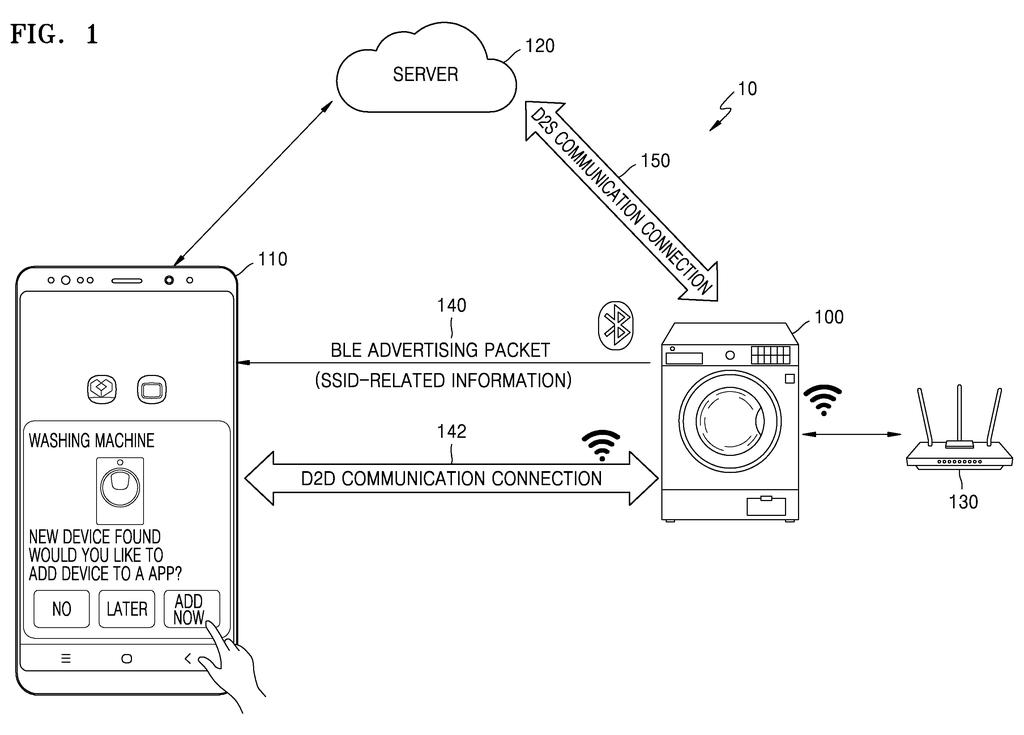
What Samsung's two-radio appliance setup actually does
Setting up a brand-new smart appliance today usually means digging through menus, entering your Wi-Fi password on a tiny screen, or wrestling with a temporary hotspot the appliance creates. It works, but it's rarely smooth. Samsung wants to make the first-time setup experience far less annoying.
The idea is to pack both a Bluetooth Low Energy (BLE) radio and a Wi-Fi radio into the appliance on a single chip. When you take a new appliance out of the box, it broadcasts a short Bluetooth signal. Your phone picks that up, identifies the device, and then sends over your home Wi-Fi network name and password. The appliance uses those details to connect directly to your router and register itself to your Samsung account.
No temporary hotspots you have to manually join. No typing your Wi-Fi password into a fridge screen. The phone handles all of it in the background, and the appliance ends up connected to your actual home network.
output, via the BLE communication module, a BLE advertising packet including a device ID of the home appliance, receive, from a mobile device that has received the BLE advertising packet from the home appliance, a control signal for an initial setting operation, the control signal including an SSID (service set identifier) and a password of an AP (access point) device …
Translation: The appliance sends its ID via Bluetooth so your phone can send it your home Wi-Fi details.
How BLE advertising hands off to a Wi-Fi connection
The patent describes an appliance that ships with a single-chipset communication module combining both BLE and Wi-Fi radios. In its out-of-box state, the appliance broadcasts a BLE advertising packet (a short, low-power Bluetooth signal) that includes a device ID.
Your phone, running Samsung's app, catches that BLE broadcast and recognizes the appliance. The app then sends a control signal back to the appliance over Bluetooth, carrying your home router's SSID (the network name) and password. The appliance uses those credentials to connect its own Wi-Fi radio directly to your home router, bypassing any need for the phone to act as a bridge.
Once on your home network, the appliance completes an initial setting operation, which registers the device under your Samsung account on Samsung's servers. The patent also describes an earlier version of the flow where the appliance first creates its own temporary Wi-Fi hotspot (Soft AP) to receive setup instructions, before switching over to the home network.
The key engineering claim is that both radios live on one chipset rather than two separate chips, which reduces cost and board space inside the appliance.
outputting, via Bluetooth low energy (BLE) advertising, a BLE advertising packet including service set identifier (SSID)-related information related to an SSID of a software enabled access point (Soft AP) of the home appliance in a new product state in which the home appliance has not been registered in a server …
Translation: An unregistered appliance uses Bluetooth to broadcast its presence and network info when first turned on.
What this means for setting up your next Samsung appliance
For everyday buyers, the pitch is simpler setup. Most people have wrestled with connecting a smart TV or robot vacuum to Wi-Fi at least once. The experience varies wildly by brand, and it often involves joining a temporary network on your phone, waiting for a handshake, then re-joining your real network. This patent describes cutting most of that out.
For Samsung, the single-chipset angle is also a cost and manufacturing story. Fewer components per appliance means lower production costs across a product line that spans refrigerators, washing machines, air conditioners, and more. Samsung's run of home-connectivity filings shows the company treating appliance setup as an ongoing engineering priority, not a solved problem.
Samsung's 171st filing in our chip coverage since May adds to a run that includes one on overload rerouting and one on conflict rerouting.
This patent is close to shippable territory, which is not always the case with connectivity filings. The core ingredients, BLE chips, Wi-Fi chips, and phone-based setup apps, are already standard across Samsung's appliance lineup. The main claim here is combining those two radios onto one chipset, which is more of a hardware integration step than an entirely new capability.
The shortest path from this patent to a real product is probably an updated system-on-chip in a future appliance generation, paired with a revised setup flow in the SmartThings app. That's an incremental engineering change, not a redesign from scratch.
The honest read is that this is a refinement of a workflow millions of people already use, aimed at making it slightly less frustrating. That's a reasonable goal, even if it doesn't warrant much excitement on its own.
There are more where this came from
We read every patent application Big Tech publishes and send you the ones worth knowing. Plain English, free, every week.
The drawings
22 drawing sheets from US 2026/0292468 A1 · click any drawing to enlarge


Want this weekly breakdown for a company we don't cover? Patentlyze Pro →
Be the first to weigh in