
Sony
Sony · Software · Filed Jul 27, 2026 · USPTO published Nov 19, 2026 · This week's release
Sony Patents a Self-Checking Fix for the Hollow, Whooshing Sound in Game Audio
Ever heard a game sound turn thin and hollow as you walk through a room? Sony Interactive Entertainment has a patent application for a fix: make the audio filters grade themselves, and redo them if they're too alike.
- Publication number
- US 2026/0371034 A1(US20260371034A1)
- Applicant
- Sony Interactive Entertainment LLC
- Filed · Published
- Jul 27, 2026 · Nov 19, 2026
- Inventors
- Michael Lee Jones, Christopher Buchanan, Danjeli Schembri, Louis-Xavier Buffoni, Allen Lee
- Status when we published
- Waiting for an examiner
- Document
- 20 claims
- US classification
- 381/1
- Parent application
- Continuation of 18/665,771 (filed May 16, 2024)(18665771)
What Sony's game audio filter check actually does
Ever walked down a hallway in a video game and heard a footstep or gunshot suddenly sound thin, like it was played through a tube? That is a real audio glitch, and it comes from the game's own echo simulation.
When a sound bounces off several virtual walls, the game ends up with many delayed copies of it. Those copies can cancel each other out in some places and boost each other in others, so the sound seems to whoosh as you move. Games usually fight this by running each copy through a slightly different random filter that nudges its timing. The catch: random filters sometimes come out nearly identical, so they fix very little.
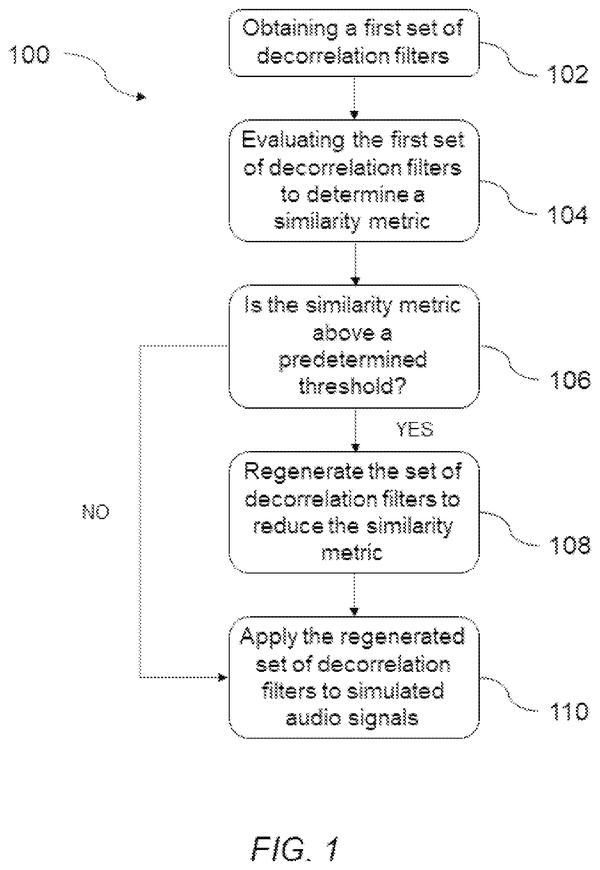
Sony's idea is to check the filters before using them. The system scores how alike they are, throws out a batch that is too similar, and draws a new one until the set is different enough.
… determining that the metric for the set of filters does not satisfy a threshold value; and in response to determining that the metric for the set of filters does not satisfy the threshold value: regenerating the set of filters …
Translation: If the audio filters are too similar, the system automatically scraps them and makes new ones.
How the filters get scored and redrawn until they differ
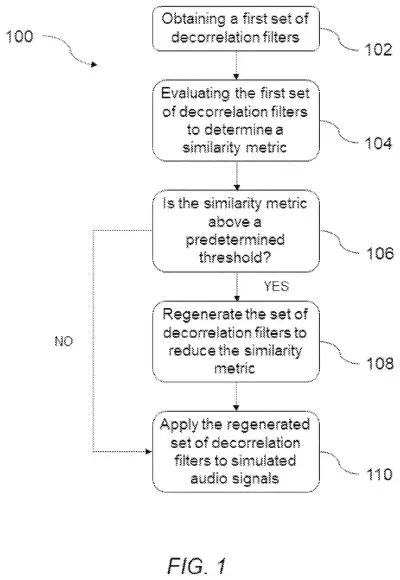
The patent describes a quality-control loop for the filters a game uses to clean up simulated sound. Sound in a virtual world is built from the game's acoustic settings, such as the size and surfaces of a room. When one sound reflects off several simulated surfaces, it produces multiple delayed copies that interfere with one another. That interference is the phasing artefact (the hollow, swirling effect) the patent targets.
The usual remedy is a set of decorrelation filters (filters that make each copy of a sound slightly different so they stop interfering). Here, each filter is defined by two things: a frequency range it affects and a phase delay (how far it shifts the timing of those frequencies). The filters can be generated at random. The filing gives an example of one filter shifting sounds between 500 and 1000 Hz, and another working in the 9000 to 15000 Hz range.
The new step is a similarity score:
- The system measures how alike the filters are using cross-correlation (a standard way of measuring how closely two sets of numbers move together).
- If the score fails a threshold, the set is regenerated.
- The loop repeats until a set passes, and only then are the filters applied to the audio.
The filters mainly change timing, not volume, so the character of the sound stays the same. The filing also mentions that machine learning could build the filter set directly instead of relying on random draws.
… evaluating the first set of decorrelation filters to determine a similarity metric representing the similarity between the first set of decorrelation filters; if the similarity metric is above a predetermined threshold, regenerating the set of decorrelation filters so as to reduce the similarity metric …
Translation: It checks if the audio filters sound too much alike and remakes them until they are properly varied.
Why this matters for sound in your next game
If this approach were used in a game, you would hear it as less odd sound: fewer moments where a voice or an explosion goes hollow as you move around a room. Sound that stays natural helps a game feel real, especially on headphones, where artefacts like this are easy to notice.
The idea is also cheap to describe. It adds a check on top of something games already do, rather than replacing the audio engine. The filing does not say which games or consoles might use it, and it does not claim any measured improvement, so it is best read as a sensible tweak from a company with a big stake in how games sound.
That makes this Sony's 171st filing we've tracked since May in our PlayStation hardware and AI bets, a run that includes a haptic neckband for enemy proximity and AI training via trimmed footage.
Source: US 2026/0371034 A1 at the USPTO (PDF). Full patent text and figures are in the official publication.
Get our take in your Top Stories
Liked this breakdown? Add Patentlyze as a preferred source on Google, and our plain-English take shows up more often in your Top Stories the next time Sony patent news breaks.
Add Patentlyze on Google
One click.
There are more where this came from
We read every patent application Big Tech publishes and send you the ones worth knowing. Plain English, free, every week.
The drawings · 3 sheets
3 drawing sheets from US 2026/0371034 A1 · click any drawing to enlarge


More from Sony
All 722 Sony patents →
More in Software
All 814 Software patents →
Sony
Sony Patent Connects Multiplayer Game Events to Specific In-Game Activities
Sony
Sony Files Patent for a Digital Ball That Changes as the Game Unfolds
Sony
Sony Files Patent to Shrink Game Graphics Files Stored on Disk
Sony
No comments yet