
Toyota
Toyota · Automotive · Filed Feb 19, 2026 · USPTO published Nov 19, 2026 · This week's release
Toyota's New Patent Filing Covers a Warning System That Checks If You Already Looked Before Alerting You
Lane-departure warnings are one of the most complained-about features in modern cars, mostly because they fire off during perfectly intentional lane changes. Toyota is now filing a patent for a system that actually checks whether you looked before it beeps.
- Publication number
- US 2026/0365194 A1(US20260365194A1)
- Applicant
- TOYOTA JIDOSHA KABUSHIKI KAISHA
- Filed · Published
- Feb 19, 2026 · Nov 19, 2026
- Inventors
- Chiemi SEKIGUCHI
- Status when we published
- Waiting for an examiner
- Document
- 4 claims
- US classification
- 340/576
How Toyota's eye-tracking lane alert decides to stay quiet
Imagine you're on the highway, you check your rearview mirror, glance at your side mirror, do a quick shoulder check into your blind spot, then start moving into the next lane. Your car beeps at you anyway. That's the problem Toyota wants to fix.
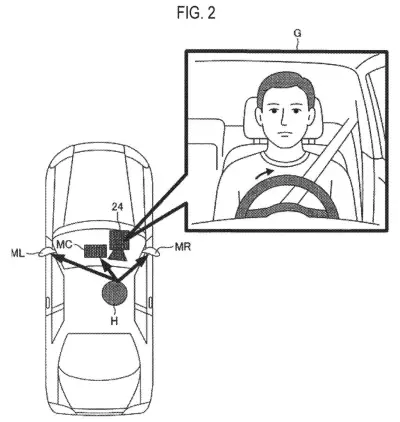
The idea is to watch your eyes. A small camera inside the car tracks where you're looking. If the system can confirm you checked the right mirrors and turned your head to cover the blind spot in the few seconds before you drifted toward the lane line, it stays silent. No beep, no warning flash on the dashboard.
There's an important catch: the system only holds its tongue if the car has been driving calmly for a meaningful stretch of time beforehand. If you were swerving, braking hard, or the steering wheel was moving erratically in the past several minutes, it will still warn you, even if you did check your mirrors. That way a drowsy driver who happens to glance sideways doesn't accidentally silence the alert they actually need.
… a third condition for determining that the driver visually confirms safety in the vicinity within a predetermined period immediately before the first point in time is satisfied, based on a history of the gaze information.
Translation: It also checks eye-tracking data to verify you recently looked around to ensure the road was safe.
The three conditions Toyota's system checks before muting the alarm
The system ties together three separate checks before it decides to skip the lane-departure alarm.
Check one (is a lane departure likely?): Cameras on the outside of the car track the white lane markings. If the gap between the car's front corner and the nearest lane line drops below a threshold distance, the alarm would normally fire. This is the standard trigger that already exists in most cars today.
Check two (has the car been behaving normally?): The system runs a continuous background timer that resets any time the car's behavior looks unstable. "Unstable" means things like:
- The steering wheel reversed direction too many times in a short window (a sign of indecision, drowsiness, or a collision-avoidance swerve)
- The car moved sideways faster than a threshold speed
- Aggressive acceleration or braking changes
If more than a set amount of time (the filing gives 10 minutes as an example) has passed since the last unstable moment, the car is considered calm enough to trust an intentional lane change.
Check three (did you actually look?): A camera aimed at the driver's face tracks head position and pupil direction to build a precise gaze vector. Within the few seconds before the potential departure (3 seconds in the filing's example), the system checks whether your gaze hit the rearview mirror, the relevant side mirror, and the blind-spot zone beside the car that mirrors don't cover. All three must be confirmed. Looking at the mirrors alone isn't enough.
Only when all three conditions line up does the system stay quiet. Miss any one of them and the warning plays.
What this means for drivers who find lane warnings annoying
For most drivers, the practical payoff is fewer false alarms during routine lane changes. That matters more than it sounds: studies on driver behavior consistently show that repeated unnecessary warnings train people to ignore all warnings, including the ones they need. A system that learns to tell the difference between "driver is changing lanes carefully" and "driver is drifting without noticing" should, in theory, make the alerts that do fire feel more credible.
The design also shows Toyota thinking about the specific failure mode of gaze-based suppression systems, which older cars already use in a simpler form. Those systems just check whether you're looking in the direction of travel. This one requires a full mirror-and-blind-spot check, the same sequence a driving instructor would expect from a student, before it agrees to stay quiet. That's a more demanding standard, and it's specifically designed to catch drowsy drivers who happen to be facing forward.
Toyota's sixth filing since November in our Toyota coverage continues a battery reuse thread started with the AI brain idea and the sudden-death pricing patent.
Source: US 2026/0365194 A1 at the USPTO (PDF). Full patent text and figures are in the official publication.
Get our take in your Top Stories
Liked this breakdown? Add Patentlyze as a preferred source on Google, and our plain-English take shows up more often in your Top Stories the next time Toyota patent news breaks.
Add Patentlyze on Google
One click.
There are more where this came from
We read the new patents from Big Tech, carmakers and more and send you the ones worth knowing. Plain English, free, every week.
The drawings · 4 sheets
4 drawing sheets from US 2026/0365194 A1 · click any drawing to enlarge


More from Toyota
All 16 Toyota patents →
More in Automotive
All 432 Automotive patents →
Amazon
Amazon Unit Zoox Files Patent for Maps That Draw Their Own Lane Lines
Mobileye (Intel)
A New Intel Self-Driving Tech Patent Uses Other Drivers' Paths to Find Where Lanes Split and Merge
Ferrari
Ferrari Patents a Suspension That Tilts the Front Wheels Without a Bulky Extra Arm
Hyundai & Kia
No comments yet