
Toyota
Toyota · AI / ML · Filed May 15, 2026 · USPTO published Nov 19, 2026 · This week's release
Toyota Files Patent for Crowd Simulations That Check In With an AI Only Once
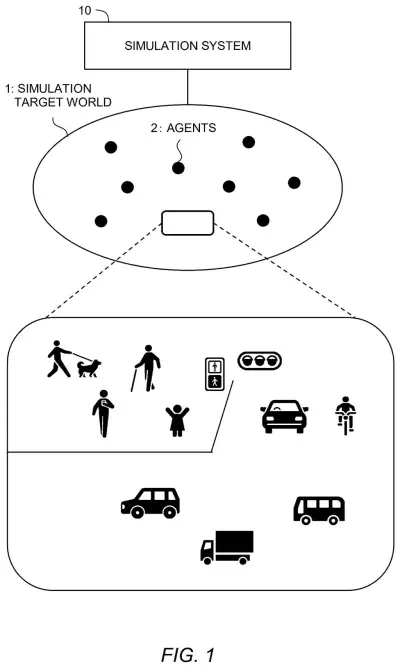
Toyota has filed a patent for a simulator that asks a big outside AI what each simulated person might do next, then stops calling and runs on its own.
- Publication number
- US 2026/0368574 A1(US20260368574A1)
- Applicant
- TOYOTA JIDOSHA KABUSHIKI KAISHA
- Filed · Published
- May 15, 2026 · Nov 19, 2026
- Inventors
- Kei KAWASAKI, Yuta EZOE
- Status when we published
- Waiting for an examiner
- Document
- 12 claims
- US classification
- 706/46
What Toyota's one-call crowd simulator does
Ever tried to plan a road trip by calling a friend every five minutes to ask what to do next? You would get good advice, but your phone bill and your friend's patience would both take a beating. Computer simulations of towns face a similar problem.
Toyota's filing covers simulations of pedestrians, cars, buses and robots moving through a town. A big, well-trained AI sits outside the simulator. At the start, the simulator asks it for odds on what each character will do next, such as a 40% chance of taking the bus, a 35% chance of driving and a 25% chance of walking.
After that, the simulator stops asking and runs the scene with its own built-in AI, using those odds as the starting point. That means far less data flying back and forth, which matters most when thousands of characters are in play.
execute an initial setting process that communicates with an external system outside the simulator, acquires a probability of a next action of an agent calculated by the external system, and sets the next action represented by the probability as an initial state of the agent; …
Translation: It talks to an external AI just once at the very beginning to figure out what agents are likely to do.
How the simulator sets a starting guess, then goes solo
The patent describes a two-stage setup. In the first stage, called the initial setting process, the simulator contacts an outside system through an API (a standard doorway that lets two programs talk to each other). It sends a request describing the scene, and it can also send reference information about each simulated character.
That reference information can include attributes such as age, vehicle type, or even a personality label like extrovert or pessimist. It can also include the surroundings: weather, season, time of day, traffic and crowd levels. The outside system runs its own AI model and sends back probabilities, not a final decision. Those probabilities become the character's starting state.
In the second stage, the simulator's own internal AI model takes over and plays out the characters' actions without contacting the outside system at all. Because the choice is still open, the simulator can run varied what-if cases, like a delayed train or a missed connection.
The filing also adds a reset. The simulator can stop and ask the outside system again after a set amount of time. It can also do so when its predictions drift too far from what actually happened, which it can check against images from street cameras. One outside system can serve many simulators at once.
After the initial setting process, the one or more processors execute a simulation process that simulates an action of the agent without using the external system.
Translation: Once the simulation starts running, it completely ignores the outside AI and handles everything on its own.
Why Toyota cares about cheaper city-scale simulations
Cities, carmakers and planners use simulated crowds to test traffic flow, congestion, power demand and even shopping habits. Those runs get expensive as the cast grows. Toyota's design aims to let many teams share one well-trained AI while keeping each team's own simulator free to customize its behavior.
For you, the payoff is indirect. Better and cheaper simulations can mean better-tested traffic plans and safer designs for roads where people, cars and robots mix. The filing describes city-scale runs with low load, but it gives no test results, so the real-world gain is unproven.
Toyota's second filing we've tracked since November builds on our Toyota coverage, which started with a robot error-detection application.
Source: US 2026/0368574 A1 at the USPTO (PDF). Full patent text and figures are in the official publication.
Get our take in your Top Stories
Liked this breakdown? Add Patentlyze as a preferred source on Google, and our plain-English take shows up more often in your Top Stories the next time Toyota patent news breaks.
Add Patentlyze on Google
One click.
There are more where this came from
We read the new patents from Big Tech, carmakers and more and send you the ones worth knowing. Plain English, free, every week.
The drawings · 8 sheets
8 drawing sheets from US 2026/0368574 A1 · click any drawing to enlarge


More from Toyota
All 16 Toyota patents →
More in AI simulation
All 193 AI simulation patents →
Adobe
Adobe Patents a Test That Checks Whether AI Videos Move Like Real Things
Google
Google Files Patent for a TV Channel of AI-Made Videos Built Around You
Adobe
Adobe Patents an AI That Turns a Description Into Realistic Fabric, Stone and Metal Textures
Sony
No comments yet