
Toyota
Toyota · Automotive · Filed Mar 12, 2026 · USPTO published Nov 19, 2026 · This week's release
A New Toyota Patent Prices Used EV Batteries by Their Odds of Dying Suddenly
A battery that tests as healthy can still die without warning. Toyota's filing builds a score for that risk and uses it to set the price when a used battery pack changes hands.
- Publication number
- US 2026/0367173 A1(US20260367173A1)
- Applicant
- TOYOTA JIDOSHA KABUSHIKI KAISHA
- Filed · Published
- Mar 12, 2026 · Nov 19, 2026
- Inventors
- Ayano KOBAYASHI
- Status when we published
- Waiting for an examiner
- Document
- 5 claims
- US classification
- 702/63
What Toyota's used-battery warning actually does
Imagine you're buying a used battery pack for your electric car. Its health reading looks fine, so you hand over the money. Then one day it simply stops charging and driving, with no slow fade beforehand. The patent calls this sudden death, and the usual battery health number does not capture it.
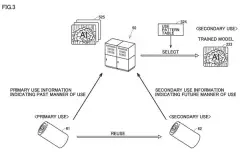
Toyota's filing describes a system that looks at two things. The first is how the previous owner treated the pack: the heat it lived in, how often it was plugged in, and how hard it was drained. The second is how you plan to use it, such as where you live, how often you charge, and how much you drive. From those, it estimates the chance the pack fails suddenly on your watch.
That chance is shown to you and to the seller, along with a price that reflects it. Until you approve the deal, the car keeps the pack switched off.
… sudden death risk indicating a probability that the power storage device will suddenly enter an unusable state during use by the second user …
Translation: The system calculates the chance that a used EV battery will fail without warning for the next owner.
How the battery's past and your plans get scored
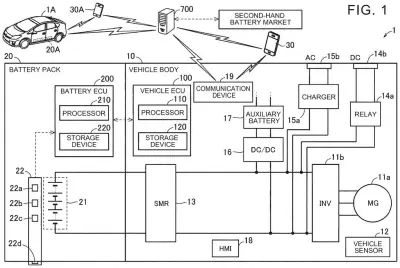
The patent covers a controller (an "annunciation control device," meaning a unit that decides what to tell people and when) that works out a sudden death risk. That is the probability that a battery pack suddenly becomes unable to charge or discharge while its next owner is using it. It runs before the second owner starts, using two inputs: the first owner's usage history, and the second owner's planned use (region, charging habits, driving frequency), typed into a phone app.
The risk number comes from a trained neural network (software that learns patterns from past examples) on a cloud server. The server groups vehicles by battery model and region, learns from fleet data on which packs died suddenly, and gives risk estimates over periods such as five or ten years.
From there, the filing describes several steps:
- The pack's value drops as the risk and the wear both rise.
- Both the buyer and the seller are told, and the buyer approves or declines.
- A relay (an electrical switch) keeps the pack from charging or discharging until that announcement happens.
- For packs made of many cells, the system can suggest replacing only the riskiest cells.
After the pack is in use, a screen shows wear and risk side by side and refreshes after each charge.
Why used EV batteries need a price on sudden death
If you ever buy or sell a used EV battery, this is aimed at your wallet. Today a pack is judged mostly by how much capacity it has lost. That leaves out the risk of a pack that looks healthy and then dies. A score that feeds into the price gives buyers a fairer deal and gives sellers a number they can defend.
The filing describes swappable battery packs, a second-hand battery market and per-cell replacement. Together those point to a used-battery trade where a pack carries a documented history and a price tag, similar to a used car's service record. For you, that could mean less guesswork and fewer surprise repair bills.
Toyota's fourth filing we've tracked since November in our Toyota coverage follows patents on summoning a parked car faster and smarter crowd simulations.
Source: US 2026/0367173 A1 at the USPTO (PDF). Full patent text and figures are in the official publication.
Get our take in your Top Stories
Liked this breakdown? Add Patentlyze as a preferred source on Google, and our plain-English take shows up more often in your Top Stories the next time Toyota patent news breaks.
Add Patentlyze on Google
One click.
There are more where this came from
We read the new patents from Big Tech, carmakers and more and send you the ones worth knowing. Plain English, free, every week.
The drawings · 6 sheets
6 drawing sheets from US 2026/0367173 A1 · click any drawing to enlarge


More from Toyota
All 16 Toyota patents →
More in Automotive
All 432 Automotive patents →
Tesla
Tesla Patents a Fallback for When Part of Its Car Screen Fails
Honda
Honda Files Patent for Driver Assist That Finds the Riskiest Spot in a Turn
Amazon
Amazon Patent Teaches Self-Driving Cars to Weigh Risk Before Every Move
Qualcomm
No comments yet