
Toyota
Toyota · Robotics · Filed Dec 31, 2025 · USPTO published Nov 19, 2026 · This week's release
Toyota Patents a Shopping Robot That Lifts Items Over the Shelf Lip
A grocery robot that tugs an item off a shelf can get stuck on the clear lip at the front edge. Toyota's patent describes a fix: the arm senses the snag and lifts the item up and over.
- Publication number
- US 2026/0364806 A1(US20260364806A1)
- Applicant
- Toyota Research Institute, Inc.
- Filed · Published
- Dec 31, 2025 · Nov 19, 2026
- Inventors
- Isabella Huang, Richard Cheng, Sangwoon Kim, Daniel C. Kruse, Carolyn C. Matl, Lukas S. Kaul, Mark Edward Tjersland, James W. Borders, Daniel M. Helmick
- Status when we published
- Waiting for an examiner
- Document
- 20 claims
- US classification
- 700/259
- Examiner
- MORFORD, ALEXANDRA ROBYN (Art Unit 3658)
- Parent application
- Claims priority from a provisional application 63805403 (filed May 14, 2025)
What Toyota's shelf-picking robot actually does
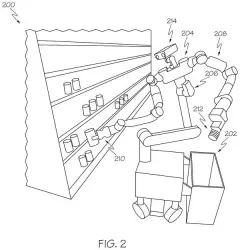
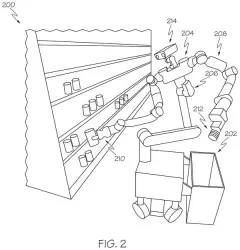
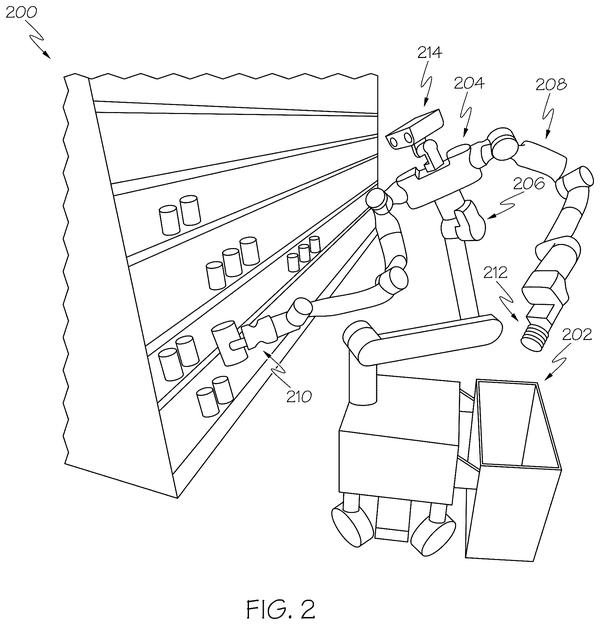
Imagine a robot rolling down a grocery aisle with your shopping list in its head. It spots the cereal box you ordered, reaches out, and pinches it between two fingers. Then the box catches on the clear plastic lip at the front of the shelf and refuses to come out.
That snag is the problem Toyota's research arm is tackling. Before grabbing anything, the robot checks the items on either side of your cereal and picks the grip spot with the most breathing room. When the box hits the lip, a force sensor in the arm notices, and the robot lifts the box up and over the edge instead of yanking harder.
The trick is a bit of math that turns a push in one direction into a lift in another. The patent describes it for a robot that fetches store orders straight from the shelves.
… determine a grasp strategy to acquire the target object based on the one or more geometric features of the target object; and direct the mobile manipulator robot to execute the grasp strategy using an admittance controller, wherein the admittance controller comprises a stiffness matrix that includes a non-diagonal coupling term.
Translation: It figures out how to pick up the item and guides the robot using advanced motion controls.
How the robot picks a grip with room to spare
The claims describe a wheeled robot with cameras and arms. It looks at a shelf, finds the right product, and builds a 3D cloud of points from the camera depth data. It flattens that cloud into a 2D outline of the product's front face, called a concave hull (a shape that hugs the item's edges). In the description, the robot confirms the product by image search, barcode or printed text, and checks it against a customer shopping list.
For a two-finger grip, the planner then chooses pinch points on the left and right edges of that outline:
- It discards any pair of points wider than the gripper can open (the example uses a 55 mm opening).
- It measures how far each pinch point sits from the neighboring items on both sides.
- It ranks the pairs by that spacing and takes the one with the most room.
The part claim 1 hinges on is the admittance controller (software that decides how an arm moves when something pushes back on it). Its stiffness matrix (a table of numbers setting how springy the arm acts in each direction) includes a non-diagonal coupling term. In practice, a force in one direction produces motion in another. When the item bumps the shelf lip during retraction, a force sensor reads the hit and the arm accelerates upward, repeating until the item clears.
The filing also covers suction, side, handle and pinch grips for other items, such as bagged goods.
Disclosed herein are apparatus, method, and computer-readable medium embodiments for providing grasp strategy for manipulation of shelved items.
Translation: The patent describes systems for helping robots grab products off of store shelves.
What this means for robots fetching your groceries
If you ever shop for groceries by app and have a robot fill the order, this is the fine motor skill it needs. Real shelves are packed tight, items sit shoulder to shoulder, and display edges get in the way. A robot that fumbles one item in twenty slows down an entire shopping run.
The filing makes that point itself: it says a single percentage point drop in success rate matters more at the system level than a faster path or a quicker calculation. Toyota Research Institute frames grocery stores and warehouses as test beds for building robots that work in spaces made for people. The patent describes the method only, with no product named.
Toyota's fifth filing in our Robotics coverage since November adds to a set that already includes one on gripping grocery items and one on lifting jugs by handles.
Source: US 2026/0364806 A1 at the USPTO (PDF). Full patent text and figures are in the official publication.
Get our take in your Top Stories
Liked this breakdown? Add Patentlyze as a preferred source on Google, and our plain-English take shows up more often in your Top Stories the next time Toyota patent news breaks.
Add Patentlyze on Google
One click.
There are more where this came from
We read the new patents from Big Tech, carmakers and more and send you the ones worth knowing. Plain English, free, every week.
The drawings · 9 sheets
9 drawing sheets from US 2026/0364806 A1 · click any drawing to enlarge


Show sheet 9

More from Toyota
All 16 Toyota patents →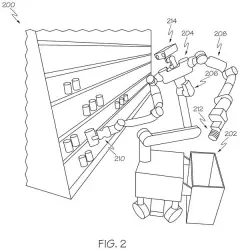
More in Hardware
All 2,375 Hardware patents →
Sony
Sony Files Patent for Robot Arms That Dodge Obstacles Before They Get Close
Figure AI
Figure AI Patents a Backpack Rig That Lets Workers Teach Humanoid Robots
Tesla
Tesla Patents a Touch-Sensitive Skin Molded to Fit Robot Hands
Sony
No comments yet