
Toyota
Toyota · Robotics · Filed Dec 31, 2025 · USPTO published Nov 19, 2026 · This week's release
Toyota Patents a Grocery Robot That Lifts Items Past Shelf Edges
Pulling a jar off a store shelf is easy for you. For a robot with a suction cup, the lip of the shelf, a hook or a wire grate can snag the item on the way out, and Toyota's patent application is about handling that moment.
- Publication number
- US 2026/0364805 A1(US20260364805A1)
- Applicant
- Toyota Research Institute, Inc.
- Filed · Published
- Dec 31, 2025 · Nov 19, 2026
- Inventors
- Sangwoon Kim
- Status when we published
- Waiting for an examiner
- Document
- 20 claims
- US classification
- 700/259
- Examiner
- MORFORD, ALEXANDRA ROBYN (Art Unit 3658)
- Parent application
- Claims priority from a provisional application 63805403 (filed May 14, 2025)
What Toyota's grocery-picking robot actually does
Most robot demos happen on a clean table. A real store is messier: items hang from hooks, sit behind wire grates, or catch on the lip of a shelf the moment you try to slide them out. Toyota Research Institute's patent application is about getting a robot past exactly those snags.
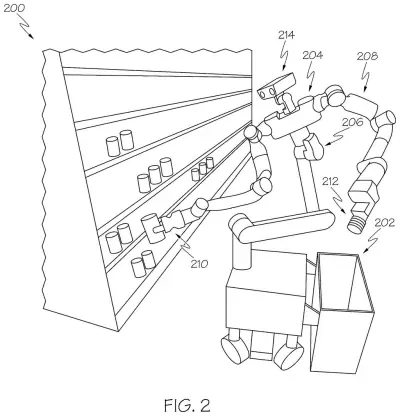
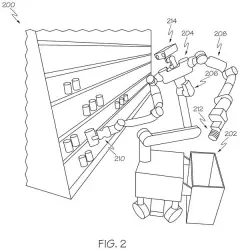
The robot looks at a shelf with its cameras, spots the item on a customer's shopping list (by matching the picture, the barcode or the printed text), and picks a spot on the item for a suction cup. If the item catches on a fixture while coming out, the arm lifts and eases off its grip at the same time, so the item slides clear instead of being torn free.
If the suction doesn't hold on the first try, the robot tries nearby spots in a widening spiral until it gets a grip or a timer runs out.
… determine that the target object is obscured by a display fixture; select a suction grasp strategy to acquire the target object from a set of one or more grasp strategies based on the one or more geometric features of the target object …
Translation: The robot realizes an item is blocked by a shelf edge and picks a suction method to grab it based on its shape.
How the robot frees an item snagged on a shelf
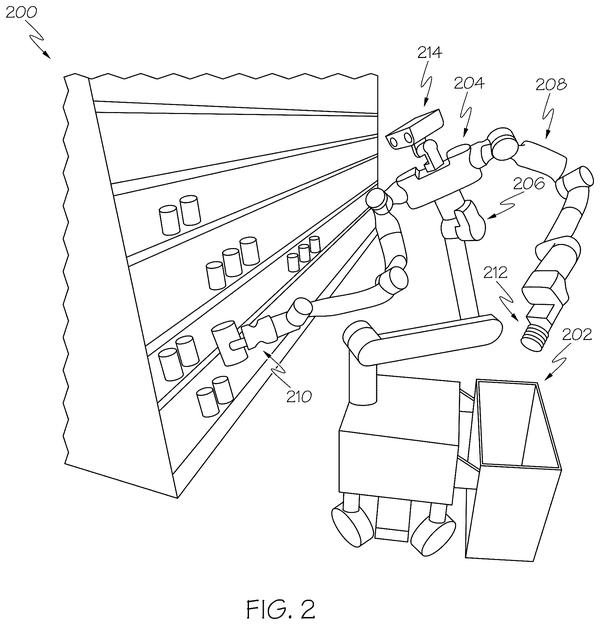
The patent covers a wheeled robot with arms, camera pairs and a suction gripper. It matches what the cameras see against a customer shopping list using an image search, a barcode or text on the package. The matching item becomes the target.
To choose where to grab, the system works through a few steps:
- It turns depth data into a point cloud (a cloud of 3D dots tracing the item's surface), flattens it into a 2D outline, and scores each dot by how far it sits inside the edge.
- A machine learning model decides whether the item hangs on a hook or sits on a grate or shelf. Hooks get the best-scoring spot that is flat enough and clear of neighbors. Grates and shelves get spots near the top, which the description says helps with heavier items.
- The cup moves in along a straight line and a pressure sensor checks the seal. On a miss, it tries points along an expanding spiral until a preset timer (examples: 30, 60 or 120 seconds) expires.
The distinctive part is the pull-out. The arm uses an admittance controller, a control method that lets the arm give way when forces push on it. Its stiffness matrix (the numbers setting how stiff the arm feels in each direction) includes a non-diagonal coupling term, which turns a push in one direction into movement in another. When a wrist force sensor feels the item hit a shelf lip, the arm moves up and relaxes the suction force together.
… directs a mobile manipulator robot to execute the suction grasp strategy using an admittance controller that comprises a stiffness matrix that includes a non-diagonal coupling term …
Translation: It tells the grocery bot to use precise pressure controls so its suction tool can pull the item past the obstacle safely.
What this means for robot grocery shopping
If robots ever fill grocery orders in ordinary stores, they will have to cope with shelves as people built them, hooks and grates included. The filing calls stores and warehouses good test settings because items are packed tightly, pick points are tight, and a shopping list is long enough that both reliability and speed count.
The filing also argues that at the whole-system level, a one percent drop in success rate matters more than a big gain in route efficiency or computing time. That explains the focus on small recovery moves like the spiral retry and the lift-and-ease pull-out. The patent application describes behavior, not a product, and says nothing about when or where a robot like this would work.
Toyota's seventh filing in the robotics work we cover since November follows a camera sync fix and a shelf-lifting shopping robot, adding another piece to its applied robotics picture.
Source: US 2026/0364805 A1 at the USPTO (PDF). Full patent text and figures are in the official publication.
Get our take in your Top Stories
Liked this breakdown? Add Patentlyze as a preferred source on Google, and our plain-English take shows up more often in your Top Stories the next time Toyota patent news breaks.
Add Patentlyze on Google
One click.
There are more where this came from
We read the new patents from Big Tech, carmakers and more and send you the ones worth knowing. Plain English, free, every week.
The drawings · 10 sheets
10 drawing sheets from US 2026/0364805 A1 · click any drawing to enlarge


Show the other 2 sheets


More from Toyota
All 16 Toyota patents →
More in Hardware
All 2,375 Hardware patents →
Sony
Sony Files Patent for Robot Arms That Dodge Obstacles Before They Get Close
Figure AI
Figure AI Patents a Backpack Rig That Lets Workers Teach Humanoid Robots
Symbotic
Symbotic Patents a Camera System That Helps Robots Remove Warehouse Boxes One Row at a Time
Samsung
No comments yet