
Toyota
Toyota · Robotics · Filed Dec 31, 2025 · USPTO published Nov 19, 2026 · This week's release
Toyota Files Patent for a Grocery Robot That Lifts Heavy Jugs by Their Handles
Most robot demos grab small, easy things. Toyota's patent goes after the awkward heavy stuff: detergent jugs and other containers you carry by a handle.
- Publication number
- US 2026/0364808 A1(US20260364808A1)
- Applicant
- Toyota Research Institute, Inc.
- Filed · Published
- Dec 31, 2025 · Nov 19, 2026
- Inventors
- Carolyn C. Matl
- Status when we published
- Waiting for an examiner
- Document
- 20 claims
- US classification
- 700/259
- Examiner
- MORFORD, ALEXANDRA ROBYN (Art Unit 3658)
- Parent application
- Claims priority from a provisional application 63805403 (filed May 14, 2025)
What Toyota's handle-grabbing grocery robot does
Robots that work in the real world still stumble on everyday objects. A grocery store is full of them: tightly packed shelves, narrow gaps, and items that come in every shape, from bags to bottles to heavy jugs.
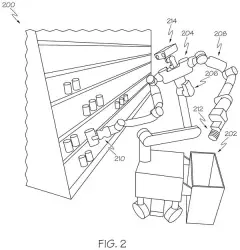
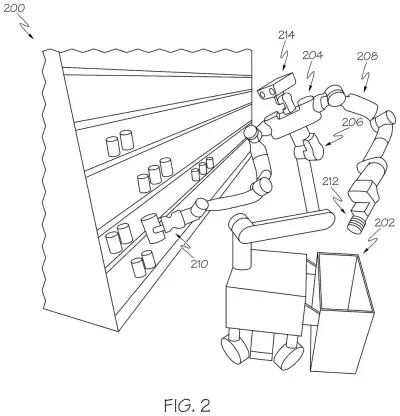
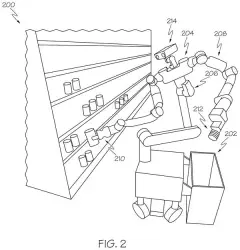
Toyota Research Institute's patent tackles one of those awkward cases. When the robot's cameras spot an item on your shopping list that has a built-in handle, the robot picks a grip made for handles instead of treating it like any other box. It slides one finger of its gripper through the handle opening and keeps the other finger outside, the way you would hook your fingers through a jug.
The patent also covers pulling the item back off the shelf and dropping it in a basket on the robot's body.
… target object comprises a container with an integrated handle; extract one or more geometric features of the target object from the image data; select a handle-item grasp strategy to acquire the target object …
Translation: The robot spots a jug with a built in handle, measures its shape from camera footage, and picks the best way to pick it up.
How the robot finds a handle it can grip
The claims cover a robot with cameras and a computer that decides how to pick things up. It looks at the camera images, finds an item to grab, and pulls out its geometric features (basic shape measurements like outline, height and width). If the item is a container with an integrated handle, it chooses a handle-item grasp strategy from a menu of grips.
Finding the handle works like this:
- The robot builds a point cloud (a 3D scatter of dots showing the item's surface) from depth data, flattens it onto a 2D plane, and draws a concave hull (a tight outline that follows the shape).
- It looks for a hole inside that outline. If it finds one, it measures gaps between the hole's edge and the outer edge, and keeps only the spots narrow enough to fit the gripper's opening.
- It then tries random spots in that area and picks the one that lets the gripper's fingers spread widest.
- If no hole is visible, because the handle curves outward, a machine learning model marks the middle of the handle instead.
The robot approaches along a straight line, closes the gripper at the chosen spot, and pulls the item back along the same line. The description says heavy items (over three kilograms) get a strict hand position to prevent slipping.
The claims also tie item choice to a customer shopping list, matching what the cameras see against it using image, barcode or text lookups.
Disclosed herein are apparatus, method, and computer-readable medium embodiments for providing grasp strategy for manipulation of heavy handled items.
Translation: This patent describes the computer technology used to help robots figure out how to lift heavy handled objects.
Why Toyota's handle grasp matters for store robots
If robots ever fetch groceries or warehouse orders, the heavy handled items are exactly the ones that can't be skipped. A detergent jug or a big container of milk shows up on plenty of real shopping lists, and a robot that drops or misses them is a robot that can't finish an order. Handle-based gripping gives it a stable way to carry the load.
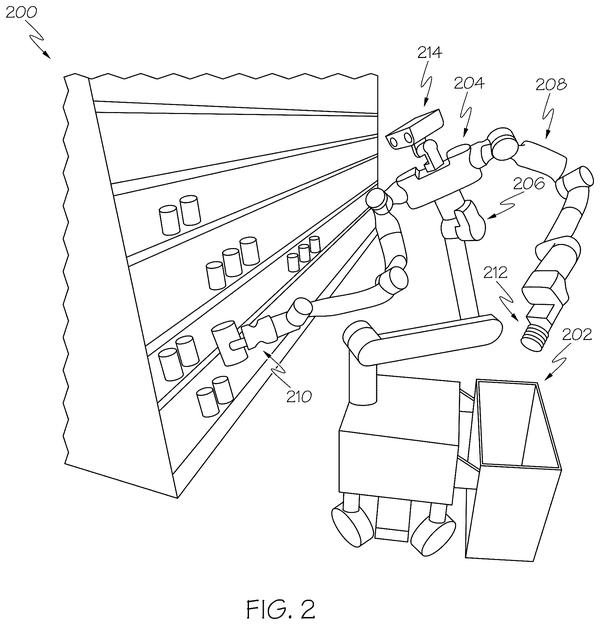
The filing is about the software that picks the grip, not new robot hardware. Toyota's description uses a robot with two arms, one with a suction gripper and one with a two-finger gripper, and the handle grasp is one of six grips it can choose from. For you, the near-term effect is none. The long-term hope is a store robot that handles the whole shelf, not only the easy items.
Toyota's third patent in the robotics filings we cover since November follows one on a grocery-picking robot and one on detecting when robots go wrong.
Source: US 2026/0364808 A1 at the USPTO (PDF). Full patent text and figures are in the official publication.
Get our take in your Top Stories
Liked this breakdown? Add Patentlyze as a preferred source on Google, and our plain-English take shows up more often in your Top Stories the next time Toyota patent news breaks.
Add Patentlyze on Google
One click.
There are more where this came from
We read the new patents from Big Tech, carmakers and more and send you the ones worth knowing. Plain English, free, every week.
The drawings · 11 sheets
11 drawing sheets from US 2026/0364808 A1 · click any drawing to enlarge


Show the other 3 sheets


More from Toyota
All 16 Toyota patents →
More in Other
All 4 Other patents →
Microsoft
Microsoft Files Patent for Teaching Robot Hands to Handle Objects They've Never Seen
Qualcomm
Qualcomm Files Patent to Help Robot AI Focus on What It Holds and Skim the Rest
Nvidia
Nvidia Patents a Way to Speed Up Robot Training by Simplifying What It Has to Simulate
Sony
No comments yet