
Toyota
Toyota · AI / ML · Filed Dec 31, 2025 · USPTO published Nov 19, 2026 · This week's release
Toyota Research Patents a Way for Grocery Robots to Grab Bags Off Crowded Shelves
Bags of rice, dog food, and cat litter have long stumped grocery robots because they're too wide to grip from the front and too porous to vacuum up from above. Toyota Research Institute's new patent describes a robot arm that slips a gripper between the bag and its neighbor, nudges the neighbor aside, and clamps down from the side.
- Publication number
- US 2026/0364788 A1(US20260364788A1)
- Applicant
- Toyota Research Institute, Inc.
- Filed · Published
- Dec 31, 2025 · Nov 19, 2026
- Inventors
- Isabella Huang
- Status when we published
- Waiting for an examiner
- Document
- 20 claims
- US classification
- 700/245
- Examiner
- MORFORD, ALEXANDRA ROBYN (Art Unit 3658)
- Parent application
- Claims priority from a provisional application 63805403 (filed May 14, 2025)
How Toyota's robot figures out what to pick up and how to hold it
Robots that pick grocery orders run into a wall with bagged items. A bag of rice is too wide for a standard pinch grip from the front, and a suction cup won't hold because the fabric is porous or too heavy. So most robots just skip those items, forcing a human to follow behind and finish the job.
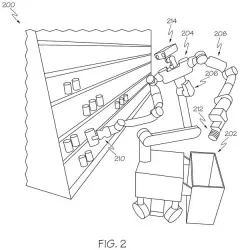
Toyota Research's filing describes a robot that spots the bag on the shelf, figures out what's sitting next to it, and chooses a smarter approach: slide the gripper in from the side. The robot checks whether the neighboring item is something fragile like a glass bottle (don't touch it) or something that can be safely nudged (a cardboard box or a plastic bag). If it can be nudged, the robot pushes it aside, slips the gripper between the two items, and clamps the target bag at an angle that avoids knocking anything over.
The whole process runs on camera images, a 3D map of the shelf, and a database of product shapes and materials. The robot matches what it sees to a shopping list, picks the right grip style, and places the item in a basket on its own chassis.
… identify a target object to be grasped by the mobile manipulator robot from the one or more objects in the image data, wherein the target object comprises a bagged item; extract one or more geometric features of the target object from the image data; …
Translation: The robot spots a bag on a crowded shelf and analyzes its shape from camera footage.
How the gripper slides in, pushes aside, and grabs from the edge
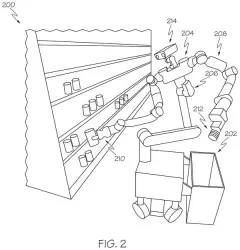
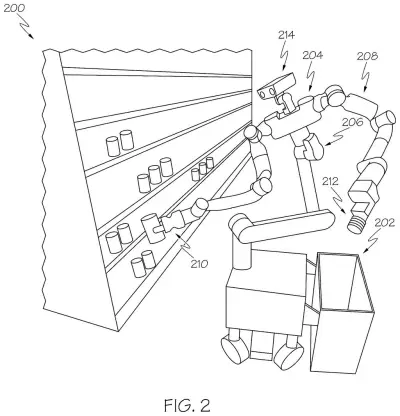
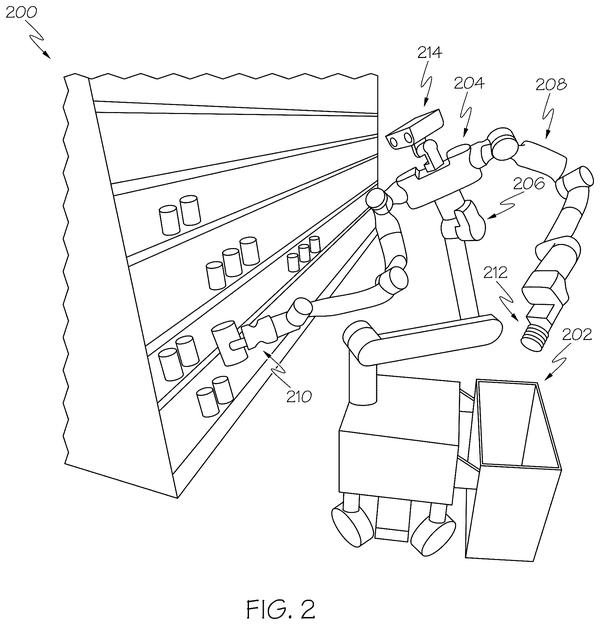
The patent covers the full decision loop on a wheeled robot with two arms: one arm carries a suction gripper, the other an antipodal gripper (two opposing fingers that open and close like a pair of tongs). Cameras on the robot feed depth images into a software stack that detects objects, draws a bounding box around each one, and classifies them using image search, barcode scanning, or text recognition.
When the system spots a bagged item on the customer's shopping list, it checks the item's shape. If the face is small enough for suction, it uses suction. If the face is large (a full bag of cat litter, for example), it triggers the side grasp strategy:
- The robot looks at the objects immediately to the left and right of the bag.
- It compares a 3D point cloud (a cloud of thousands of measured dots in space) of each neighbor against a database of known products.
- If a neighbor matches a product and that product isn't glass, the robot marks it as movable. If it matches nothing (a shelf bracket, for instance), or if it contains glass, it's marked off-limits.
- The robot then calculates the highest angle at which the gripper can rotate toward the bag without hitting the movable neighbor or the shelf above, using small simulated collision checks in 5- or 10-degree steps.
- The gripper advances perpendicular to the bag's front edge, sweeps across toward the neighbor, opens its fingers, rotates to the calculated angle, and closes on the bag's near edge.
If the bag catches on a shelf lip during extraction, a force sensor on the wrist detects the collision and an admittance controller (software that converts force readings into corrective motion) lifts the arm slightly until the bag clears.
What this means for robot-picked grocery orders
For anyone who orders groceries online and occasionally finds a substitution note where the 10-pound bag of flour should be, this filing points at the actual reason: robots skip bags because picking them reliably has been an unsolved problem. A system that can identify neighbors as movable or fragile, calculate a safe grip angle, and physically nudge items aside would meaningfully extend what a grocery robot can retrieve without human help.
Toyota Research's track record in manipulation patents shows continued investment in the specific, everyday failure modes of real-world robots rather than lab demonstrations. The design is tightly scoped to shelved bagged items, so it doesn't claim to solve every grasping challenge, but that specificity is probably what makes it buildable at the reliability levels a real warehouse actually needs.
Toyota's eighth filing in the robotics work we've tracked since November follows earlier applications like one covering a shelf-edge lifting robot and one covering a camera alignment fix.
Source: US 2026/0364788 A1 at the USPTO (PDF). Full patent text and figures are in the official publication.
Get our take in your Top Stories
Liked this breakdown? Add Patentlyze as a preferred source on Google, and our plain-English take shows up more often in your Top Stories the next time Toyota patent news breaks.
Add Patentlyze on Google
One click.
There are more where this came from
We read the new patents from Big Tech, carmakers and more and send you the ones worth knowing. Plain English, free, every week.
The drawings · 8 sheets
8 drawing sheets from US 2026/0364788 A1 · click any drawing to enlarge


More from Toyota
All 16 Toyota patents →
More in AI / ML
All 2,745 AI / ML patents →
Nvidia
Nvidia Files Patent for Robots That Handle Surprises They Were Never Trained On
Google
Google Files Patent for an AI That Turns Plain-English Orders Into Robot Programs
Samsung
Samsung's New Patent Wants AI to Write the Rules That Teach Robots How to Move
Samsung
No comments yet