
Adobe
Adobe · AI / ML · Filed May 13, 2025 · USPTO published Nov 19, 2026 · This week's release
Adobe Patents an AI That Turns a Description Into Realistic Fabric, Stone and Metal Textures
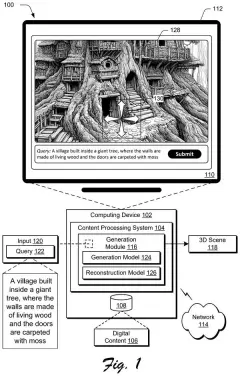
Ask an ordinary image AI for "cobblestone with moss" and it will draw one nice picture, but a 3D artist needs a whole set of matching layers, and the moss drifts to a different spot in each one. Adobe's patent aims to fix that by drawing the entire set at once.
- Publication number
- US 2026/0368954 A1(US20260368954A1)
- Applicant
- Adobe Inc.
- Filed · Published
- May 13, 2025 · Nov 19, 2026
- Inventors
- Yiwei HU, Milos HASAN
- Status when we published
- Waiting for an examiner
- Document
- 20 claims
- US classification
- 345/428
- Examiner
- ROBINSON, TERRELL M (Art Unit 2614)
What Adobe's texture-from-text patent does
You're building a 3D scene and you need a patch of cobblestone with moss. In a 3D program, that surface isn't one picture. It's a stack of matching images: one for color, one for shininess, one for bumps, and so on, and every layer has to line up exactly.
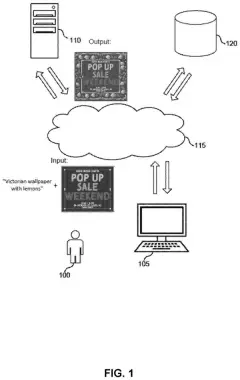
The trouble is that popular image generators draw one picture at a time. Ask for several and the moss lands in a different spot each time, so the layers no longer agree. Adobe's patent describes an AI image model that draws the whole stack together, with every image able to "look at" all the others while it's being made. The moss ends up in the same place in every layer.
Adobe then trains the model on a library of digital materials, such as wood, metal, fabric and leather. You type a description (or drop in a photo), and out comes a full set of layers you can wrap around a 3D object.
… using the trained diffusion model to generate a group of material maps with spatially aligned features from an input prompt that describes a material …
Translation: It creates matching texture images from a simple text description.
How Adobe makes every texture layer line up
The patent covers a diffusion model (an image-generating AI that starts with random noise and removes it step by step until a picture appears) that is changed to produce a group of images at once instead of one. The key change is in its attention mechanism, the part of the model that decides which pieces of data to focus on.
Normally each image only pays attention to itself. Here, the model reshapes its internal data (grids of numbers called query, key and value tensors) so that every pixel in the group is generated with attention to every other pixel across the whole group. The patent calls this cross-attention, and it gives the images shared spatial features: the same shapes in the same places.
The filing describes three stages:
- Start with a pretrained text-to-image model.
- Fine-tune it on a material dataset, a library covering wood, metal, fabric, plastic, glass, concrete and details like rust, cracks and scratches.
- At use time, take a text or image prompt, create several seeds (random starting values), one per channel, and run them through together.
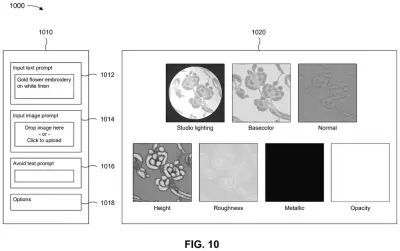
Each channel is one optical property, such as base color, normal map (the angle of the surface), height, roughness, metallic look or opacity. Maps come out at 512 by 512 pixels and can be enlarged to 2048 by 2048.
… each material map in the group of material maps is an image that depicts a respective optical property associated with the material …
Translation: Every generated image shows a different physical trait of the surface like shininess or depth.
What this means for 3D artists using Adobe
If you make 3D art, the practical payoff is a faster start. Type "gold flower embroidery on white linen" or upload a photo, and the system returns a whole set of layers describing color, shininess, surface bumps, height and see-through-ness, all for the same piece of cloth. Because the layers share the same layout, the embroidery sits in the same spot in each one.
The filing also says the model builds on what a big pretrained image generator already knows, because training a model from scratch tends to give low-quality results. That makes the new training mostly a matter of teaching it what materials look like. Output starts at 512 by 512 pixels and can be enlarged to 2048 by 2048 for production work.
That makes this Adobe's 50th filing we've tracked since May in our controllable AI image watchlist, which already covers work like keeping faces and outfits intact and styling letters without warping.
Source: US 2026/0368954 A1 at the USPTO (PDF). Full patent text and figures are in the official publication.
Get our take in your Top Stories
Liked this breakdown? Add Patentlyze as a preferred source on Google, and our plain-English take shows up more often in your Top Stories the next time Adobe patent news breaks.
Add Patentlyze on Google
One click.
There are more where this came from
We read every patent application Big Tech publishes and send you the ones worth knowing. Plain English, free, every week.
The drawings · 15 sheets
15 drawing sheets from US 2026/0368954 A1 · click any drawing to enlarge


Show the other 7 sheets


More from Adobe
All 270 Adobe patents →
More in AI simulation
All 192 AI simulation patents →
Nvidia
Nvidia Patents AI That Gives Plain 3D Models Realistic Surfaces From a Written Description
Nvidia
Nvidia Patents an AI System That Renders Film-Quality Surfaces in Real Time
Nvidia
Nvidia Patents an AI System for Building Realistic Worlds to Train Other AI
Nvidia
No comments yet